
Togather or Together: Which Spelling Is Correct?
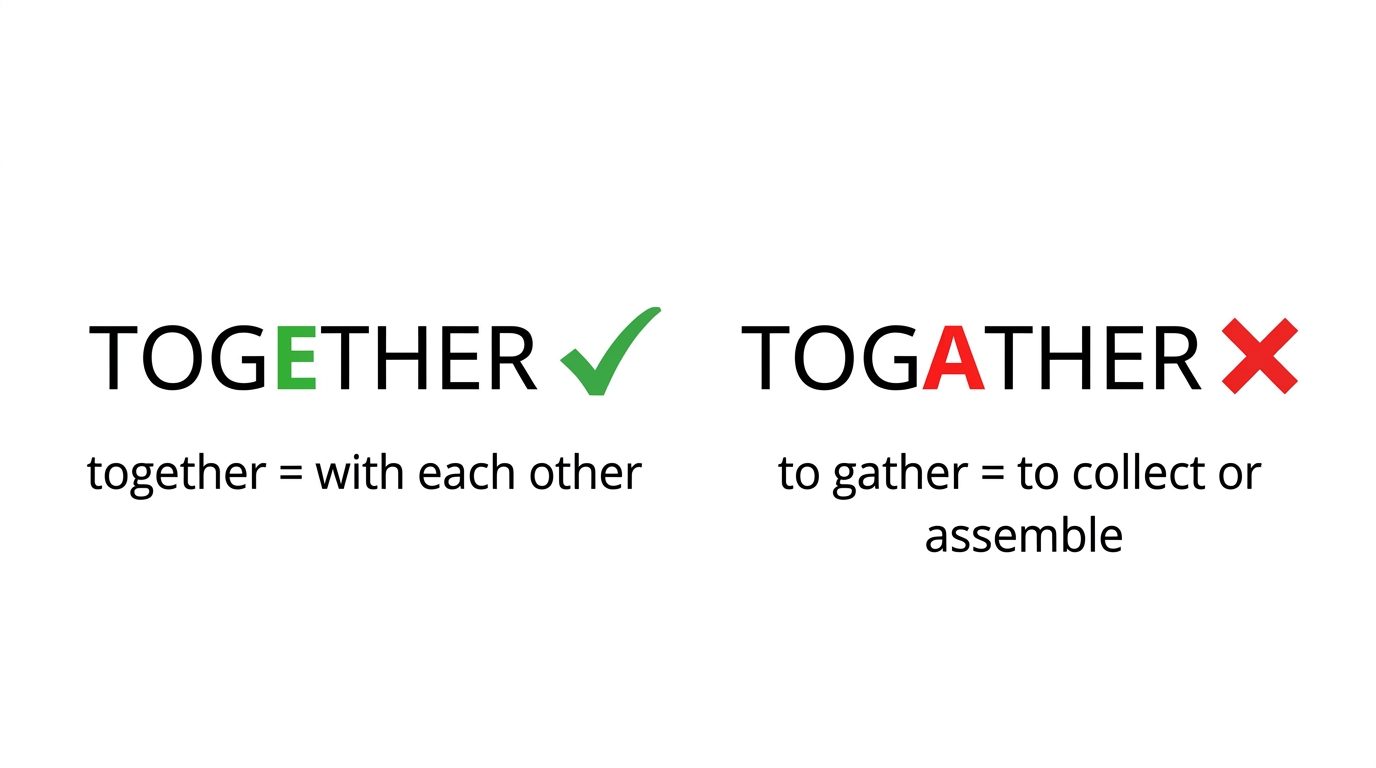
Quick Answer: Together is the correct spelling in standard English. Togather is not the standard spelling when you mean “with each other,” “in the same place,” “jointly,” or “as one group.” The confusion is understandable because together is historically related to gather, and the two forms look and sound similar in some contexts. If you are writing a normal English sentence, use together.
What Togather or Together Means
The correct word is together.
Together is mainly an adverb used when people or things are with each other, in the same place, combined, connected, or doing something jointly. It can also describe actions that happen at the same time.
For example:
- We studied together.
- They live together.
- Put the two pieces together.
- We solved the problem together.
- The two events happened together.
Togather, when intended as the spelling of together, is a misspelling. It should not be used in standard English writing.
There is, however, an important expression that can cause even more confusion: to gather. This is two words and is perfectly correct when gather is being used as a verb.
Compare:
- We worked together.
- We decided to gather outside.
The first sentence means that the people worked with one another. The second means that they decided to assemble or meet.
So, the real spelling choice is usually not simply “togather or together.” In some sentences, the useful distinction is together versus to gather.
The Main Difference
The central difference is simple:
| Form | Status | Meaning |
|---|---|---|
| together | Correct | With each other, jointly, combined, in the same place, or at the same time |
| togather | Incorrect as the intended spelling of together | Usually a misspelling of together |
| to gather | Correct | To collect, assemble, or bring people/things together |
Together is one word.
SEE MORE: Advice vs Advise: Difference, Meaning, Usage & Examples
To gather is two words because gather is a verb following the infinitive marker to.
For example:
The students worked together.
Here, together tells us how the students worked.
Now compare:
The students planned to gather after class.
Here, to gather describes an action they planned to perform.
This distinction matters because simply changing the spelling can change the grammatical structure of a sentence.
Another useful comparison is:
We sat together near the window.
versus:
We decided to gather near the window.
The first describes people being in the same place. The second describes the action of assembling.
The Core Rule
The Rule in Simple English
Use together as one word when you mean:
- with each other
- in the same place
- jointly
- as one group
- combined or joined
- at the same time
- in agreement or cooperation
Use to gather as two words when gather is the verb meaning to collect, assemble, or bring people or things into one place.
Never write togather when you mean together.
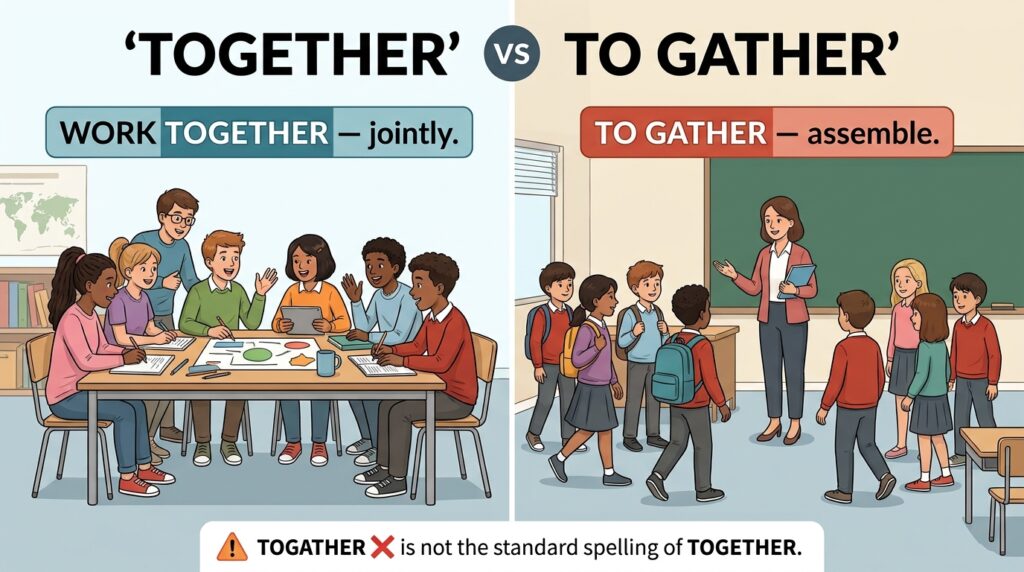
A simple rule is:
Together = one word. To gather = two words. Togather = misspelling.
Examples:
- We traveled together.
- Let’s work together.
- They stood together.
- We need to gather more information.
- The students will gather in the hall.
- The manager asked everyone to gather near the entrance.
Why the Rule Works
The spelling togather looks believable because English contains the very familiar word gather.
A writer may mentally connect the idea of people being “together” with people “gathering,” and this can lead to the spelling togather.
There is also a genuine historical relationship between together and gather. The modern word together developed from older English forms related to the idea of being together or united, and its history is connected with the same Germanic family associated with gather.
That historical relationship explains why the mistake can feel logical, but it does not make togather the modern standard spelling.
ALSO READ: Incomplete or Uncomplete: Which Is Correct?
How to Use It
Common Usage
Together is extremely useful because it can express several related ideas.
1. With each other
My brother and I went shopping together.
2. In the same place
The children were sitting together.
3. As a team or group
We worked together to finish the project.
4. Joining separate things
She tied the two ropes together.
5. At the same time
The two speakers answered together.
6. In agreement or cooperation
The departments worked together on the new plan.
7. As a complete or combined amount
The three boxes together weigh twenty kilograms.
These uses all share the basic idea of things or people being connected, combined, associated, or occurring jointly.
Less Common or Special Usage
Together can also appear as an informal adjective.
For example:
She is very together and organized.
Here, together does not mean physically “with another person.” It describes someone who appears organized, confident, or in control. This adjective use is informal.
There are also many established expressions containing together, including:
- get together
- put together
- bring together
- stick together
- work together
- live together
- grow together
- pull together
- piece together
The exact meaning depends on the surrounding words.
Correct Examples
Here are natural examples showing different uses of together:
- We walked home together after school.
- My parents have lived together for many years.
- The team worked together to solve the problem.
- Please put all the documents together.
- The children sat together during the performance.
- We should discuss these two issues together.
- The two pieces fit perfectly together.
- Everyone sang together during the final song.
- The students prepared the presentation together.
- Let’s get together this weekend.
- She kept all the photographs together in one folder.
- The two companies worked together on the project.
- Add the ingredients and mix them together.
- They moved the tables together before the meeting.
- We can compare the results together after class.
Notice that together can describe people, physical objects, actions, relationships, and combined results.
ALSO READ: Incomplete or Uncomplete: Which Is Correct?
Incorrect vs Correct
| ❌ Incorrect | ✅ Correct | Why |
|---|---|---|
| We worked togather. | We worked together. | Together is the correct spelling. |
| They traveled togather. | They traveled together. | The meaning is “with each other.” |
| Let’s stay togather. | Let’s stay together. | The standard spelling is together. |
| We studied togather. | We studied together. | The students studied jointly. |
| They sat togather. | They sat together. | They were in the same place. |
| The pieces are togather. | The pieces are together. | Together describes their joined position. |
| We should work togather. | We should work together. | The intended meaning is jointly. |
| They lived togather for years. | They lived together for years. | Together is the correct adverb. |
| Let’s get togather tomorrow. | Let’s get together tomorrow. | Get together is the standard expression. |
| We solved it togather. | We solved it together. | The people solved it jointly. |
| I kept the papers togather. | I kept the papers together. | The papers were kept in one group. |
| They stood togather outside. | They stood together outside. | The people stood in the same group. |
The important lesson is not to memorize twelve separate corrections. Once you remember the spelling together, the same rule applies everywhere.
Why People Make This Mistake
The error usually comes from a combination of spelling, pronunciation, and word association.
Similarity to “Gather”
The word gather is very familiar. It means to collect things or bring people into a group.
For example:
We need to gather the students in the hall.
Because gather is strongly associated with people coming together, it is easy to imagine that together might be spelled togather.
The meaning connection is understandable, but modern spelling does not work that way.
Pronunciation Can Hide the Vowel
English spelling and pronunciation do not always match perfectly.
The pronunciation of together is approximately:
tuh-GETH-er
The unstressed first and final parts may sound less distinct in normal speech. This can make it harder for learners to identify the exact written vowels.
Dictionaries give pronunciations such as /təˈɡeð.ər/ in British English and /təˈɡeð.ɚ/ in American English.
Fast Typing
Another common cause is simple typing speed.
Someone may know that together is correct but type togather automatically because gather is a familiar spelling pattern.
This is especially easy to miss when writing quickly in a chat or message.
False Visual Logic
The incorrect form looks reasonable at first glance:
TOGATHER
It appears to contain TO + GATHER, which creates a visually familiar pattern.
But standard English does not spell together that way.
Common Mistakes
Mistake 1 — Writing “Togather”
The most direct error is replacing the e in together with a:
❌ We went togather.
Correct it to:
✅ We went together.
The meaning has not changed; only the spelling is wrong.
Mistake 2 — Confusing “Together” With “To Gather”
These are not interchangeable.
We worked together.
Here, together means jointly.
We decided to gather outside.
Here, to gather means to assemble.
Mistake 3 — Thinking “Gather” Determines the Spelling
The relationship between gather and together is historically interesting, but you should not use the spelling of gather to reconstruct together.
English words do not always preserve an obvious modern spelling relationship.
Mistake 4 — Adding an Extra “A”
Another common error is:
❌ togeather
The standard spelling is:
✅ together
There is no a after the e in together.
Mistake 5 — Dropping the “e”
You may also see forms such as:
❌ togther
❌ togeter
The correct spelling remains:
✅ together
TOGATHER OR TOGETHER in Real English
In standard modern English, together is the form to use when you mean “with each other,” “jointly,” “combined,” or a related idea. Major English dictionaries list together as a standard word and describe several of these meanings.
Togather, by contrast, is not the standard spelling for those meanings.
An important point is that to gather is completely legitimate:
The researchers need to gather more information.
Here, gather is a verb.
Compare:
The researchers worked together.
The researchers cooperated.
The researchers decided to gather more information.
They decided to collect more information.
This is one of the most useful distinctions to remember because it explains why the incorrect spelling can feel natural.
Correct but Natural
We worked together.
Very natural.
They sat together.
Very natural.
Let’s get together tomorrow.
Very natural.
Correct but Different Structure
We need to gather the documents.
Correct, but this is not an alternative spelling of together. It uses the verb gather.
Incorrect
We worked togather.
The intended word is together, so togather should be corrected.
Formal vs Informal Usage
Formal Usage
Together is completely appropriate in formal English.
You can use it in:
- reports
- essays
- business emails
- academic writing
- presentations
- professional documents
Examples:
The two departments worked together to complete the project.
These findings should be considered together rather than separately.
The committee reviewed the proposals together.
There is no need to replace together with a more complicated word simply because the writing is formal.
Everyday Usage
Together is equally natural in everyday conversation and informal writing.
Examples:
Let’s go together.
We had dinner together.
Are you two still together?
Let’s get together sometime.
The same spelling applies in both formal and informal English.
Comparison Table
| Feature | Together | Togather |
|---|---|---|
| Standard English word | Yes | No, when intended as together |
| Spelling | together | togather |
| Main role | Mainly adverb | No standard role |
| Meaning | With each other, jointly, combined, etc. | Usually a misspelling |
| Used in formal writing | Yes | No |
| Used in everyday English | Yes | No |
| Example | We worked together. | ❌ We worked togather. |
| Related valid expression | to gather | Not togather |
One important distinction is worth repeating:
together and to gather are both correct, but they perform different grammatical jobs.
Memory Trick
Use this simple memory trick:
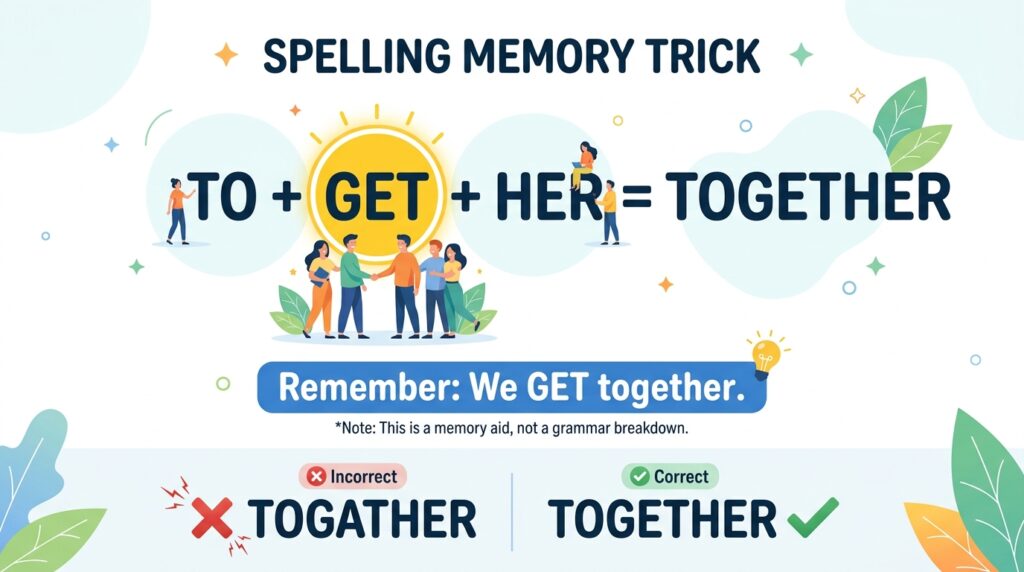
TO-GET-HER = TOGETHER
Look at the spelling:
TO + GET + HER = TOGETHER
This is only a memory aid, not the actual grammatical or historical rule for forming the modern word. Its purpose is simply to help you remember the letters.
Another useful sentence is:
We get together, not get togather.
Whenever you want to write together, look for the E after G:
TOG E THER ✅
Not:
TOG A THER ❌
Real-Life Examples
At Work
Our marketing and sales teams worked together on the campaign.
Let’s review the two reports together before the meeting.
The departments came together to solve the issue.
In professional writing, together is standard and natural.
In an Email
Hi Sarah,
Could we review the proposal together tomorrow?
Let’s put all the documents together before sending the final version.
The team worked together to complete the report.
The spelling does not become different just because the message is formal.
In Conversation
Do you want to go together?
We used to play football together.
Let’s get together this weekend.
These are ordinary everyday uses.
At School or University
We studied together for the exam.
The students worked together on the presentation.
Let’s compare our answers together.
Again, together is the only standard spelling for this meaning.
Expert Tips
1. Memorize the whole word, not just the sound.
Think of together as one fixed spelling.
2. Watch for the “gather” trap.
If your brain suggests togather, stop and check whether you actually mean together or to gather.
3. Check the grammar.
If you need a word describing how people perform an action, together may be the answer:
They worked together.
If you need an action meaning “collect” or “assemble,” use gather:
They gathered the documents.
4. Remember that “to gather” has two words.
Do not combine them into togather.
5. Use the spelling pattern repeatedly.
Words such as together, togetherness, and expressions such as get together reinforce the same spelling.
6. Do not invent a rule from the word “gather.”
Although the words are historically related, the modern spelling of together must simply be learned as together.
Quick Summary
Together is the correct spelling in standard English. It is mainly an adverb meaning “with each other,” “jointly,” “in the same place,” “combined,” or “at the same time.” Togather is a misspelling when it is intended to mean together. The most important related expression is to gather, which is two words and means to collect or assemble. For example, “We worked together” means we worked jointly, while “We decided to gather outside” means we decided to assemble there. The confusion is understandable because together and gather are historically related and their meanings can overlap. For everyday writing, remember one simple pattern: TOGETHER has an E, not an A.
Frequently Asked Questions
Is “togather” correct?
No. Togather is not the standard spelling when you mean together. Use together.
Is “together” one word or two?
Together is one word.
For example:
We stayed together.
Do not write it as to gether or to gather when you mean the adverb together.
What is the difference between “together” and “to gather”?
Together is mainly an adverb meaning with each other, jointly, or combined.
To gather is an infinitive phrase in which gather is a verb meaning to collect or assemble.
Compare:
We worked together.
We decided to gather at noon.
Why do people spell “together” as “togather”?
The spelling mistake can be encouraged by the familiar word gather, the related meaning, pronunciation, and fast typing. The incorrect form looks visually plausible because it resembles to + gather.
Does “togather” have a meaning?
When someone writes togather while intending together, it is normally simply a spelling error. It should not be used as the standard spelling of together.
Is “to gather” correct English?
Yes. To gather is completely correct when gather is being used as a verb.
For example:
We need to gather the students.
Here, gather means to bring the students into one place.
Is “together” used in formal English?
Yes. Together is standard in both formal and informal English.
For example:
The researchers analyzed the results together.
There is no need to replace it with a more complicated expression.
Is “together” the same in American and British English?
Yes. The standard spelling is together in both American and British English. Pronunciation can differ somewhat between accents, but the spelling does not change.
Can “together” be an adjective?
Yes. In informal English, together can describe someone who appears organized, confident, or in control.
For example:
She seems very together.
This is different from the more common adverbial use.
What is the easiest way to remember “together”?
Remember:
TO-GET-HER → TOGETHER
The important spelling point is that the word contains E, not A, after the G.
Is “get together” correct?
Yes. Get together is a standard expression.
For example:
Let’s get together after work.
It can mean meeting socially or coming together, depending on context.
Mini Quiz
| # | Question | Answer | Explanation |
|---|---|---|---|
| 1 | Choose the correct form: We worked togather / together. | together | The sentence means that the people worked jointly. |
| 2 | Fill in the blank: They traveled ______ last summer. | together | They traveled with each other. |
| 3 | Correct the sentence: “Let’s get togather tomorrow.” | Let’s get together tomorrow. | Together is the standard spelling. |
| 4 | Choose: We need together / to gather more information. | to gather | Gather is the verb meaning collect. |
| 5 | Fill in the blank: Put the two pieces ______. | together | The pieces need to be joined. |
| 6 | Correct the spelling: “The students sat togather.” | The students sat together. | Togather is a misspelling. |
| 7 | Choose: The team worked together / to gather on the project. | together | The team worked jointly. |
| 8 | Fill in the blank: We decided ______ outside after class. | to gather | To gather means to assemble. |
| 9 | Choose the correct sentence: “They live together” or “They live togather.” | They live together. | Together is the correct spelling. |
| 10 | Correct this sentence: “We should study togather for the exam.” | We should study together for the exam. | The intended meaning is studying jointly. |