Your vs You’re: Difference, Meaning, Rules & Examples
Your and you’re sound the same in most everyday English, but they do completely different jobs in a sentence. Your shows that something belongs to, relates to, or is associated with you, while you’re is the contraction of you are. The quickest way to check is to replace you’re with you are. If the sentence still makes sense, use you’re. If the sentence identifies something connected with the person being addressed, use your.
What YOUR VS YOU’re Means
The words your and you’re are commonly confused because their pronunciation is the same or nearly the same in ordinary speech. The difference becomes important when you write them because their grammatical functions are completely different.
Your is a possessive determiner. It comes before a noun or noun phrase and tells us that something belongs to, relates to, or is associated with the person being addressed.
Examples:
- Your phone is on the desk.
- I like your idea.
- Please bring your passport.
- Your answer was clear.
In each sentence, your connects the noun with the person being addressed.
You’re, on the other hand, is a contraction of you are. The apostrophe represents letters omitted when the two words are shortened.
Examples:
- You’re late. → You are late.
- You’re very helpful. → You are very helpful.
- You’re making good progress. → You are making good progress.
- You’re invited to the meeting. → You are invited to the meeting.
The two forms are therefore not interchangeable. A sentence needs your when it needs a possessive determiner, and it needs you’re when it needs the meaning you are.

The Main Difference
The central difference is simple:
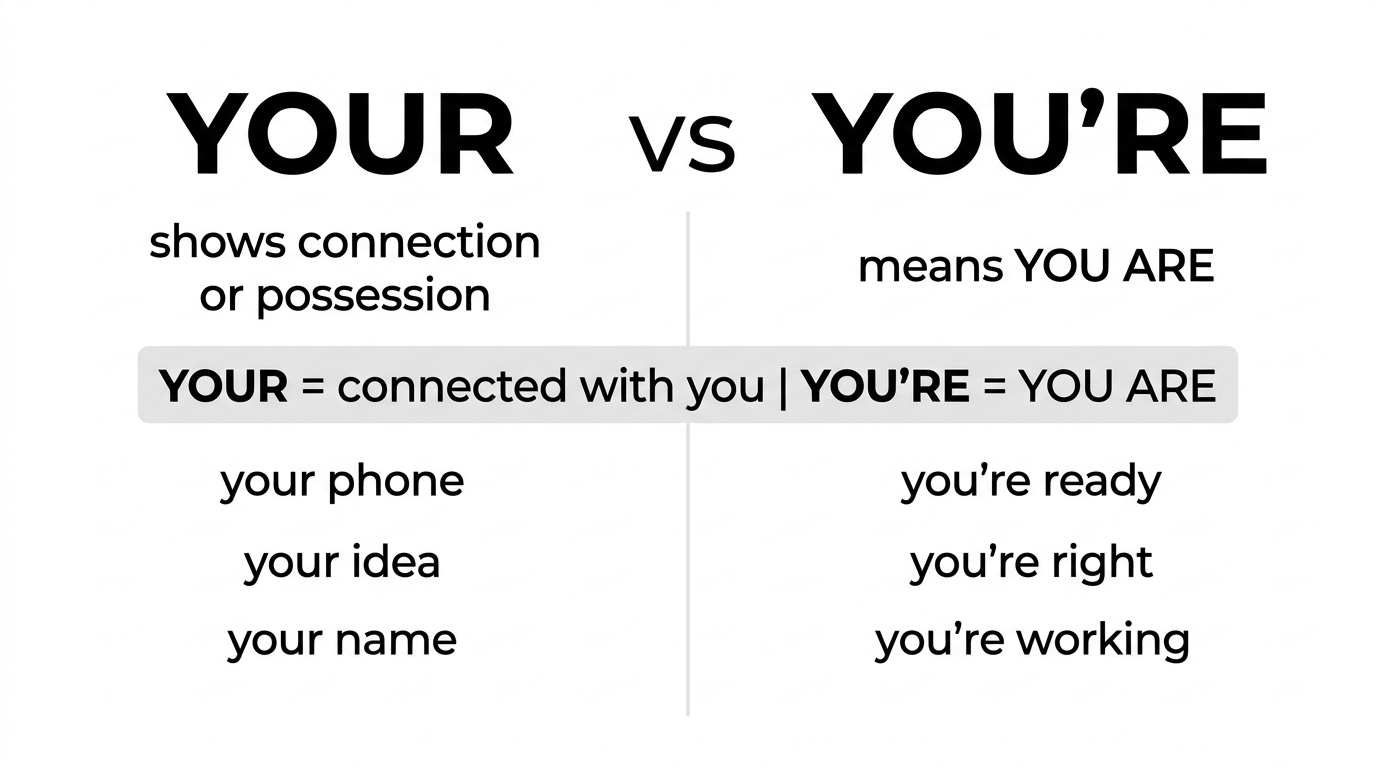
Your = connected with you / belonging to you
You’re = you are
Consider these two sentences:
- Your jacket is wet.
- You’re wet.
The first sentence refers to a jacket associated with you. The second says that you are wet.
Another pair makes the distinction even clearer:
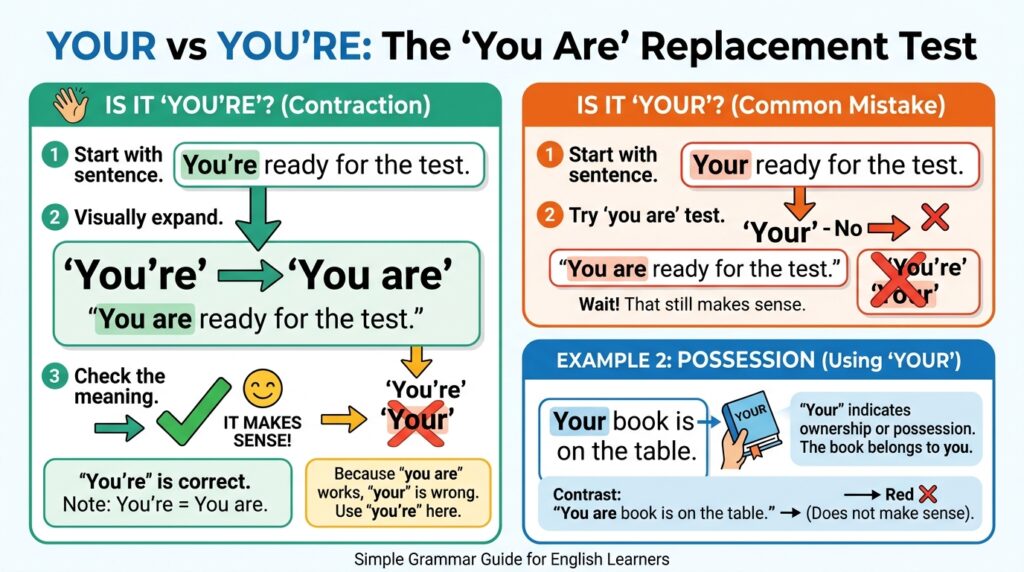
- Your ready for the interview. ❌
- You’re ready for the interview. ✅
Why? The intended meaning is “You are ready for the interview.” Since you’re can be expanded to you are, it is the correct choice.
Now consider:
- You’re interview starts at nine. ❌
- Your interview starts at nine. ✅
Here, the sentence refers to an interview associated with you. It does not mean “You are interview.” Therefore, your is required.
A useful way to think about the difference is that your introduces a noun, while you’re contains a subject and verb.
Your
- your name
- your house
- your opinion
- your teacher
- your plan
- your responsibility
You’re
- you’re ready
- you’re working
- you’re correct
- you’re invited
- you’re the winner
- you’re going home
There can be more words after you’re, but the underlying structure still contains you are.
The Core Rule
The Rule in Simple English
Use your when you mean something like “belonging to you” or “associated with you.”
Use you’re when you mean “you are.”
The replacement test is usually the fastest way to decide:
Replace “you’re” with “you are.”
If the sentence still works, you’re is correct.
For example:
You’re doing well.
→ You are doing well.
The sentence works, so you’re is correct.
Now try:
Your doing well.
→ Your doing well.
This does not produce the intended grammatical structure. The correct sentence is “You’re doing well.”
For possession:
Your computer is fast.
Trying to replace your with you are gives:
You are computer is fast.
That does not work. Therefore, your is correct.
Why the Rule Works
The test works because you’re has a fixed grammatical expansion: you are.
The apostrophe in you’re marks the contraction. It is not there to show ownership.
By contrast, your is already a complete possessive determiner. It does not expand to you are.
This is also why your and you’re behave differently in sentences.
Compare:
- Your brother is here.
- You’re here.
In the first sentence, your modifies brother. In the second, you’re is the subject-and-verb combination meaning you are.
One important detail is that your does not necessarily mean literal ownership. It can describe a relationship or association.
For example:
- your mother
- your teacher
- your country
- your opinion
- your problem
- your appointment
These things do not necessarily “belong” to you in a physical sense. The broader idea is that they are connected with or associated with the person being addressed.
SEE ALSO: Requester vs Requestor: Which Spelling Is Correct?
How to Use It
Common Usage
Use your before a noun or noun phrase when referring to something connected with the person you are addressing.
Examples:
- Check your email.
- Where is your sister?
- I liked your presentation.
- Don’t forget your keys.
- What’s your name?
- Your appointment is at three.
- I understand your concern.
The noun can be singular or plural:
- your book
- your books
- your friend
- your friends
It can also be used with abstract nouns:
- your opinion
- your decision
- your responsibility
- your experience
- your confidence
Use you’re wherever the full phrase you are is grammatically appropriate.
Examples:
- You’re early.
- You’re doing well.
- You’re welcome.
- You’re invited.
- You’re working too hard.
- You’re the person I called.
- You’re going to enjoy this.
The contraction can appear in questions and conditional structures too:
- Are you sure you’re ready?
- If you’re tired, take a break.
- I think you’re right.
- When you’re finished, let me know.
A particularly useful pattern is:
if you’re + adjective / noun phrase / -ing form / past participle
Examples:
- If you’re ready, we can begin.
- If you’re busy, I’ll call later.
- If you’re studying, don’t interrupt yourself.
- If you’re invited, you should attend.
Remember, the contraction still means you are.
ALSO READ: Hoodie or Hoody: Which Spelling Is Correct?
Less Common or Special Usage
There is no special alternative meaning of you’re. It is simply a contraction of you are.
Likewise, your does not become you’re because the sentence sounds conversational or informal. The choice depends on grammatical function, not on how casual the situation is.
For example:
- Your phone is ringing. ✅
- You’re phone is ringing. ❌
The sentence remains the same in a text message, email, school assignment, or formal report. The spelling does not change according to formality.
One useful distinction is between your and yours. Your normally occurs before a noun:
- your book
- your idea
- your car
Yours can stand independently:
- The book is yours.
- Is this pen yours?
Neither your nor yours means you are.
Correct Examples
- Your laptop is charging in the other room.
- I really like your new design.
- Is this your seat?
- Please check your email before the meeting.
- Your answer explains the problem clearly.
- You’re doing a great job on the project.
- I think you’re ready for the test.
- You’re going to need more time.
- If you’re available tomorrow, let me know.
- You’re responsible for submitting the form.
- Your manager left a message for you.
- I hope you’re feeling better after the long journey.
Notice that some sentences can contain both forms:
I think you’re going to like your new phone.
Here:
- you’re = you are
- your = associated with you
Another example:
If you’re finished with your homework, you can go outside.
Again:
- you’re finished = you are finished
- your homework = homework associated with you
These sentences are useful because they show that the two forms are not competitors. Sometimes the same sentence legitimately needs both.
Incorrect vs Correct
| ❌ Incorrect | ✅ Correct | Why |
|---|---|---|
| Your very kind. | You’re very kind. | “You are very kind” works. |
| You’re car is outside. | Your car is outside. | “Car” is associated with you. |
| Your going to be late. | You’re going to be late. | “You are going to be late” works. |
| Is this you’re bag? | Is this your bag? | “Bag” is the noun connected with you. |
| I think your right. | I think you’re right. | “You are right” is the intended meaning. |
| Please bring you’re notebook. | Please bring your notebook. | “Notebook” is associated with you. |
| Your welcome. | You’re welcome. | “You are welcome” is the underlying phrase. |
| I know you’re name. | I know your name. | “Name” is associated with you. |
| Your invited to dinner. | You’re invited to dinner. | “You are invited” works. |
| You’re opinion matters. | Your opinion matters. | “Opinion” is connected with you. |
| I hope your okay. | I hope you’re okay. | “You are okay” works. |
| You’re phone is ringing. | Your phone is ringing. | “Phone” is associated with you. |
The most important thing is not to memorize every incorrect sentence separately. Instead, identify the grammatical job.
If the next important word is a noun being introduced as something connected with the listener, your is usually needed.
If the sentence needs you are, use you’re.
Why People Make This Mistake
The biggest reason is pronunciation.
In most ordinary speech, your and you’re sound the same or very similar. Because the listener hears one sound, spoken English does not always reveal which spelling belongs on the page.
Writing creates a different problem. The writer must select between two spellings that represent different grammatical structures.
Speed also contributes to mistakes. In texting, social media posts, chats, and quick emails, people often type according to sound or habit rather than stopping to inspect the grammar.
Another problem is that both forms are legitimate English words. Spellcheck may not identify the mistake because a sentence containing your instead of you’re can still contain a correctly spelled word.
For example:
Your going to love it.
The word your itself is spelled correctly. The problem is that it is the wrong grammatical form for the sentence.
This makes the error different from a simple spelling mistake. It is primarily a word-choice and grammar mistake.
Visual similarity also plays a role. The forms differ by only two characters and the apostrophe:
- your
- you’re
Learners may therefore remember the words as two versions of the same expression rather than recognizing that they perform different grammatical jobs.
Common Mistakes
Mistake 1 — Using “Your” Before an Adjective
Incorrect:
Your amazing.
Correct:
You’re amazing.
The intended sentence means:
You are amazing.
Therefore, you’re is required.
But compare:
Your amazing voice is easy to recognize.
Here, your is correct because it introduces voice, a noun.
Mistake 2 — Using “You’re” Before a Noun
Incorrect:
You’re brother called me.
Correct:
Your brother called me.
The sentence refers to a brother associated with the person being addressed.
Mistake 3 — Writing “Your Welcome”
This is one of the most recognizable examples.
Incorrect:
Your welcome.
Correct:
You’re welcome.
The expression means “You are welcome.”
Mistake 4 — Assuming the Apostrophe Means Possession
In English, apostrophes can sometimes signal possession, but that does not mean every possessive-looking word should have an apostrophe.
You’re has an apostrophe because it is a contraction.
The apostrophe represents omitted letters from you are.
So:
- your = possessive determiner
- you’re = contraction
The apostrophe is not marking ownership.
Mistake 5 — Choosing by Sound
Because both forms sound alike in ordinary speech, listening alone cannot reliably tell you which spelling to use.
Instead of asking:
“Which spelling sounds right?”
ask:
“Do I mean something connected with you, or do I mean you are?”
That question usually solves the problem immediately.
YOUR VS YOU’re in Real English
In real English, the distinction is grammatical rather than stylistic.
Both forms are standard:
- your is standard
- you’re is standard
Neither one is a more formal spelling of the other.
For example, in a formal email:
Please confirm your appointment.
Here, your is required because appointment is the noun associated with the reader.
In the same email:
Please let me know if you’re available.
Here, you’re is appropriate because it means you are.
A contraction such as you’re can be perfectly normal in professional English. Whether contractions are preferred in a particular formal document depends on the overall style, but you’re itself is not an incorrect or informal-only form.
The important point is grammatical function.
Correct and Natural
Your application has been received.
You’re welcome to contact us if you have questions.
Both are natural.
Correct but Context-Dependent
Sometimes the full form you are may be chosen instead of you’re for emphasis or a particular formal style:
You are responsible for keeping this information confidential.
That does not make you’re grammatically wrong in every context. The choice can depend on emphasis and writing style.
Incorrect
Your responsible for keeping this information confidential.
This is incorrect because your cannot replace you are.
A Useful Real-English Observation
English speakers often process these words differently when reading. Because the sound does not distinguish them, skilled writers usually rely on sentence structure and meaning.
That is why the best correction strategy is grammatical rather than phonetic.
Comparison Table
| Feature | Your | You’re |
|---|---|---|
| Basic meaning | Connected with or belonging to you | You are |
| Grammatical role | Possessive determiner | Contraction |
| Full form | No expansion to “you are” | You are |
| Apostrophe | No | Yes |
| Typical position | Before a noun/noun phrase | Where “you are” fits |
| Example | Your jacket is blue. | You’re very helpful. |
| Quick test | Think “your book” | Replace with “you are” |
| Can show possession/association? | Yes | No |
| Can mean “you are”? | No | Yes |
Memory Trick
Use this two-part rule:
YOUR = YOUR THING
Think:
- your phone
- your house
- your idea
- your name
- your answer
If the word is connected to a noun, think your.
YOU’RE = YOU ARE
Whenever you see you’re, mentally open it up:
you’re → you are
Examples:
- you’re happy → you are happy
- you’re late → you are late
- you’re correct → you are correct
- you’re working → you are working
If the expanded version works, you’re is the right choice.
A second useful trick is to remember the apostrophe:
you’re contains an apostrophe because letters have been removed from you are.
Do not think:
“Apostrophe means possession.”
Instead think:
“In you’re, the apostrophe signals a contraction.”
Real-Life Examples
At Work
Please review your report before the meeting.
Here, your refers to the report associated with the reader.
You’re responsible for sending the final version.
Here, you’re means you are.
Another example:
If you’re available, please bring your notes.
This sentence contains both:
- you’re = you are
- your notes = notes associated with you
In an Email
Thank you for your message.
The message is associated with the recipient.
You’re welcome to contact me again if you need help.
This means:
You are welcome to contact me again.
A useful professional-writing check is to search your email for your and you’re before sending it if you frequently confuse them.
In Conversation
Although the difference is primarily visible in writing, the words occur constantly in conversation.
Someone might say:
You’re right.
The meaning is:
You are right.
Or:
Where’s your phone?
Here, your identifies the phone as associated with the person.
Because pronunciation often does not provide a reliable distinction, the spelling must be learned through grammar and context.
At School or University
Have you finished your assignment?
Use your because assignment is associated with the student.
You’re ready for the exam.
Use you’re because the sentence means you are ready.
In academic writing, the same grammatical distinction applies. The words do not change simply because the context is educational or formal.
Expert Tips
- Use the “you are” test first.
This is the most reliable quick check for you’re. - Look at what comes after the word.
If your introduces a noun such as book, idea, name, or plan, it is probably the correct form. - Do not rely on pronunciation.
Your ear may not distinguish the two forms. - Remember that spellcheck may miss the error.
Both your and you’re are valid words, so software may not know that you selected the wrong one. - Learn the difference through sentence patterns.
Memorizing isolated definitions is less useful than recognizing patterns such as your + noun and you’re + adjective/verb phrase. - Watch for contractions in proofreading.
If you see you’re, mentally expand it to you are. - Check sentences containing both forms.
For example:
You’re going to need your passport.
Seeing both together reinforces the distinction. - Do not treat the apostrophe as an ownership marker here.
In you’re, it signals omitted letters.
Quick Summary
Your and you’re sound the same in most everyday speech, but they have different grammatical functions. Your is a possessive determiner used for something connected with or belonging to the person being addressed: your car, your idea, your name. You’re is a contraction of you are: you’re ready, you’re right, you’re working. The fastest way to check you’re is to replace it with you are. If the sentence still works, you’re is correct. If the sentence needs a word before a noun to show association or possession, use your. The key is to focus on meaning and grammar rather than sound.
Frequently Asked Questions
Is “your” the same as “you’re”?
No. Your and you’re are different words with different grammatical functions.
Your shows a relationship or possession:
Your bag is here.
You’re means you are:
You’re here.
Is “you’re” short for “you are”?
Yes. You’re is the contraction of you are.
For example:
You’re correct.
means:
You are correct.
Is “your” a contraction?
No. Your is not a contraction of you are.
It is a possessive determiner used before a noun or noun phrase.
Is “your welcome” correct?
No, when you mean the familiar response to “thank you.”
The standard form is:
You’re welcome.
This means:
You are welcome.
Is “you’re” ever used to show possession?
No. You’re does not indicate possession or association. It always represents you are.
If you need to show that something is connected with the person being addressed, use your.
Can “your” come before a verb?
Not in the way you’re does.
For example:
Your going to school. ❌
If the intended meaning is you are going to school, write:
You’re going to school. ✅
However, your can occur before a noun that is derived from a verb:
I appreciated your help.
Here, help functions as a noun, so your is correct.
Why do people confuse your and you’re?
The main reason is that they sound the same or nearly the same in ordinary speech. Writers therefore have to use grammar and meaning to choose the spelling.
Fast typing, habit, and the fact that both forms are valid English words can also make the error easy to miss.
Which is correct: “your right” or “you’re right”?
You’re right is correct when you mean you are right.
Example:
You’re right about the answer.
But your right can be correct in a different context if right is being used as a noun or part of a noun phrase:
You have the right to appeal.
Your right to appeal is protected by the rules.
So context matters.
Which is correct: “your going” or “you’re going”?
You’re going is correct when the meaning is you are going.
Example:
You’re going to enjoy the movie.
Your going can occur in a different grammatical structure when going functions as a noun, but that is a less common construction. For example:
Your going there without telling anyone surprised me.
In ordinary everyday English, however, when you mean you are going, use you’re.
Can a sentence contain both your and you’re?
Yes.
For example:
You’re going to need your passport.
Here, you’re means you are, while your passport means the passport associated with you.
Another example:
I hope you’re happy with your results.
Both forms are correct because they perform different jobs.
Is “your” more formal than “you’re”?
No. They are not formal and informal versions of the same word.
They have different grammatical functions.
Your is used for possession or association.
You’re is used as the contraction of you are.
Does the apostrophe in “you’re” mean possession?
No. In you’re, the apostrophe indicates that letters have been omitted from you are.
This is why you’re expands to you are.
The apostrophe does not indicate ownership.
What is the easiest way to remember your vs you’re?
Remember:
YOUR = connected with you
YOU’RE = YOU ARE
Then use the expansion test:
You’re ready → You are ready ✅
Your ready → Your ready ❌
For your, think of a noun:
your phone, your name, your idea, your answer
Mini Quiz
| # | Question | Answer | Explanation |
|---|---|---|---|
| 1 | Please bring ___ notebook tomorrow. | your | “Notebook” is associated with you. |
| 2 | ___ going to enjoy this book. | you’re | “You are going to enjoy” works. |
| 3 | I like ___ new shoes. | your | “Shoes” are associated with you. |
| 4 | I think ___ right. | you’re | “You are right” works. |
| 5 | Is this ___ phone? | your | “Phone” is connected with you. |
| 6 | ___ invited to the meeting. | you’re | “You are invited” works. |
| 7 | Don’t forget ___ password. | your | “Password” is associated with you. |
| 8 | If ___ ready, we can start. | you’re | “If you are ready” works. |
| 9 | ___ answer was different from mine. | your | “Answer” is associated with you. |
| 10 | I hope ___ feeling better today. | you’re | “You are feeling better” works. |
A simple final check is enough for most cases:
Can I replace the word with “you are”?
- Yes → you’re
- No → your