Requester vs Requestor: Which Spelling Is Correct?
If you have ever typed requester or requestor and wondered whether one of them is a spelling mistake, you are not alone. The two words look almost identical, sound essentially the same, and refer to the same basic role.
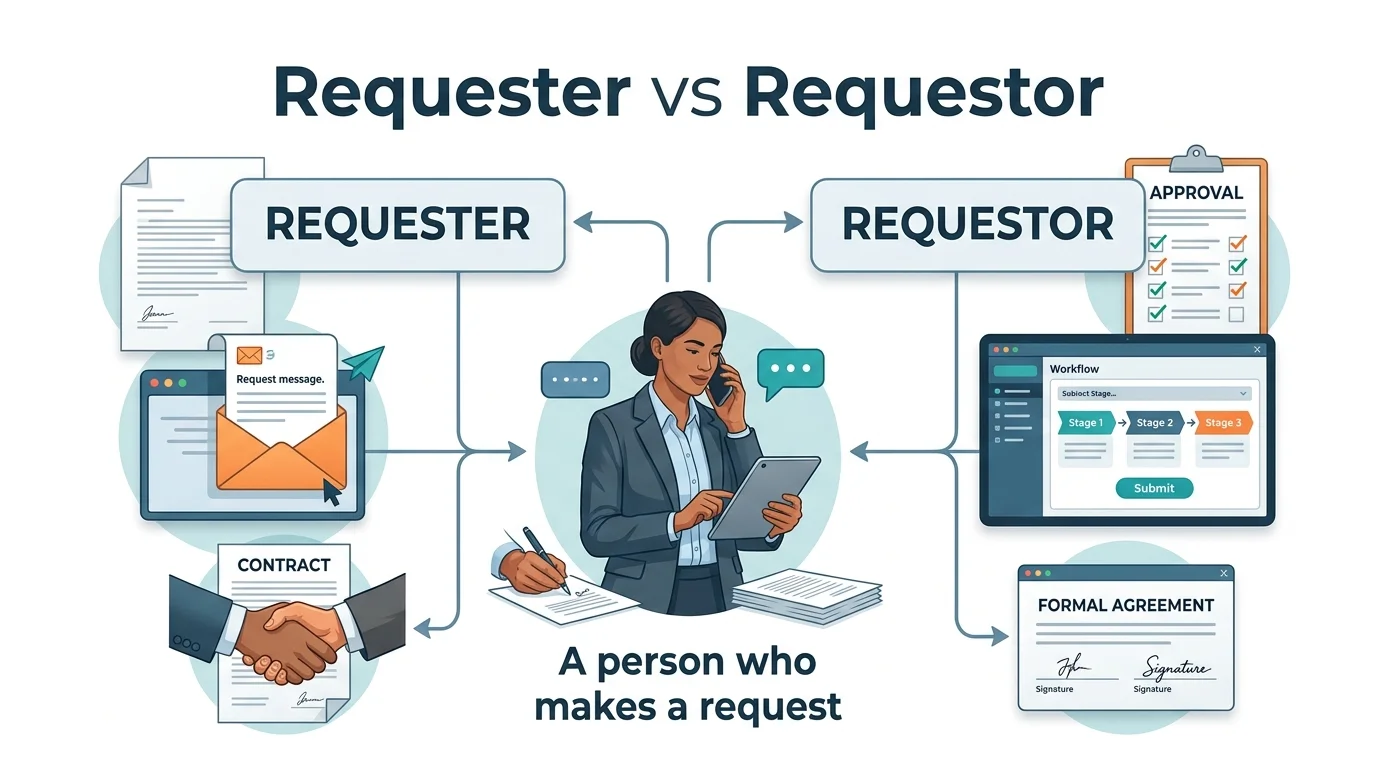
The good news is simple: both requester and requestor are legitimate English words. A requester or requestor is a person or organization that makes a request. Cambridge lists requestor as another form of requester, while other dictionary sources likewise treat requestor as a variant.
The more useful question is not simply “Which one is correct?” It is “Which spelling should I use in this situation?”
For most general writing, requester is the straightforward choice. However, requestor also appears in established legal, administrative, technical, and organizational terminology. If a particular company, form, software system, contract, or institution already uses requestor, consistency may matter more than changing the spelling.
Quick Answer
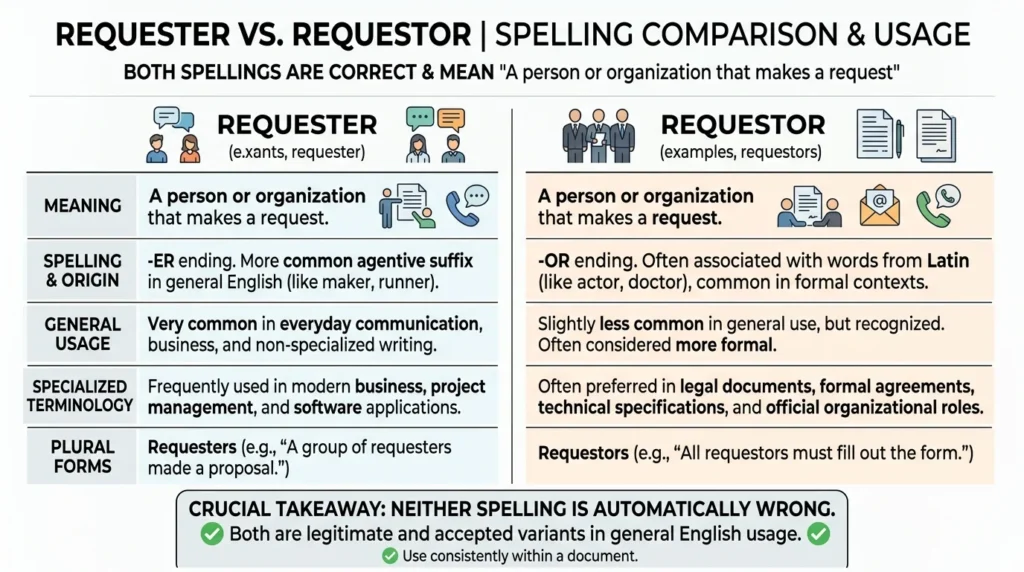
Requester and requestor are both correct spellings for a person or organization that makes a request. Requester is the more familiar general-purpose form, while requestor is also an established variant and may appear in specialized terminology. The two words normally have the same meaning. Use requester for ordinary writing unless a particular organization, system, legal document, or established terminology specifically uses requestor.
What Is a Requester?
A requester is a person, organization, or sometimes a system that asks for something.
The thing being requested could be:
- information
- permission
- access
- a document
- a service
- approval
- assistance
- a change or action
For example:
The requester submitted the application yesterday.
Here, requester simply means the person who submitted the request.

The word is formed from the verb request. In English, nouns ending in -er often identify someone or something that performs an action:
- teach → teacher
- write → writer
- drive → driver
- manage → manager
- request → requester
That familiar pattern helps explain why requester feels straightforward in general English.
Cambridge defines requester as a person who asks to see or have something and explicitly lists requestor as another form.
What Is a Requestor?
A requestor is also a person or organization that makes a request.
For example:
The requestor must provide the required information.
The basic meaning is the same as:
The requester must provide the required information.
The spelling changes from -er to -or, but the underlying role does not normally change.
Requestor is not simply a typo that should automatically be corrected. It is a recognized variant of requester. Dictionary sources specifically identify it as such.
This is important because writers sometimes assume that one word must be wrong simply because two spellings exist. In this case, that assumption would be incorrect.
Why Does the Difference Matter?
At first, the difference may seem too small to matter. After all, both words identify someone who makes a request.
But word choice matters when you are writing:
- a business email
- a customer-service message
- a legal document
- an academic paper
- a government form
- technical documentation
- software instructions
- an application
- a company policy
Using an established term consistently makes your writing easier to understand and prevents unnecessary terminology changes.
Imagine that a software system calls someone a requestor throughout its interface. If the documentation suddenly switches between requestor and requester, readers may wonder whether the two words represent different roles.
The same principle applies to legal, administrative, or organizational documents. If an official document consistently uses one spelling, retaining that spelling can be more useful than changing it simply because another variant is common elsewhere.
The key is to distinguish correctness from preference.
Both forms can be correct. The better choice depends on the writing context.
The Core Rule
Use “requester” as your general-purpose spelling. Use “requestor” when it is the established spelling in a particular system, organization, field, or document.
There is no general grammar rule saying that requestor is wrong.
Likewise, there is no rule saying that requester must always replace requestor.
Think of the distinction this way:
Requester = general, familiar spelling
Requestor = accepted variant, often retained by particular terminology or conventions
This does not mean that every legal or technical document should use requestor. Context-specific usage varies, so you should not turn a tendency into an absolute rule.
How to Use Requester
Use requester when you simply need a clear noun for someone who makes a request.
It works naturally in ordinary communication:
The requester will receive an email confirmation.
It also works in professional writing:
Please contact the requester if additional information is required.
And it can describe organizations or other entities:
The organization became the requester for the records.
The important point is that requester does not have to be limited to casual English. It can be used in professional and formal writing as well.
Common situations for requester
You can use requester when:
- writing a general business email
- explaining a process to customers
- writing an article
- preparing educational material
- communicating with a broad audience
- describing someone who submitted a request
- writing general professional documentation
For most readers, the word is immediately understandable.
How to Use Requestor
Use requestor when that spelling is already established in the terminology you are working with.
For example, suppose an organization’s internal form labels a field:
Requestor Name
Changing the label to Requester Name may be unnecessary if the entire system consistently uses requestor.
The same principle applies when you are documenting an existing technical or administrative system. If the official terminology uses requestor, preserving it can help users match the documentation with what they see on the screen.
Common situations where requestor may appear
You may encounter requestor in:
- legal documents
- administrative documents
- government terminology
- procurement systems
- technical documentation
- software interfaces
- internal organizational terminology
However, these are usage tendencies, not absolute rules. It would be inaccurate to say that requestor belongs exclusively to these fields.
ALSO READ: WJY Meaning in Text: What Does WJY Mean in Chat & Social Media?
Correct Examples
Here are examples showing how both forms can work.
- Conversation:
“The requester is waiting for a response.” - Email:
“Please contact the requester if you need additional details.” - Customer service:
“The requester will receive an update within two business days.” - Workplace:
“We have forwarded the request to the requester’s manager.” - School:
“The requester should complete all sections of the form.” - Academic writing:
“The requester must provide sufficient evidence to support the application.” - Technical documentation:
“The system records the requestor associated with each transaction.” - Administrative form:
“The requestor must sign the declaration.” - Legal context:
“The requestor submitted the required documents.” - Internal company system:
“Select the requestor from the employee directory.” - Social media or online communication:
“The requester asked for more information about the event.” - Public information request:
“The requester received a response from the agency.”
Notice something important: the spelling does not automatically change the meaning of the sentence.
Incorrect vs. Correct
The most useful correction is often not changing requestor to requester. Instead, it is understanding when each spelling is appropriate.
| ❌ Incorrect assumption | ✅ Correct understanding | Why |
|---|---|---|
| Requestor is always wrong. | Requestor is an accepted variant. | Dictionaries recognize it as a form of requester. |
| Requester is the only correct spelling. | Requester and requestor can both be correct. | They normally have the same meaning. |
| Requestor is always a legal word. | Requestor may occur in legal contexts, but it is not limited to them. | Specialized usage is a tendency, not a strict rule. |
| Requester is only informal. | Requester can be used in professional and formal writing. | Its register is not inherently casual. |
| British English requires requestor. | British English can use requester. | This is not a simple UK/US spelling pair. |
| American English forbids requestor. | Requestor is used in American English too. | Regional rules do not make it invalid. |
| Changing requestor to requester always improves a document. | Follow established terminology when appropriate. | Consistency can be more important than changing a variant. |
| The two words describe different people. | They normally describe the same role. | Both refer to someone making a request. |
| Requester means the person receiving a request. | Requester means the person making the request. | The role is defined by who makes the request. |
| Requestor and requestee mean the same thing. | Requestor/requester and requestee can describe opposite sides. | A requestee, where the term is used, is the person or entity being asked. |
Why People Make This Mistake
The confusion is understandable because the difference is only one letter.
Phonetic similarity
Requester and requestor are pronounced very similarly. When people hear the word rather than see it, they may not know which spelling was intended.
Spelling overlap
Both forms begin with the exact same sequence:
request-
The only visible difference is the final vowel before the ending:
requester
requestor
That makes the two forms easy to mix up while typing.
Overgeneralization
English uses both -er and -or endings to form nouns.
For example:
- teach → teacher
- write → writer
- act → actor
- operate → operator
Because both patterns exist, learners may wonder which one applies to request. The answer cannot be determined by a simple universal suffix rule.
Autocomplete and spellcheck
Modern writing tools may recognize both words. If your software accepts requester and requestor, that does not tell you which one fits your organization’s terminology.
Spellcheck primarily checks whether a word is recognized. It does not always understand the full context or the style convention of your document.
Translation interference
Learners who write English after translating from another language may choose the form that resembles a familiar translated term. This can be especially confusing when the target language has a single standard equivalent but English has multiple accepted forms.
The solution is to learn the usage context, not just memorize one spelling
SEE READ: SLM Meaning in Text: What Does SLM Mean in Chat, Social Media & More?
Common Mistakes Checklist
Treating requestor as a spelling error
Mistake: Automatically changing every requestor to requester.
Why it happens: Requester may be more familiar to the writer.
How to avoid it: First check whether requestor is the established terminology of the document or system.
Assuming one word has a different meaning
Mistake: Believing that requester means one type of requester while requestor means another.
Why it happens: The spelling difference looks meaningful.
How to avoid it: Remember that both normally identify the party making a request.
Switching spellings randomly
Mistake:
The requester submitted the form. The requestor then received confirmation.
Why it is a problem: Even though both words are valid, the unexplained switch can make the reader wonder whether two different roles are being discussed.
Better:
The requester submitted the form. The requester then received confirmation.
Or, if the official terminology is requestor:
The requestor submitted the form. The requestor then received confirmation.
Assuming formal means requestor
Mistake: Using requestor simply because you want your writing to sound more formal.
Why it happens: The -or ending may look more technical or official.
How to avoid it: Do not confuse formality with spelling. Requester can appear in formal writing too.
Assuming British English means requestor
Mistake: Treating requestor as the British version of requester.
Why it happens: English has many genuine British/American spelling pairs.
How to avoid it: This is not a straightforward equivalent of pairs such as colour/color. Both forms occur in English varieties.
Requester vs. Requestor in Real English
Requester in everyday professional English
Requester works naturally when a general audience needs to understand who made a request. For example, “The requester will receive a confirmation email” is clear and direct. It does not need to be changed simply because the message is professional. The word can comfortably appear in customer service, workplace communication, educational writing, and other ordinary contexts.
Requestor in established terminology
Requestor can be completely natural when it belongs to the terminology of a particular organization, application, process, or document. If a software interface calls a user a “requestor,” using the same word in its documentation can improve consistency. In such a case, replacing it with requester may actually make the documentation less consistent.
Requester in formal writing
Requester is not an informal-only word. It can describe a person making an official request, including requests for information or documents. A sentence such as “The requester must provide the required documentation” can be perfectly appropriate in formal writing.
Requestor in general writing
Requestor is also grammatically possible in ordinary English. However, if you are writing for a broad audience and there is no existing terminology to follow, requester is a straightforward choice because it is immediately recognizable and directly represents the role.
American vs. British English
There is no strong American-versus-British spelling rule that divides these words into requester = American and requestor = British, or the reverse.
Cambridge provides both forms and lists requestor as another form of requester.
Collins likewise describes requestor as a rare spelling of requester in British English.
So avoid memorizing a false rule such as:
American English = requester
British English = requestor
That is too simplistic.
Both spellings can occur across English varieties. The more useful distinction is general usage versus established terminology.
Formal vs. Informal Usage
Neither spelling is inherently informal.
Requester can appear in:
- emails
- business reports
- official communication
- educational writing
- customer-service messages
- formal applications
Requestor can also appear in formal documents, especially when an institution or system has established that spelling.
The important question is therefore not:
“Which one sounds more formal?”
Instead, ask:
“Which terminology does this document, organization, or system use?”
If no special terminology exists, requester is a practical general-purpose choice.
Requester vs. Requestor: Comparison Table
| Feature | Requester | Requestor |
|---|---|---|
| Basic meaning | Person/entity making a request | Person/entity making a request |
| Part of speech | Noun | Noun |
| Correct spelling | Yes | Yes |
| Meaning difference | Normally none | Normally none |
| General English | Common choice | Less common variant |
| Professional writing | Appropriate | Appropriate when established |
| Legal/administrative contexts | Used | Also used |
| Technical contexts | Used | Also used |
| British English | Used | Also found |
| American English | Used | Also found |
| Best general default | Requester | Use when terminology calls for it |
| Plural | Requesters | Requestors |
The central point is that the two spellings are variants, not two different grammatical categories.
SEE READ: IG Meaning in Text: What Does IG Mean in Chat, Social Media & More?
Requester vs. Requestee
Another word can create even more confusion: requestee.
The distinction is useful:
- Requester/requestor: the party making the request
- Requestee: the party being asked or receiving the request, where this term is used
Consider this example:
Ali asked the manager for approval.
Here:
- Ali = requester
- manager = the person being asked
However, requestee is much less common than requester. In many everyday sentences, writers would simply say the person receiving the request, the recipient, the manager, or another more specific term.
Do not replace requester with requestee. They refer to different sides of the interaction.
Plural Forms
The plural forms are straightforward:
Requester → Requesters
Requestor → Requestors
Examples:
Several requesters submitted applications.
The system tracks all requestors.
There is no unusual pluralization rule here. Simply add -s.
The main thing to remember is consistency. If your document uses requestor, its plural should normally be requestors, not requesters.
Possessive Forms
The possessive forms follow normal English rules.
Singular:
the requester’s application
the requestor’s account
Plural:
the requesters’ applications
the requestors’ accounts
For example:
The requester’s information was verified.
The apostrophe shows that the information belongs to or is associated with the requester.
Real-Life Situations
Job application
If an applicant submits a request for information:
The requester will receive a confirmation email.
Requester is a clear general choice.
Customer service
A customer asks for a replacement:
Please contact the requester before closing the ticket.
Again, requester works naturally.
Company software
Suppose an internal system has a field called Requestor ID.
The documentation might say:
Enter the Requestor ID shown on the approval form.
Here, retaining requestor makes sense because it matches the system’s established terminology.
Legal document
A legal document may use requestor or requester, depending on the terminology adopted by that document or institution.
The important point is not to assume that one spelling is legally mandatory everywhere.
Academic writing
A student writing about information requests could write:
The requester must provide sufficient evidence.
There is no grammatical requirement to change requester simply because the paper is academic.
Text message
A casual message might simply say:
Who was the requester?
The word is still correct, although in everyday conversation people might often choose a simpler phrase such as Who asked for it?
This illustrates an important difference between grammatically correct and most conversational.
Grammatically Correct vs. Natural Everyday English
A sentence can be grammatically correct without being the phrase people most often choose in casual conversation.
For example:
The requester contacted me.
This is grammatically correct and natural enough in a workplace or administrative context.
But in a casual conversation, someone might simply say:
The person who asked contacted me.
That does not make requester incorrect. It means the shorter everyday wording may fit the conversational setting better.
Likewise:
The requestor submitted the application.
is grammatically possible and understandable. If requestor is the official term used by the organization, it may be exactly the right choice.
The real-English lesson is therefore:
Do not judge these spellings only by whether they are “correct.” Judge them by meaning, audience, context, and established terminology.
Easy Way to Remember Requester vs. Requestor
If you are writing a normal article, email, explanation, or general business message and there is no required terminology, remember:
Request → Requester
This follows a familiar -er pattern found in many English agent nouns:
- teach → teacher
- work → worker
- write → writer
- drive → driver
- request → requester
But do not turn this memory trick into the false rule that requestor is wrong.
The better memory rule is:
Requester is the easy general choice; requestor is an accepted variant that may be required by context.
When Should You Avoid Changing Requestor?
Do not automatically edit requestor when you see it in an established system or document.
For example, imagine a company’s workflow contains these fields:
- Requestor Name
- Requestor ID
- Requestor Department
- Requestor Email
Changing only one field to Requester could create inconsistent terminology.
In technical writing, consistency helps users connect the documentation with the interface they are using.
Likewise, if you are quoting or referring to an official title, field name, form label, or defined term, preserve the established spelling unless you have a reason to change it.
When Should You Prefer Requester?
Choose requester when:
- you are writing for a broad audience;
- no official terminology dictates another spelling;
- you want a straightforward general-English noun;
- you are explaining the concept to English learners;
- you are writing general business communication;
- you are creating public-facing educational content.
This does not make requestor incorrect. It simply makes requester a useful default when there is no competing convention.
A Simple Decision Guide
Use this quick process whenever you are unsure:
- Does your organization already use one spelling?
Use its established terminology. - Is the word part of a software field or system label?
Match the system’s spelling. - Are you reproducing an official document or defined term?
Keep the original terminology. - Are you writing general English with no special terminology?
Requester is a clear default. - Are you wondering whether requestor is “wrong”?
No. It is an established variant.
Common Questions to Ask Yourself
Before publishing, ask:
- Am I describing the person who makes the request?
- Have I confused requester with the person who receives it?
- Does my organization have a preferred spelling?
- Does the software or form already use one version?
- Am I switching between requester and requestor without a reason?
- Am I incorrectly treating this as an American-versus-British spelling difference?
- Am I using requestor merely because I think it sounds more formal?
These questions will solve most usage problems.
Quick Quiz
Choose the form that best fits each sentence. In some cases, both forms are possible.
- The ______ submitted the application yesterday.
a) requester
b) requestor - Our software uses the field name “______ ID.”
a) requester
b) requestor - Is “requestor” a real English word?
a) Yes
b) No - Which person is the requester?
a) The person making the request
b) The person receiving the request - Does British English require “requestor”?
a) Yes
b) No - Which is the plural of requester?
a) requesters
b) requester’s
Quiz Answers
- a or b — both can be correct depending on terminology.
- a or b — use whichever spelling the software officially uses.
- a — requestor is an established variant.
- a — the requester makes the request.
- b — there is no strict British-English rule requiring requestor.
- a — the plural is requesters.
FAQ
Is requester or requestor correct?
Both are correct. They normally refer to a person or organization that makes a request. Requestor is recognized as a variant of requester.
Is requestor a real word?
Yes. Requestor is a recognized English word meaning someone who makes a request. It is not automatically a misspelling of requester.
Is requester more common than requestor?
In general English, requester is a familiar and widely used form. Requestor also occurs, particularly where a particular terminology or convention has established it.
Does requestor mean something different from requester?
Normally, no. Both identify the person or entity making a request. The main difference is spelling and usage convention.
Is requestor more formal than requester?
Not as a universal rule. Requestor may appear in formal or specialized documents, but you should not assume that it is automatically more formal. Requester can also be used in formal writing.
Should I use requester in a business email?
If your organization does not have a required terminology, requester is a clear choice for a general business email. If your company consistently uses requestor, follow that convention.
Is requester American English?
No. Requester is not exclusively American English. It is also used in British English and other varieties of English.
Is requestor British English?
No. Requestor is not specifically the British equivalent of requester. Both forms can occur in different English varieties.
What is the plural of requestor?
The plural is requestors.
One requestor
Several requestors
What is the plural of requester?
The plural is requesters.
One requester
Several requesters
What is the difference between requester and requestee?
A requester makes the request. A requestee, where that term is used, is the person or entity being asked. The two terms therefore describe different sides of a request.
Can I use both requester and requestor in the same article?
You can, but unnecessary switching may confuse readers. Choose one spelling for general discussion unless you specifically need to discuss the alternative or reproduce an established term.
Quick Summary
Requester and requestor are both correct English spellings for someone who makes a request. The difference is normally one of spelling, usage, and convention rather than meaning. Requester is a clear general-purpose choice, especially when you are writing for a broad audience and no organization-specific terminology applies. Requestor is also valid and may appear in legal, administrative, technical, software, or organizational contexts. However, these contexts do not create an absolute rule: either spelling can occur outside them. The safest approach is to follow an established terminology when one exists and otherwise use requester consistently. Most importantly, do not treat requestor as a spelling error or assume that the two words describe different roles.