Hoodie or Hoody: Which Spelling Is Correct?
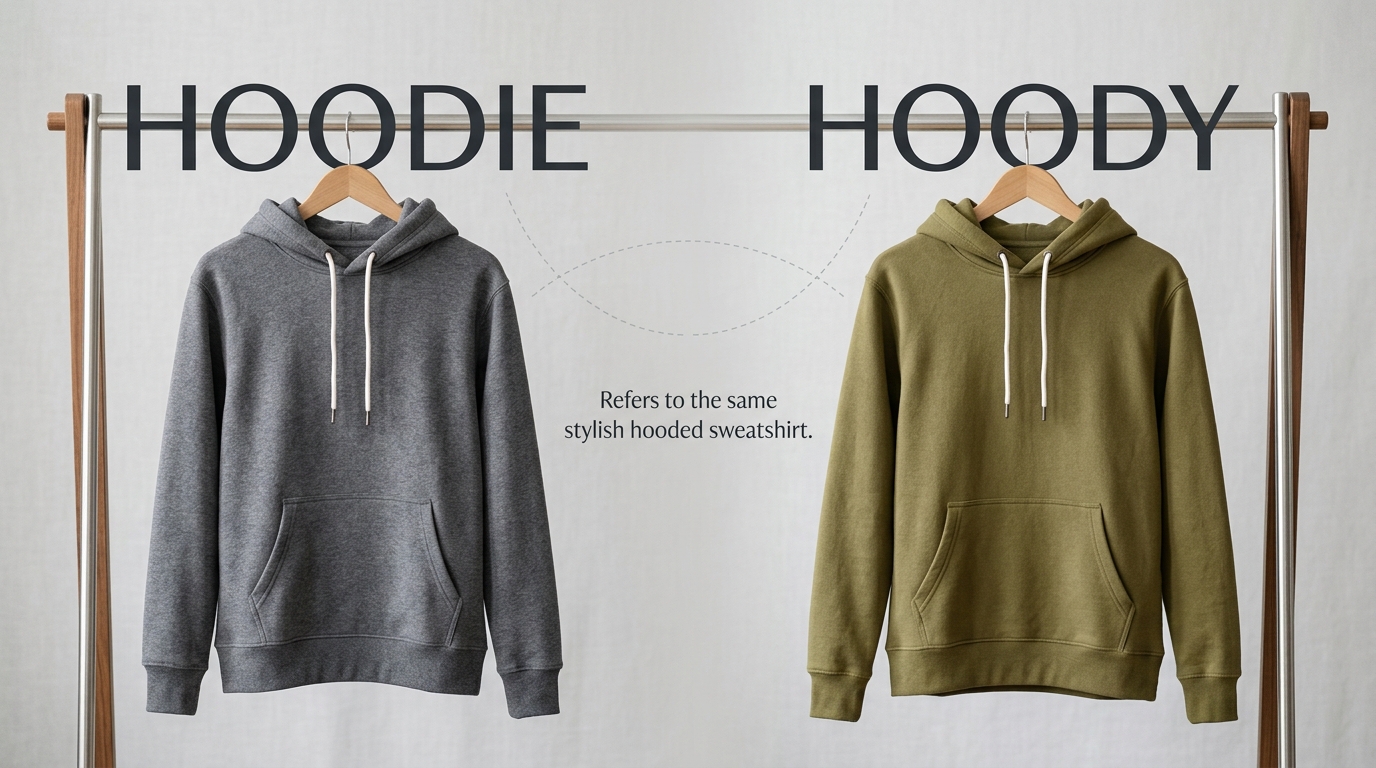
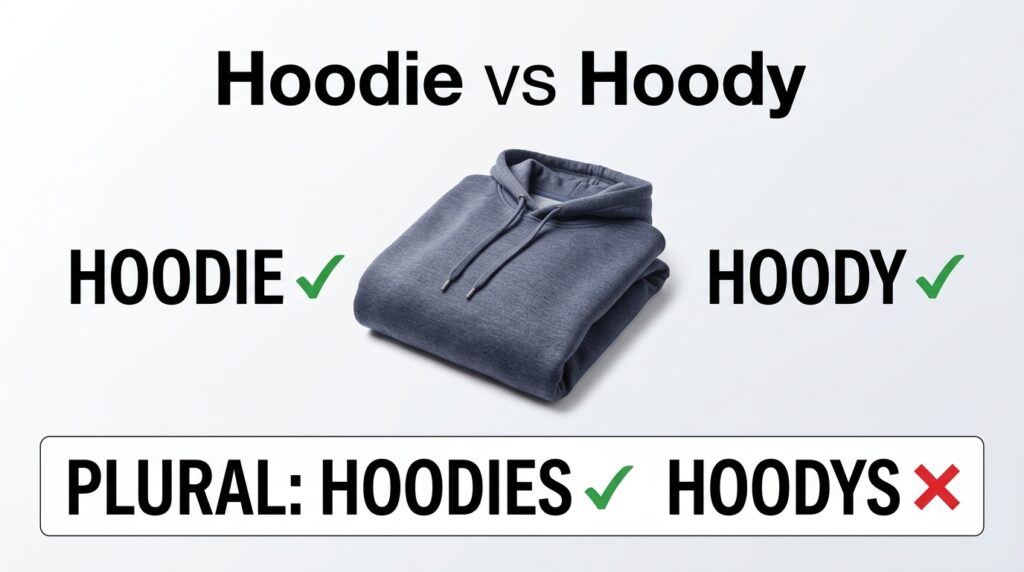
Hoodie and hoody are both accepted spellings for a sweatshirt, jacket, or casual top with a hood. However, hoodie is the more widely used spelling in modern English and is the safest choice for general writing, schoolwork, websites, product descriptions, and everyday communication. Hoody is a recognized variant, not simply a spelling mistake. The two forms normally have the same meaning and pronunciation.
What Is a Hoodie or Hoody?
A hoodie is a casual piece of clothing with a hood attached to it. It is commonly made from cotton, fleece, or a similar comfortable fabric and may be designed as a pullover or as a zip-up jacket.
Hoody can refer to the same garment. The difference between hoodie and hoody is primarily spelling, not the type of clothing being described.
Major English dictionaries recognize hoody as an alternative form of hoodie. Cambridge, for example, lists hoodie and identifies hoody as another spelling. Oxford’s American English dictionary also gives hoody as an alternative form.
So, if you write:
I bought a new hoodie.
or:
I bought a new hoody.
the intended garment is essentially the same.
The important practical difference is frequency and familiarity. Modern readers are more likely to encounter hoodie, so it is generally the better default when you are unsure which spelling to choose.
Why It Matters
At first glance, choosing between hoodie and hoody may seem unimportant. After all, both forms can refer to the same garment.
But spelling choices matter when you are writing for other people.
Consider these situations:
- You are writing a school assignment.
- You are creating an online clothing store.
- You are describing a product.
- You are writing an article or blog post.
- You are sending a professional email.
- You are creating social-media content.
- You are searching for clothing online.
In these situations, hoodie is usually the clearest choice because it is the form most readers expect.
This does not mean that hoody is automatically wrong. Treating every less-common spelling as an error can create a different kind of language mistake: confusing uncommon with incorrect.
That distinction is important throughout English.
A word can be:
- Correct and common.
- Correct but less common.
- Grammatically possible but unusual.
- Incorrect in a particular context.
Hoody generally belongs to the second category when it means a hooded garment. Dictionaries explicitly recognize it as an alternative form.
The Core Rule
Rule: When referring to a hooded sweatshirt or similar casual garment, both hoodie and hoody are recognized spellings, but hoodie is the safer and more familiar default for most modern English writing.
A simple way to remember it is:
hood + ie → hoodie
If you are writing for a broad audience and have no reason to use the variant spelling, choose hoodie.
What about the plural?
The plural is:
hoodies
Examples:
- I bought two hoodies.
- These hoodies are made from cotton.
- She sells custom hoodies online.
Notice something interesting: the plural is hoodies whether the singular is written as hoodie or hoody.
How to Use It
Use “hoodie” as your normal choice
Use hoodie when you are writing ordinary modern English.
Examples:
- I need a warm hoodie for winter.
- He wore a black hoodie to school.
- She ordered a new hoodie online.
- This hoodie has a front pocket.
- My favorite hoodie is very comfortable.
This spelling works naturally in conversation, schoolwork, online writing, product descriptions, and most other everyday contexts.
Use “hoody” when the variant spelling is appropriate
Hoody is an accepted alternative spelling, so you may encounter it in informal writing, older usage, particular publications, or names and branding.
You do not need to “correct” someone’s hoody to hoodie merely because hoodie is more common.
For example:
He bought a gray hoody.
The sentence can be understood as referring to a gray hooded sweatshirt.
However, if you are writing your own general-purpose content and simply want the form most readers recognize, hoodie is the practical choice.
Do not treat the two spellings as two different garments
There is normally no clothing distinction such as:
- hoodie = pullover
- hoody = zip-up
That distinction is not created by the spelling.
A zip-up garment can be called a hoodie, and a pullover garment can also be called a hoodie. The spelling does not determine the design.
Correct Examples
Here are examples showing how hoodie works naturally in different situations.
- Conversation:
“Where did you get that hoodie?” - School:
“I wore my blue hoodie to school because the classroom was cold.” - Email:
“Please remember to bring your hoodie for the outdoor activity.” - Workplace:
“The company logo will be printed on the front of the hoodie.” - Online shopping:
“I am looking for a black hoodie with a zipper.” - Social media:
“This hoodie is perfect for a chilly evening.” - Product description:
“This lightweight hoodie features a soft cotton blend and an adjustable drawstring.” - Academic writing about clothing:
“The hoodie has become a familiar item of casual clothing.” - Text message:
“Can you bring my hoodie tomorrow?” - Everyday conversation:
“I left my hoodie in the car.” - Fashion writing:
“The oversized hoodie remains popular as casual streetwear.” - School notice:
“Students may wear a plain hoodie during the winter months.”
The important point is that hoodie works naturally across many registers, from casual conversation to informative writing.
Incorrect vs. Correct
| ❌ Incorrect | ✅ Correct | Why |
|---|---|---|
| I bought two hoodys. | I bought two hoodies. | The standard plural is hoodies. |
| She is wearing a hoodies. | She is wearing a hoodie. | Singular hoodie needs a singular determiner. |
| He bought three hoodie. | He bought three hoodies. | A number greater than one requires the plural. |
| I left my hoodyes at home. | I left my hoodies at home. | The plural is spelled hoodies. |
| Where is my hoodi? | Where is my hoodie? | Hoodie is the standard spelling. |
| I bought two hoodie’s. | I bought two hoodies. | An apostrophe is not used to form an ordinary plural. |
| This hoodie’s are warm. | These hoodies are warm. | Hoodies is plural; hoodie’s is not the plural form. |
| I need a hoodies. | I need a hoodie. | A requires a singular noun. |
| These hoodie is expensive. | This hoodie is expensive. | Singular hoodie takes this, not these. |
| Those hoodys look comfortable. | Those hoodies look comfortable. | The correct plural spelling is hoodies. |
One important correction
Do not conclude that hoody itself is always incorrect.
For example:
He bought a new hoody.
This can be acceptable because hoody is recognized as an alternative spelling of hoodie.
The more important spelling mistake is usually hoodys or other incorrect attempts to form the plural.
Why People Make This Mistake
The confusion exists partly because English has several spelling patterns for words ending in sounds similar to -ee.
Compare:
- hoodie
- hoody
- cookie
- candy
- baby
- city
- happy
English does not have one simple rule that tells learners whether every word should end in -ie or -y.
Phonetic similarity
Hoodie and hoody are normally pronounced the same or essentially the same in standard usage. Cambridge gives the pronunciation as /ˈhʊd.i/ for the word.
Because speakers hear the same sound, they may naturally wonder which spelling represents it.
Spelling overlap
The base word is hood, which makes hoodie visually intuitive:
hood → hoodie
At the same time, English frequently uses -y endings in informal vocabulary, making hoody look plausible too.
Overgeneralisation
Learners sometimes apply a familiar spelling pattern to a new word.
For example, after seeing words ending in -y, they may assume:
hood + y = hoody
That is understandable, especially because hoody is actually a recognized spelling.
Autocomplete and spellcheck
Digital tools can make the situation even more confusing.
One keyboard may suggest hoodie while another may not flag hoody. Spellcheck behavior is not itself proof that a word is grammatically or lexically incorrect.
Dictionary evidence is more useful than assuming that a spelling is wrong simply because a particular app prefers another form.
Translation interference
Learners who translate clothing terms from another language may also try to map the word directly into English spelling.
The safest approach is to learn the complete English word:
hoodie
rather than trying to construct its spelling from pronunciation.
SEE READ:Togather or Together: Which Spelling Is Correct?
Common Mistakes Checklist
1. Assuming “hoody” is always wrong
It is not. Major dictionaries recognize hoody as an alternative form.
How to avoid it:
Distinguish between less common and incorrect.
2. Using “hoodys” as the plural
This is a common spelling mistake.
Correct: hoodies
How to avoid it:
Remember that the plural is written hoodies, regardless of whether the singular is hoodie or hoody.
3. Adding an apostrophe
Do not write:
hoodie’s
when you simply mean more than one hoodie.
The apostrophe can indicate possession:
The hoodie’s zipper is broken.
Here, hoodie’s means the zipper belonging to the hoodie.
But for the plural:
The hoodies are on sale.
4. Assuming the spelling changes the garment
It does not normally do so.
Hoodie and hoody can describe the same type of clothing.
5. Thinking “hoody” has a different pronunciation
The spelling difference does not normally create a different pronunciation for the garment.
6. Thinking “hoodie” is formal clothing vocabulary
Hoodie itself is an informal noun referring to a casual item of clothing. Cambridge labels it informal
That does not make the word unsuitable for ordinary writing. It simply describes the register of the word.
7. Assuming every dictionary treats the forms identically
Dictionary entries can differ in how they label alternative forms, regional senses, or additional meanings.
That is why it is better to consult reliable dictionary evidence rather than relying on a single spelling rule.
Hoodie or Hoody in Real English
Hoodie: grammatically correct and naturally common
Hoodie is the spelling most readers are likely to recognize immediately when you mean a hooded sweatshirt or casual top. Current dictionary entries from Cambridge, Collins, and Oxford’s American English dictionary recognize the word, while Cambridge and Oxford also identify hoody as an alternative form.
In ordinary English, sentences such as “I bought a new hoodie” or “Where is my hoodie?” sound completely natural.
Hoody: correct but less common
Hoody is not merely a random misspelling. It is a recognized variant of hoodie. Dictionary sources explicitly record it as an alternative spelling.
However, if your goal is to write the form most readers expect, hoodie is generally the more practical choice. Using hoody may attract more attention to the spelling itself because readers encounter it less often.
“Hoodys”: incorrect plural formation
This is different from hoody.
While hoody can be an accepted singular variant, hoodys is not the normal plural form.
Use:
one hoodie → two hoodies
and, if you start from the variant spelling:
one hoody → two hoodies
This is one of the easiest points to remember.
ALSO READ: Rug vs Rag: Meaning, Difference, and Examples
American vs. British English
There is not a simple rule saying that hoodie is American and hoody is British.
That popular assumption is too simplistic.
Cambridge lists hoodie, with hoody as an alternative form, in both its UK and US dictionary entries. Oxford’s American English dictionary likewise lists hoody as an alternative form.
There is, however, an additional British usage worth knowing.
In British English, hoodie can also refer informally to a young person wearing a hoodie. Collins records this additional British sense.
For example:
The article referred to a group of hoodies outside the shop.
Here, hoodies does not necessarily mean several garments. It can refer to people.
That meaning is context-dependent and should not be confused with the ordinary clothing sense.
For international English, hoodie is the clearest default when you mean the garment.
Formal vs. Informal Usage
The word hoodie describes casual clothing, so the subject itself is often informal.
That does not mean you cannot use the word in formal writing.
For example, a formal report about fashion could naturally say:
The hoodie has become an important part of modern casual clothing.
The word is appropriate because the report is discussing the garment.
However, if you are writing a highly formal document and do not need the everyday term, you could use:
hooded sweatshirt
This can sound more descriptive or technical.
Compare
Everyday:
He wore a black hoodie.
More descriptive:
He wore a black hooded sweatshirt.
Both can be correct. The choice depends on context, not on a rule that says hoodie is grammatically unacceptable in formal writing.
Comparison Table
| Feature | Hoodie | Hoody |
|---|---|---|
| Meaning | Hooded sweatshirt or casual top | Same basic garment |
| Spelling | More common modern form | Recognized variant |
| Pronunciation | Usually /ˈhʊd.i/ | Usually the same |
| Singular | hoodie | hoody |
| Plural | hoodies | hoodies |
| Common in everyday writing | Yes | Less common |
| Suitable for general writing | Yes | Yes, but less familiar |
| Automatically incorrect? | No | No |
| Best default when unsure | Yes | Usually no |
| Main difference | Spelling/frequency | Variant spelling |
The key takeaway is simple: the difference is mainly spelling and usage frequency, not meaning. Dictionary sources support both forms for the garment.

Real-Life Situations
In a job interview
If you are discussing workplace clothing:
“The company provides branded hoodies for employees.”
Hoodies is natural and clear.
In a school setting
“Students should bring a hoodie because the auditorium may be cold.”
The spelling hoodie is the straightforward choice.
In an email
“I left my hoodie in the conference room yesterday.”
There is no problem using hoodie in a normal email.
In a text message
“Did you take my hoodie?”
This is ordinary conversational English.
In an online store
“Men’s Cotton Zip-Up Hoodie”
Hoodie is the obvious default for a product title intended for a broad audience.
In an academic paper
“The hoodie has developed from practical sportswear into a widely recognized item of casual clothing.”
The word can appear in academic writing when the subject requires it.
On social media
“New hoodie, new favorite outfit.”
The informal word fits the informal platform and context.
ALSO READ:MK Meaning in Text: What Does MK Mean in Chat, Social Media & Dating?
How to Remember the Correct Spelling
The easiest memory trick is:
HOOD + IE = HOODIE
Think about the original word:
hood
Then add:
-ie
→ hoodie
For the plural, remember:
hoodie → hoodies
Not:
hoodys ❌
You can also remember the practical rule:
If you’re unsure, choose “hoodie.”
That does not mean hoody is wrong. It simply gives you a reliable default for modern general English.
Practice Quiz
Choose the best answer in each sentence.
1. I bought a new ___ yesterday.
A. hoodie
B. hoodys
C. hoodie’s
Answer: A. hoodie
2. She owns three ___.
A. hoodie
B. hoodies
C. hoodys
Answer: B. hoodies
3. Which statement is accurate?
A. Hoody is always incorrect.
B. Hoodie and hoody can refer to the same garment.
C. Hoodys is the standard plural.
Answer: B.
4. Choose the correct sentence.
A. These hoodie are expensive.
B. These hoodies are expensive.
C. These hoodys are expensive.
Answer: B.
5. Which spelling is the safest default for general modern English?
A. hoodie
B. hoody
C. hoodi
Answer: A. hoodie
6. Which is the correct plural?
A. hoodys
B. hoodie’s
C. hoodies
Answer: C. hoodies
7. Is “hoody” automatically a spelling mistake?
A. Yes
B. No
Answer: B. No.
It is a recognized alternative spelling.
8. Complete the sentence:
The ___ has a large front pocket.
A. hoodie
B. hoodies
C. hoodys
Answer: A. hoodie
FAQ
Is “hoodie” or “hoody” correct?
Both hoodie and hoody are recognized spellings for a hooded sweatshirt or similar casual garment. Hoodie is the more familiar modern form and is generally the best default when you are unsure.
Is “hoody” a real word?
Yes. Hoody is recognized as an alternative spelling of hoodie in major dictionary sources.
Is “hoodie” more common than “hoody”?
Yes. Hoodie is the more commonly encountered spelling in modern general English. Dictionary entries commonly present hoodie as the main entry and hoody as an alternative form.
What is the plural of hoodie?
The plural of hoodie is hoodies.
Example:
I bought two hoodies.
What is the plural of hoody?
The plural used for the garment is also hoodies.
Example:
The shop sells several hoodies.
Is “hoodys” correct?
No. The normal plural spelling is hoodies, not hoodys.
Is “hoodie” formal or informal?
Hoodie is an informal noun because it names a casual item of clothing. Cambridge labels it informal. However, the word can still appear in formal writing when the subject being discussed is a hoodie.
Do Americans say “hoodie” or “hoody”?
Both forms can be found, but hoodie is the normal modern choice. Oxford’s American English dictionary lists hoody as an alternative form.
Do British people spell it “hoody”?
British English uses hoodie as well. It is too simplistic to describe hoody as exclusively British. Cambridge lists hoody as an alternative to hoodie in its UK entry.
Are hoodie and hoody pronounced differently?
They are normally pronounced the same for the clothing sense. Cambridge gives /ˈhʊd.i/ for hoodie.
Does “hoodie” only mean a sweatshirt?
Usually, it refers to a hooded sweatshirt, jacket, or similar casual top. In British English, hoodie can also have an additional informal meaning referring to a young person wearing a hoodie.
What is the easiest way to remember hoodie vs. hoody?
Use hood + ie = hoodie. If you are unsure, hoodie is the safest general-purpose spelling.
Quick Summary
Hoodie and hoody can both refer to a casual garment with an attached hood. The main difference is spelling and frequency, not meaning. Hoodie is the more common and familiar spelling in modern English, so it is usually the best choice for general writing, schoolwork, websites, product descriptions, and everyday communication. Hoody is still a recognized variant and should not automatically be marked as wrong. The plural form is hoodies, not hoodys. There is also no reliable rule that makes hoodie exclusively American and hoody exclusively British. When in doubt, remember: hood + ie = hoodie.
SEO Metadata
SEO Title: Hoodie or Hoody: Which Spelling Is Correct?
Meta Description: Is it hoodie or hoody? Learn which spelling is correct, whether both are accepted, the plural form, usage differences, and easy examples.
URL Slug: hoodie-or-hoody
Primary Keyword: hoodie or hoody
Secondary Keywords:
- hoodie vs hoody
- hoody or hoodie
- is hoody correct
- is hoodie correct
- hoodie spelling
- hoody spelling
- plural of hoodie
- plural of hoody
- hoodie meaning
- hoody meaning
- hoodie or hoody difference
- how to spell hoodie
Search Intent: Comparison / Correction / Definition
Suggested Schema: Article + FAQPage
Suggested Article Type: Grammar / Word-choice comparison
Suggested Internal Links:
Because the target website’s existing URL structure and published pages were not provided, I would not invent internal URLs. The article can naturally link to relevant existing pages about spelling comparisons, commonly confused words, pluralization, and English usage once those URLs are available.
1. Hero Image — Hoodie vs. Hoody
Create a realistic, high-quality editorial image for an English grammar article titled “Hoodie or Hoody?”. Show two stylish hooded sweatshirts side by side on a clean modern background. Add elegant, clearly readable typography: “HOODIE” on the left and “HOODY” on the right, with a subtle visual connection showing that both spellings refer to the same type of clothing. Professional educational website aesthetic, natural fabric texture, soft studio lighting, clean composition, realistic photography, no people, no logos, no watermark, 16:9 landscape format.2. Comparison Image — Correct Spelling & Plural
Create a clean educational comparison graphic about “Hoodie vs Hoody”. Show a realistic folded hoodie in the center, with the words “HOODIE ✓” and “HOODY ✓” displayed clearly to show that both spellings are accepted. Below them, prominently show “PLURAL: HOODIES ✓” and “HOODYS ✗”. Modern English-learning infographic style, minimal background, excellent typography, high readability, professional editorial design, no unnecessary decorations, no brand logos, no watermark, 16:9 landscape format.3. Real-English Usage Image
Create a realistic lifestyle scene illustrating the everyday use of the word “hoodie”. Show a young adult wearing a comfortable plain hoodie while casually studying and using a laptop at a modern desk. Include a subtle educational text element on a nearby notebook reading: “Hoodie = the common modern spelling” and a smaller note: “Hoody = accepted variant”. Natural daylight, authentic everyday environment, realistic photography, warm but neutral atmosphere, professional English-learning article aesthetic, no logos, no watermark, 16:9 landscape format.