

Hustle or Hussle: Which Spelling Is Correct?
Have you ever typed hussle and wondered whether it should be hustle? The two forms look almost identical, and their pronunciation is very similar. That makes this a common spelling question, especially when writing quickly or using English as a second language.
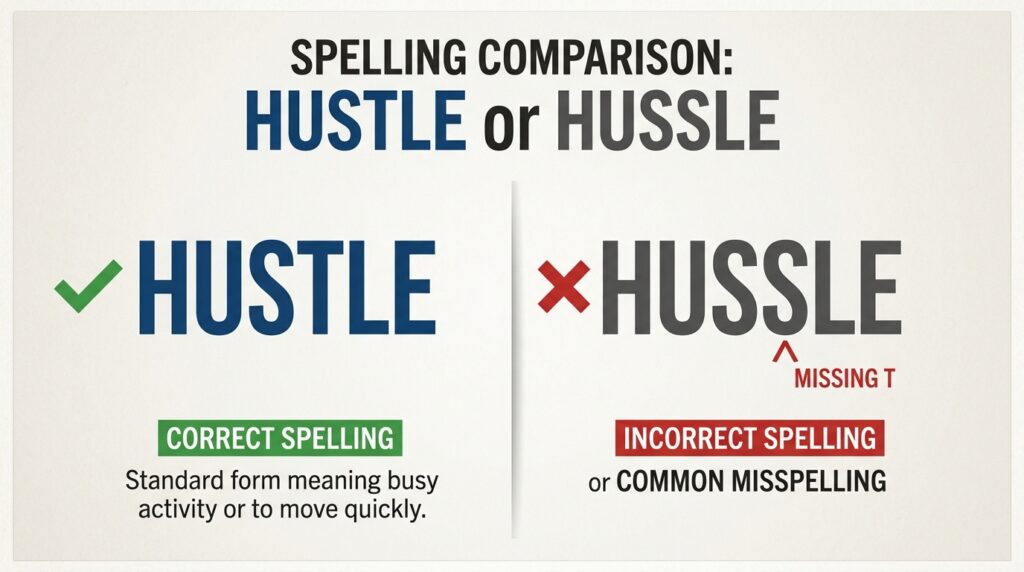
The good news is that the main rule is simple. Hustle is the standard English spelling. Hussle is usually a misspelling when you mean the ordinary English word. However, Hussle can also be a proper name, such as the stage name of rapper Nipsey Hussle.
This distinction matters because a word that looks familiar is not necessarily a standard spelling. Whether you are writing a school assignment, a business email, a social media caption, or an article, choosing the correct form helps your message remain clear.
Quick Answer
Hustle is the correct spelling for the standard English word. It can mean to work energetically, move quickly, or make a determined effort. Hussle is generally a misspelling of hustle, but it can be correct when used as a proper name, such as Nipsey Hussle. Use hustle in ordinary English writing, and reserve Hussle for the specific name or brand that uses it.
What Is Hustle or Hussle?
The difference between hustle and hussle is mainly a spelling difference, but it also involves how English words and proper names work.
Hustle is a recognized English word. It can function as a verb or a noun, and its meaning changes according to the sentence.
As a verb, hustle can mean to work hard, move quickly, or encourage someone to hurry. As a noun, it can describe energetic effort, a busy activity, or a way of earning money. In some contexts, it can also refer to a dishonest scheme.
Hussle, when written as a common word, is generally an incorrect spelling of hustle. It does not normally function as an alternative spelling with its own standard English meaning.
However, capitalized Hussle can be a proper name. For example, Nipsey Hussle used that spelling as his stage name. A proper name may have a deliberate spelling that differs from an ordinary dictionary word.
The easiest way to remember the difference is:
- Hustle: The standard English word.
- Hussle: Usually a misspelling, or a specific name.
Why Does the Difference Matter?
Spelling is not just about passing a grammar test. It helps readers understand what you mean and how carefully you have written.
If you use hussle in a school essay, a job application, or a professional email when you mean hustle, the reader may interpret it as a spelling mistake. One small error does not necessarily ruin a piece of writing, but repeated errors can distract from your message.
The difference also matters in digital writing. Search engines, spellcheckers, and readers may interpret a common word differently from a proper name. If you are writing about hard work, a side business, or moving quickly, hustle is the appropriate standard spelling.
There is one important exception: names and brands. If a person or organization deliberately uses Hussle, changing it to Hustle would change the name.
The Core Rule
Use hustle when you mean energetic work, quick movement, determined effort, or the standard English word. Use Hussle only when referring to a specific name or brand that uses that spelling.
For example:
- Correct: She had to hustle to finish the report.
- Incorrect: She had to hussle to finish the report.
- Correct: Nipsey Hussle was an American rapper and entrepreneur.
The rule is not that every appearance of Hussle is wrong. The rule is that hussle is not the standard spelling of the ordinary English word hustle.
How to Use Hustle Correctly
The word hustle has several meanings, so understanding the context is important.
Hustle as a Verb
A verb describes an action. When hustle is used as a verb, it often means to move quickly or work with energy.
Examples:
- I need to hustle if I want to catch the bus.
- She hustled through the final part of the assignment.
- The team hustled to prepare for the presentation.
It can also mean to push or persuade someone, sometimes in an aggressive way.
- The salesman tried to hustle the customer into buying an expensive product.
In informal English, hustle may also describe working hard to earn money.
- He hustles every evening after his regular job.
Hustle as a Noun
A noun names a person, place, thing, or idea. As a noun, hustle can describe effort, busy activity, or a money-making activity.
Examples:
- Her hustle helped her build a successful business.
- The hustle of city life can be exhausting.
- His side hustle brings in extra income.
The phrase side hustle is especially common in modern English. It usually refers to work or a small business done in addition to a main job.
Hustle in Different Contexts
The meaning of hustle depends on the situation.
| Context | Meaning |
|---|---|
| Work | To work hard or energetically |
| Movement | To move quickly |
| Business | A side job or money-making activity |
| Sports | Energetic effort and determination |
| Informal speech | A busy or active way of life |
| Negative context | A dishonest scheme or attempt to deceive |
For example, “She has a strong hustle” praises her effort, while “That was a hustle” may refer to a dishonest trick. The surrounding words tell you which meaning is inte
Correct Examples
Here are original examples showing how hustle can be used in everyday English, schoolwork, business, and social media.
- I had to hustle to reach the station before the train left.
- Her weekend hustle helped her save money for college.
- The team showed real hustle during the final minutes of the match.
- He started a small online hustle after work.
- The busy restaurant was full of hustle and activity.
- Please hustle; the meeting starts in five minutes.
- She hustled to finish her presentation before the deadline.
- His determination and hustle impressed the manager.
- The city’s morning hustle begins before sunrise.
- Building a business requires patience, skill, and consistent hustle.
Each sentence uses the standard spelling hustle. The word can describe physical movement, work, business, or effort.
Incorrect vs. Correct
The following examples show common mistakes and the correct form.
| ❌ Incorrect | ✅ Correct | Why |
|---|---|---|
| I need to hussle to work. | I need to hustle to work. | Hustle is the standard spelling of the verb. |
| She has a side hussle. | She has a side hustle. | The business expression is side hustle. |
| We must hussle to meet the deadline. | We must hustle to meet the deadline. | The word describing urgent effort is hustle. |
| His hussle is inspiring. | His hustle is inspiring. | The noun for determined effort is hustle. |
| The team showed great hussle. | The team showed great hustle. | The standard noun is hustle. |
| I am hussling every day. | I am hustling every day. | The -ing form is hustling. |
| She hussled across the street. | She hustled across the street. | The past-tense form is hustled. |
| The city hussle never stops. | The city hustle never stops. | The standard noun is hustle. |
| He wants to hussle for success. | He wants to hustle for success. | The verb is spelled hustle. |
| That was a clever hussle. | That was a clever hustle. | The noun describing a scheme is hustle. |
The mistake in each sentence is the spelling of the ordinary English word. In contrast, a proper name such as Nipsey Hussle should retain its original spelling.
Why Do People Make This Mistake?
Phonetic Similarity
Phonetics refers to the sounds used in speech. Hustle and hussle look different, but many speakers pronounce them very similarly.
When people hear a word rather than see it written, they may not remember which letters belong in the spelling. This is especially common for English learners because English spelling does not always follow simple sound-to-letter rules.
Spelling Overlap
English contains many words with double consonants. This can make hussle look familiar.
For example:
- Lesson
- Address
- Success
- Coffee
Seeing these words may lead a writer to assume that hustle should also contain a double s. But spelling patterns are not always predictable. The correct spelling must be learned as a whole word.

Autocomplete and Spellcheck
Spellcheckers are useful, but they are not perfect. Some systems may accept unusual names or fail to identify a mistake when a word appears in a familiar context.
A proper name such as Hussle can also appear in dictionaries, databases, and search results. That does not mean it is the standard spelling of the common word.
Translation Interference
English learners sometimes transfer spelling patterns from another language into English. A word may sound similar to a familiar word in a learner’s first language, encouraging a different spelling.
The best solution is to learn the complete English word and use it in several sentences.
Common Mistakes Checklist
- Writing hussle for hard work: Use hustle when describing effort or determination.
- Writing side hussle: The standard expression is side hustle.
- Using Hussle as a common noun: Unless it is a name or brand, use hustle.
- Adding an extra s: Remember the spelling H-U-S-T-L-E.
- Changing a proper name: Keep the spelling of a person’s or brand’s name unchanged.
- Assuming similar sounds mean identical spellings: Check the written form rather than relying only on pronunciation.
- Using a name as proof of a spelling rule: A proper name can have a special spelling that does not apply to ordinary words.
Hustle in Real English
The word hustle is grammatically correct and natural in many everyday situations. It is common when people talk about work, effort, business, or moving quickly.
For example, “I need to hustle to finish this” sounds natural in informal conversation. “She has a side hustle” is also a familiar expression in business and everyday speech.
However, hustle can have different meanings depending on context. It may suggest determination, but it can also describe a dishonest scheme. A sentence such as “He hustled the customer” can imply that someone was deceived.
The form hussle is not a standard alternative spelling of hustle. When used as a proper name, it is a different case.
American vs. British English
There is no standard American-versus-British spelling difference between hustle and hussle.
Both American and British English use hustle as the standard spelling of the ordinary word. The spelling hussle is generally not used as an alternative dictionary spelling.
For example:
- American English: She has a side hustle.
- British English: She has a side hustle.
The pronunciation and some meanings may vary slightly across English-speaking regions, but the spelling rule remains the same.
Formal vs. Informal Usage
Hustle can be used in both formal and informal English, but the meaning and tone depend on the context.
In everyday conversation, people often use hustle to describe working hard, moving quickly, or earning money through a side business.
In formal writing, the word is acceptable when it expresses the intended meaning clearly. However, some meanings of hustle are informal or slang-related, so a more precise word may be better in academic or professional writing.
For example:
- Informal: I have to hustle to finish this.
- More formal: I need to work efficiently to complete this.
The word itself is not grammatically wrong in formal writing. The choice depends on the tone and meaning you want to communicate.
Comparison Table
| Feature | Hustle | Hussle |
|---|---|---|
| Standard English word | Yes | No, when intended as the common word |
| Spelling | H-U-S-T-L-E | H-U-S-S-L-E |
| Can be a verb | Yes | No, as the common word |
| Can be a noun | Yes | No, as the common word |
| Meaning | Work, movement, effort, or other contexts | Usually a misspelling |
| Common phrase | Side hustle | Not standard |
| Formal writing | Acceptable when appropriate | Not appropriate as a misspelling |
| Proper name | Not necessarily | Can be a proper name |
| Example | She has a side hustle. | Nipsey Hussle |
Real-Life Situations
In an Interview
If you are talking about your work ethic, you can say:
“I believe in consistent effort, and I am willing to hustle to meet important goals.”
This uses hustle as a verb.
In a Meeting
A manager might say:
“We need to hustle a little if we want to finish the project on time.”
The word suggests urgency and effort.
In an Email
For formal business writing, you may prefer:
“We need to work efficiently to meet the deadline.”
This is more neutral than hustle, but both can be grammatically correct
.
In a Text Message
A friend might write:
“Come on, hustle! We’re already late.”
This is informal and natural.
In an Exam
If a question asks for the correct spelling, choose:
Hustle
If the question refers to a person’s name, use the spelling of that name.
How to Remember the Correct Spelling
The easiest memory trick is to focus on the letters.
Hustle = H-U-S-T-L-E
The t is part of the standard spelling. The extra s in hussle is what makes it incorrect when you mean the common English word.
You can also remember the phrase:
Work hard? Hustle. A person’s name? Check the name.
This helps you distinguish the ordinary word from a proper name.
Another useful approach is to learn the word in a phrase:
- Side hustle
- Hustle culture
- Hustle and bustle
- Hustle to finish
- Hustling for success
Seeing the word repeatedly in correct phrases makes it easier to remember.
also read: WJY Meaning in Text: What Does WJY Mean in Chat & Social Media?
FAQ
Is hustle or hussle correct?
Hustle is the correct spelling of the standard English word. Hussle is usually a misspelling, although it can be a proper name.
Is hussle a real English word?
Hussle is not generally recognized as the standard spelling of the common English word. It may appear as a name or brand.
What does hustle mean?
Hustle can mean to work hard, move quickly, make an energetic effort, or engage in certain money-making activities.
What is a side hustle?
A side hustle is a job, business, or activity that someone does in addition to their main work, often to earn extra money.
How do you spell hustle?
Hustle is spelled H-U-S-T-L-E.
Is hustle a noun or a verb?
Hustle can be both a noun and a verb. As a verb, it describes an action. As a noun, it can describe effort, activity, or a money-making activity.
Is hustling the correct spelling?
Yes. Hustling is the standard -ing form of hustle. The final e is removed before adding -ing.
Is hussle ever correct?
Yes, when it is part of a proper name or brand that deliberately uses that spelling. It is not the standard spelling of the ordinary word.
Why do people spell hustle as hussle?
The two forms look similar, and the pronunciation is close. People may also be influenced by double-consonant spelling patterns or familiar names.
Is hustle formal or informal?
Hustle can be used in both formal and informal writing, but some meanings are informal. Choose the word that best matches the tone and context.
Quick Summary
Hustle is the correct spelling of the standard English word. It can function as a noun or verb and may describe working hard, moving quickly, energetic effort, or a side business. Hussle is generally a misspelling when used as the common word, but it can be correct as a proper name or brand. The easiest way to remember the difference is to spell hustle with one s after the u: H-U-S-T-L-E. Use hustle in schoolwork, emails, articles, and ordinary conversation when you mean effort or movement. Keep Hussle only when referring to a specific name that uses that spelling.