Togather or Together: Which Spelling Is Correct?
If you have ever typed “togather” and wondered whether it is the right spelling, the answer is simple: together is the correct spelling. Togather is a common misspelling when the writer means “with each other,” “jointly,” or “in one place.” The real source of confusion is the valid phrase “to gather,” which contains the familiar word gather but has a different meaning and grammatical structure.
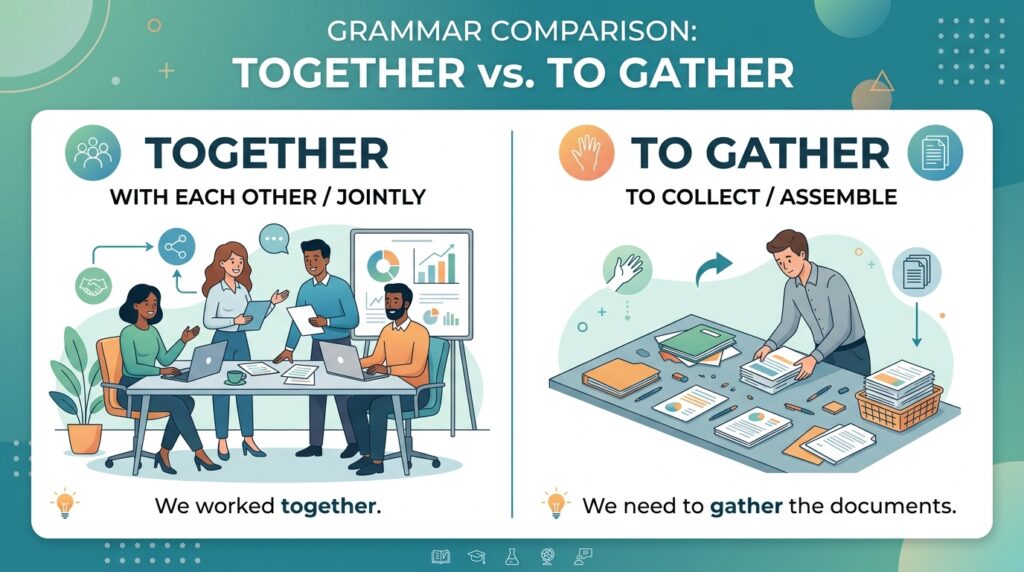
Together is the correct spelling. Togather is not the standard spelling of the English word. Use together when you mean “with each other,” “in the same place,” “jointly,” or “combined.” Use to gather as two separate words when gather is the verb meaning “to collect” or “to assemble.” For example: “We worked together,” but “We need to gather more information.”
What Is “Together”?
Together is a standard English word, usually used as an adverb. In simple terms, an adverb can tell us how, when, or where something happens. Together commonly tells us that people or things are acting, existing, or being placed with one another.
For example:
We studied together.
Here, together explains how the people studied: they studied with each other.
The word can also describe things that are joined or combined:
Put the two pieces together.
It can describe people being in the same place:
The whole family was together.
It can describe simultaneous action:
We arrived together.
And it can describe cooperation:
The two teams worked together to finish the project.
Major English dictionaries treat together as an established word with several related uses, including being with others, joining things, acting jointly, and doing something at the same time.
The important point for this spelling question is that together is one word.
Not:
- ❌ togather
- ❌ to gather, when you mean “with each other”
- ❌ togeather
- ❌ togeter
- ❌ togther
The correct spelling is:
- ✅ together
There is, however, a completely legitimate expression that looks very similar:
- ✅ to gather
That distinction explains most of the confusion.
Why It Matters
A spelling mistake such as togather may seem minor, especially in a quick text message, but spelling becomes more important when your writing represents you in a formal setting.
Consider these situations:
- a school assignment
- a university essay
- a job application
- a résumé or CV
- a professional email
- a business proposal
- a report
- website content
- an examination
- an application letter
Writing “We worked togather on the project” instead of “We worked together on the project” does not normally prevent readers from understanding you. However, it signals that the word has been misspelled.
In casual communication, readers may simply understand what you intended. In edited or professional writing, repeated spelling errors can make a document appear less carefully checked.
There is another reason the distinction matters: togather can accidentally blur the difference between together and to gather.
Compare:
We worked together.
This means we worked with one another.
We need to gather.
This means we need to collect or assemble something.
Those are different grammatical constructions and different meanings.
Correct spelling therefore is not just about memorizing letters. It helps preserve the difference between words and phrases that perform different jobs in a sentence.
The Core Rule
RULE: Write “together” as one word when you mean with each other, jointly, in the same place, or combined. Write “to gather” as two words when “gather” means to collect or assemble.
The easiest comparison is:
| Meaning | Correct form | Example |
|---|---|---|
| With each other | together | We worked together. |
| In the same place | together | The children stayed together. |
| Combined | together | Mix the ingredients together. |
| Collect or assemble | to gather | We need to gather the documents. |
| Bring people into one place | to gather | The teacher asked everyone to gather outside. |
So:
Together = one word
To gather = two words
Togather = incorrect spelling when intended as either of the above
How to Use “Together”
The most common use of together is to show that people or things are with one another.
1. People doing something jointly
My brother and I worked together.
The two people cooperated.
2. People in the same place
The entire family was together for dinner.
The family members were in the same place.
3. Things being joined
Press the two pieces together.
The pieces are being brought into contact.
4. Things being combined
Mix the flour and sugar together.
The separate ingredients become part of one mixture.
5. Actions happening at the same time
We arrived together.
The people arrived at the same time or as a group.
6. People cooperating
The departments worked together to solve the problem.
The departments collaborated rather than working separately.
7. Relationships
They have been together for five years.
Here, together refers to their relationship or shared life.
8. Meeting socially
Let’s get together this weekend.
Get together is a common expression meaning to meet or spend time together. A noun referring to such an informal gathering is commonly written get-together.
The important thing is to understand the meaning of the sentence rather than simply memorize a spelling.
If the sentence means “with each other” or “jointly,” use together.
If the sentence means “collect” or “assemble,” use gather after to.
Correct Examples
Here are original examples showing how together works in different real-life contexts.
- Conversation:
“Do you want to walk home together?” - Text message:
“We should study together before the exam.” - Email:
“I look forward to working together on the new project.” - School:
“The students completed the science experiment together.” - Workplace:
“Our design and marketing teams worked together to prepare the presentation.” - Academic writing:
“These findings, taken together, suggest that the two factors are related.” - Family:
“We usually eat dinner together on Fridays.” - Instructions:
“Place the two parts together before tightening the screws.” - Social media:
“So happy we finally got together after such a long time!” - Everyday conversation:
“Let’s put our ideas together and see what we can create.” - Travel:
“We booked the tickets together so we could sit next to each other.” - Business communication:
“We can discuss the remaining details together during tomorrow’s meeting.”
Notice that together does not have one single narrow meaning. Its exact meaning depends on context, but the central idea is connection, combination, joint action, or shared time or place.
Incorrect vs. Correct
| ❌ Incorrect | ✅ Correct | Why |
|---|---|---|
| We worked togather on the project. | We worked together on the project. | Together is the standard spelling when people work jointly. |
| They went togather to the meeting. | They went together to the meeting. | The sentence means they went with each other. |
| Let’s eat togather tonight. | Let’s eat together tonight. | The intended meaning is eating with each other. |
| We studied togather yesterday. | We studied together yesterday. | Together describes joint activity. |
| They stayed togather during the trip. | They stayed together during the trip. | The people remained with each other. |
| We need togather the information. | We need to gather the information. | Here gather is a verb meaning collect. |
| Please togather all the documents. | Please gather all the documents. | Gather means collect; no to is needed after please. |
| Everyone should stand togather. | Everyone should stand together. | The people should stand in one group. |
| The two pieces were placed togather. | The two pieces were placed together. | The pieces were put in contact with each other. |
| We should meet togather next week. | We should meet together next week. | The intended meaning is meeting with one another. |
| She asked us togather outside. | She asked us to gather outside. | To gather means to assemble. |
| The team came togather for the final meeting. | The team came together for the final meeting. | Together describes the group coming into one place. |
The most useful lesson is that togather is not the alternative spelling of together. In sentences where gather is actually the verb, the correct phrase may instead be to gather.
Why People Make This Mistake
Phonetic Similarity
One reason learners make this mistake is that English spelling cannot always be predicted perfectly from pronunciation.
When people speak quickly, unstressed sounds can be less distinct. Together is commonly pronounced approximately /təˈɡeðər/ in both major pronunciation varieties, with differences in the final vowel depending on accent.
A learner who already knows gather may hear the beginning of together and mentally connect it to the spelling ga.
That can produce:
❌ togather
instead of:
✅ together
Spelling Overlap With “Gather”
This is probably the most obvious visual reason for the error.
Gather is a real English word:
We need to gather the students.
Because gather means bringing people or things into one group, it is semantically related to some uses of together. Dictionaries also trace the historical development of together through older forms related to gather.
But modern spelling does not work by simply combining to + gather.
Therefore:
❌ togather
is not the spelling of together.
Overgeneralisation
Learners sometimes see a familiar pattern and apply it too broadly.
They may think:
to + gather = togather
That reasoning would make sense if the intended phrase were the infinitive to gather, but together is a separate established word.
Compare:
We went together.
with:
We went to gather information.
The first means we went with each other.
The second means we went for the purpose of collecting information.
Autocomplete and Spellcheck
Digital tools can help identify spelling errors, but they are not a substitute for understanding the sentence.
A spellchecker may flag an unfamiliar spelling, but you still need to decide whether the intended expression is together, gather, or to gather.
This matters particularly when several possible words are correctly spelled.
For example:
We need to gather information.
Every word in that sentence is spelled correctly.
But if you intended to say that two people worked with one another, the correct word is:
We worked together.
A spelling checker cannot always explain the difference in meaning as clearly as a human reader can.
Translation Interference
Learners who translate directly from another language may also choose spelling based on the sound or structure of an equivalent expression in their first language.
That can make English spelling patterns harder to remember.
The safest approach is to learn together as one complete English word and learn to gather as a separate verb phrase.
Common Mistakes Checklist
Before publishing, submitting, or sending your writing, check these common errors.
1. Writing “togather”
Problem: You use togather when you mean together.
Why it happens: The word resembles gather.
Fix: Remember that the standard spelling is together.
2. Joining “to gather”
Problem: You write togather when you actually mean the verb phrase to gather.
Why it happens: You remove the space between to and gather.
Fix: Keep the words separate:
We need to gather more evidence.
3. Confusing “gather” and “together”
Problem: You use one where the other is needed.
Fix: Ask what the sentence means.
- gather = collect or assemble
- together = with each other, jointly, combined
4. Writing “togeather”
Problem: An unnecessary a is inserted.
Correct form:
together
5. Writing “togeter”
Problem: The h is omitted.
Correct form:
together
6. Writing “togther”
Problem: The e is dropped.
Correct form:
together
7. Confusing “together” with “altogether”
These words are different.
Together commonly expresses connection, joint action, or being in the same place.
Altogether commonly means completely or in total. Cambridge specifically distinguishes altogether from all together and together.
Compare:
We worked together.
There were altogether fifty people.
8. Forgetting the hyphen in “get-together”
When get-together functions as a noun for an informal gathering, the hyphenated form is used.
We are having a family get-together on Sunday.
As a verb phrase, however:
Let’s get together on Sunday.
The noun and verb uses should not be treated as identical forms.
Together in Real English
The most useful way to understand together is to separate what is grammatically correct from what would actually sound natural in context.
“We worked together.”
This is both grammatically correct and completely natural everyday English. It means that two or more people worked jointly or cooperated. It is suitable for conversation, emails, school writing, and professional communication. Together naturally follows verbs such as work, study, live, travel, and play when the meaning involves shared action.
“We need to gather the information.”
This is also completely natural, but it does not mean the same thing as work together. Here, gather is the main verb and means to collect information. The word to is the infinitive marker. Because to and gather are separate words, writing togather would change the spelling incorrectly. The distinction is grammatical, not merely visual.
“Let’s get together.”
This is natural everyday English when suggesting that people meet or spend time together. It is common in casual conversation and messages. It can also appear in professional contexts when the tone is appropriate, although a phrase such as “Let’s meet” may be more direct in a formal business email. The expression get together has established meanings including meeting socially.
“She is very together.”
This use is grammatically possible but has a different meaning. Here, together can function as an informal adjective describing someone as organized, confident, or capable of managing things. It is not the ordinary meaning of together as “with each other.” This adjective use is recognized in major dictionaries, but its informal character means it may be less suitable in highly formal writing.
“We put the documents together.”
This is natural English, but the exact meaning depends on context. It can mean physically placing documents together, organizing them into one collection, or assembling them into a finished set. The expression put together also has broader meanings such as assemble or create.
American vs. British English
There is no spelling difference between American and British English for the standard word together.
Both use:
✅ together
Neither standard variety changes the spelling to:
❌ togather
Pronunciation can vary between accents. Dictionary entries give slightly different pronunciation representations for British and American English, but the written form remains together.
There can also be differences in how particular expressions are used or how informal adjective senses are perceived, but these do not create an AmE/BrE spelling alternative for togather.
So you do not need to remember an American version and a British version.
Just remember:
Together is spelled together in both.
Formal vs. Informal Usage
Together itself is suitable in virtually every register of English.
You can use it in:
- casual conversations
- text messages
- school assignments
- business emails
- reports
- academic writing
- professional presentations
For example:
We worked together to complete the report.
That sentence is neutral and appropriate in both everyday and professional English.
The more important register difference concerns some expressions containing together.
Get together is common and natural in casual conversation:
Let’s get together this weekend.
In a formal business context, you might instead write:
Let’s meet next week to discuss the proposal.
The issue is not that get together is grammatically wrong. It is that meet can be more direct and neutral when the context is formal.
Likewise, the adjective use of together meaning organized or composed is informal:
She seems very together.
That can sound natural in conversation, but a formal writer might choose a more precise expression such as:
She appears highly organized.
Together vs. To Gather
This is the most important comparison after togather vs. together.
| Feature | Together | To gather |
|---|---|---|
| Written as | One word | Two words |
| Main role | Usually an adverb | Infinitive verb phrase |
| Basic meaning | With each other; jointly; combined | To collect or assemble |
| Example | We worked together. | We need to gather the files. |
| Can describe cooperation? | Yes | No, not by itself |
| Can mean collect? | No | Yes |
| Correct spelling? | Yes | Yes |
| “Togather” acceptable? | No | No |
A simple test is to ask:

Does the sentence mean “with each other”?
If yes, together is probably what you need.
Does it mean “collect” or “assemble”?
If yes, you may need gather or to gather.
For example:
We studied together.
They studied with each other.
We decided to gather the research.
They decided to collect the research.
Together vs. Altogether
Another common confusion involves together and altogether.
Together usually expresses connection, joint action, combination, or shared location.
The children played together.
Altogether commonly means completely, entirely, or in total.
Altogether, we spent $200.
The difference becomes especially important in phrases such as all together.
We were all together in the same room.
Here, all together means everyone was together.
But:
Altogether, there were twenty students.
Here, altogether means in total.
The meanings are related but not interchangeable.
Together vs. Gather
| Word | Meaning | Example |
|---|---|---|
| Together | With each other | We worked together. |
| Gather | Collect or assemble | Please gather the papers. |
| To gather | To collect or assemble | We need to gather the papers. |
| Togather | Incorrect spelling in standard modern English | ❌ We worked togather. |
This distinction is worth memorizing because gather is a genuine English word.
The mistake is not that gather is wrong. The mistake is using togather as though it were another spelling of together.
Real-Life Situations
In an Interview
Natural:
“I enjoy working together with colleagues from different departments.”
The candidate is describing cooperation.
In a Meeting
Natural:
“Let’s put our ideas together before we make a decision.”
The ideas are being combined.
In a Professional Email
Natural:
“I look forward to working together on this project.”
This is a standard professional use.
In a Text Message
Natural:
“Are you free to get together tonight?”
The writer is suggesting a meeting.
In an Exam
Correct:
“The two students worked together to solve the problem.”
Writing togather would be a spelling error.
In Academic Writing
Correct:
“Taken together, these results indicate that the variables are related.”
Here, together means considered as a group.
In Instructions
Correct:
“Gather all the required documents before submitting the application.”
Here, gather means collect.
In a Family Conversation
Correct:
“We should all have dinner together tonight.”
The family will share the activity.
The Easiest Way to Remember “Together”
A useful memory aid is:
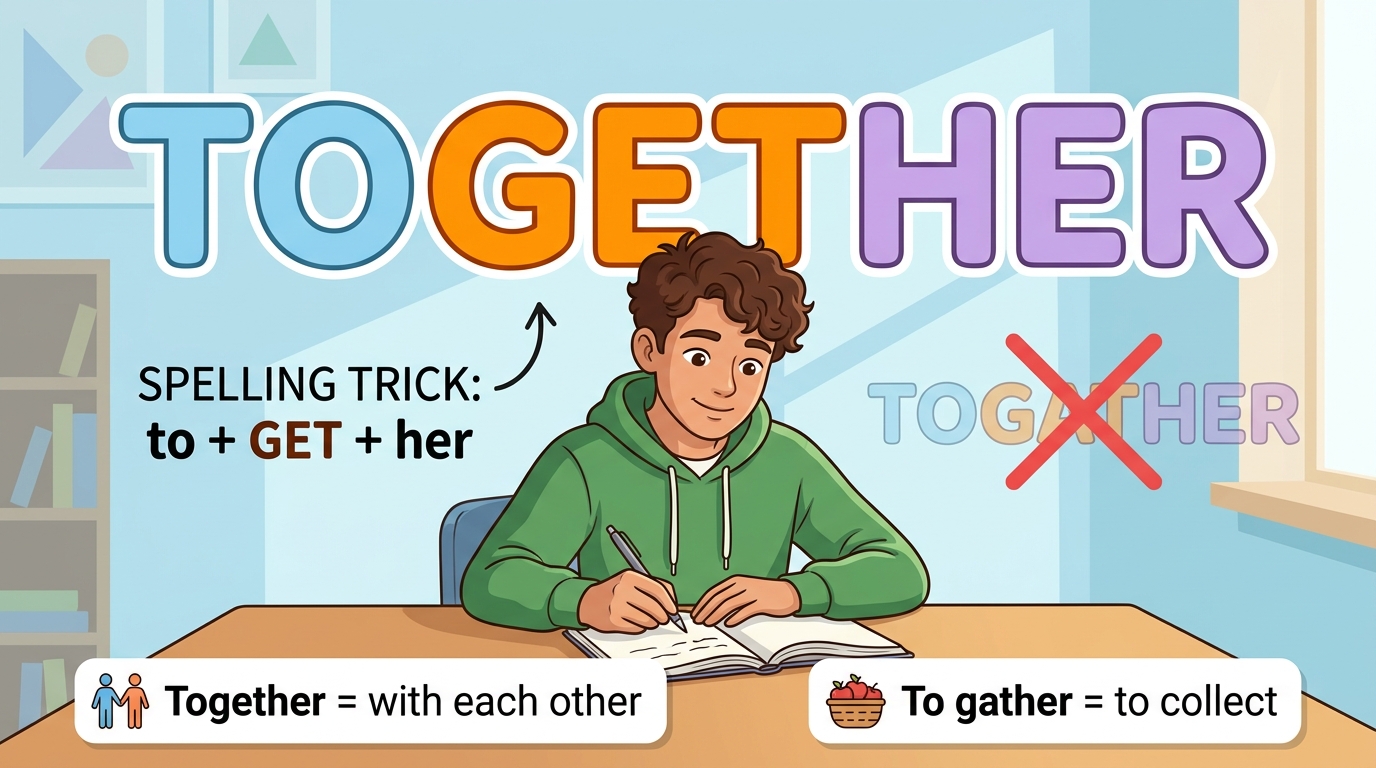
If you GET together, remember the “GET” in toGETHer.
Look at the spelling:
TO + GETH + ER
The key is the e after g:
together
Do not change it to:
❌ togather
Another useful mental comparison is:
Together = with each other
To gather = to collect or assemble
So:
We went together.
but:
We went to gather information.
The two forms may look similar when you write them quickly, but their grammatical jobs are different.
Common Questions About “Togather” and “Together”
Is “togather” a correct English word?
No. When someone writes togather intending the standard word together, it is a spelling error. The standard spelling is together.
Is “together” one word or two?
Together is one word. Do not normally split it into to gether.
Is “to gather” correct?
Yes. To gather is a correct two-word verb phrase when gather means to collect or assemble.
We need to gather more information.
What is the difference between together and to gather?
Together usually means with each other, jointly, or combined. To gather means to collect or assemble.
Why do people spell together as togather?
The mistake can arise because together sounds similar to some learners’ understanding of to + gather, and because gather is a familiar English word with a related meaning.
Can I use “togather” in texting?
If you mean together, use together even in casual texting. Casual writing may contain typos, but togather is not the standard spelling.
Is “together” used in both American and British English?
Yes. Together is the standard spelling in both American and British English. Pronunciation may vary by accent, but the spelling does not.
What does “get together” mean?
Get together commonly means to meet or spend time with someone. It can also have other meanings depending on context.
Is “get-together” one word?
As a noun for an informal gathering, get-together is normally hyphenated.
We had a family get-together.
As a verb phrase, it is written:
Let’s get together.
What is the difference between together and altogether?
Together generally expresses being with others, joining, or acting jointly. Altogether commonly means completely or in total.
What is the easiest trick for spelling together?
Remember toGETHer. The word contains geth, not gath.
Quick Summary
Together is the correct spelling when you mean with each other, jointly, in the same place, at the same time, or combined. Togather is a misspelling, not an alternative form of together. The main source of confusion is the valid phrase to gather, where gather means to collect or assemble. Compare “We worked together” with “We need to gather the documents.” There is no American/British spelling difference: both use together. Remember the spelling with toGETHer, and check whether your sentence means “with each other” or “collect/assemble.” That simple meaning test will prevent most togather vs. together mistakes.
FAQ
Which is correct: togather or together?
Together is correct. Togather is a misspelling.
Can “togather” ever replace “together”?
No, not when you are writing standard modern English and mean together.
Should “together” always be written as one word?
Yes, when you are using the standard word together, it is written as one word.
When should I write “to gather”?
Use to gather when gather is a verb meaning to collect or assemble.
We need to gather more evidence.
Is “gather together” grammatically possible?
Yes. Gather together can be used when the meaning involves assembling people or things into one group. However, context determines whether gather, gather together, or together is the most natural choice.
Is “all together” different from “altogether”?
Yes. All together means everyone or everything is together, while altogether commonly means completely or in total.
Is “together” an adverb?
Usually, yes. Major dictionaries list together primarily as an adverb, although it also has an informal adjective use.
Can “together” describe things as well as people?
Yes. You can use it for people, objects, ideas, ingredients, parts, and other things that are joined, combined, or considered collectively.
Is “get together” formal English?
It is standard English, but it often has a conversational or informal feel when it means meeting socially. In formal contexts, meet may sometimes be a more direct choice.
Is “together” difficult to spell?
The spelling is straightforward once you distinguish it from gather. The memory aid toGETHer can help.
What is the biggest mistake to avoid?
Do not write togather when you mean together. Also avoid joining to gather into one word.