
Advice vs Advise: Difference, Meaning, Usage & Examples
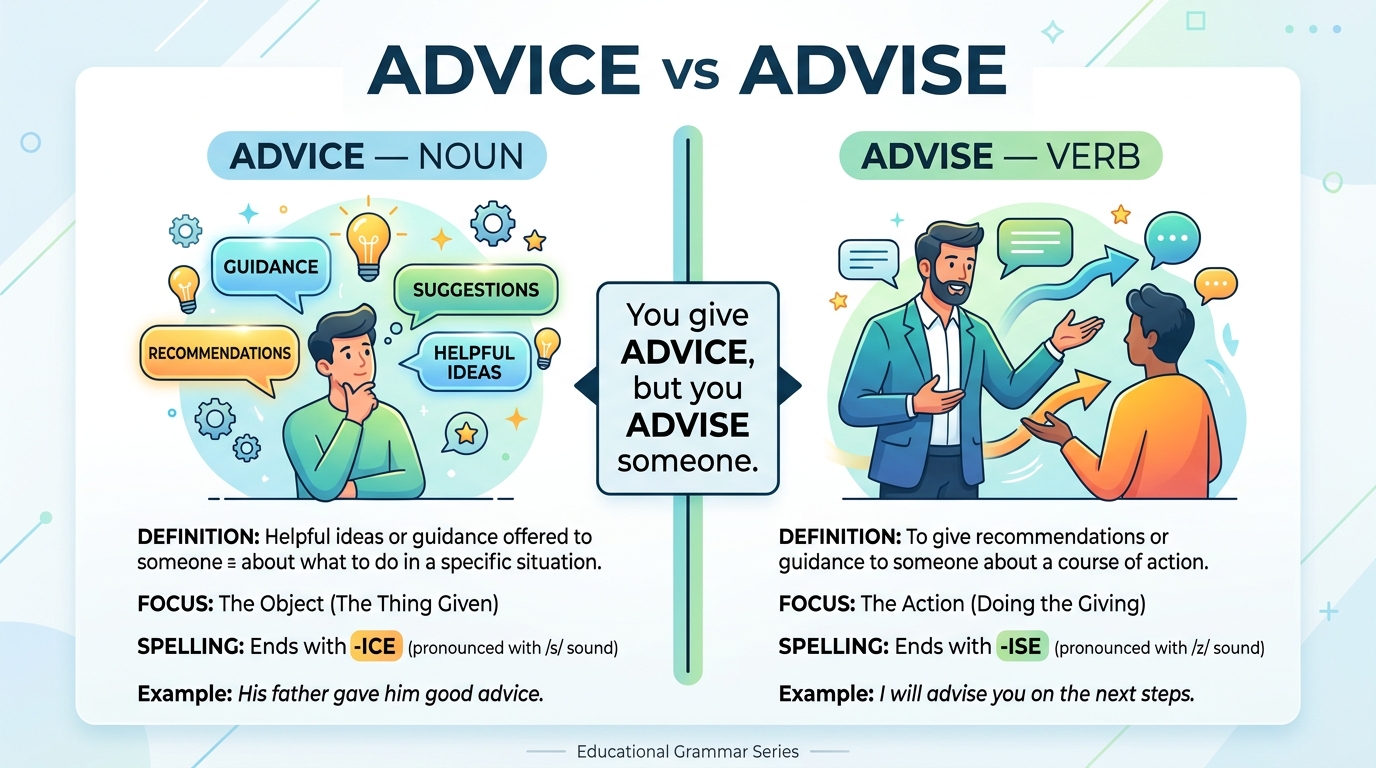
Advice and advise are closely related English words, but they do not have the same grammatical job. Advice is a noun meaning guidance, a recommendation, or a suggestion, while advise is a verb meaning to give guidance or recommend an action. For example, you can give someone advice, but you advise someone. The spelling differs by one letter, and the final sound differs too: advice ends with an /s/ sound, while advise ends with a /z/ sound.
What Advice vs Advise Means
The difference between advice and advise becomes much easier when you first identify what the word is doing in the sentence.
Advice is a noun. It refers to the guidance, recommendation, or suggestion itself.
- I need some advice.
- Her advice was helpful.
- He gave me useful advice about my interview.
Advise is a verb. It describes the action of giving guidance, recommending something, or telling someone what may be appropriate.
- I advise you to arrive early.
- The teacher advised me to revise my essay.
- My manager advised us to check the report again.
A simple way to see the relationship is:
You give advice. You advise someone.
The two words are related in meaning, but they cannot simply replace one another because they have different grammatical roles.
The Main Difference
The central difference is noun versus verb.
| Word | Part of speech | Basic meaning |
|---|---|---|
| Advice | Noun | Guidance or recommendation |
| Advise | Verb | To give guidance or make a recommendation |
Consider these two sentences:
I asked my teacher for advice.
Here, advice is the thing the speaker asked for.
My teacher advised me to practice more.
Here, advised describes what the teacher did.
The meanings are closely connected. In fact, one useful way to understand the pair is:
Advice = the guidance
Advise = the action of giving the guidance
This is why sentences such as “Can you give me some advice?” and “Can you advise me?” can communicate a similar overall idea while using different grammatical structures
The Core Rule
The Rule in Simple English
Use advice when you are talking about the recommendation or guidance itself.
Use advise when you are talking about the action of giving that recommendation or guidance.
Compare:
- She gave me some advice.
- She advised me to wait.
Another useful pattern is:
give/get/receive/offer/provide + advice
Examples:
- give advice
- receive advice
- ask for advice
- offer advice
- provide advice
- follow advice
- seek advice
For advise, common patterns include:
advise + someone + to + verb
- The doctor advised me to rest.
- My teacher advised us to start early.
You can also use:
advise + someone + against + noun/-ing
- The lawyer advised him against signing the agreement.
- I advised my friend against driving in the storm.
And in some formal contexts:
advise + someone + of + information
- Please advise us of any changes.
- The company advised customers of the new procedure.
Why the Rule Works
English often has related noun-and-verb pairs that express the same general idea in different grammatical forms.
With this pair, advice names the guidance, while advise describes the act of giving it.
Think about this contrast:
recommendation → advice
recommend → advise
The relationship is not that the words are interchangeable. Instead, they belong to the same semantic family while performing different grammatical functions.
That grammatical distinction is the key to choosing the correct spelling.
How to Use It
Common Usage
Advice commonly appears after verbs such as give, get, receive, ask for, seek, offer, provide, follow, and take.
Examples:
- Can you give me some advice?
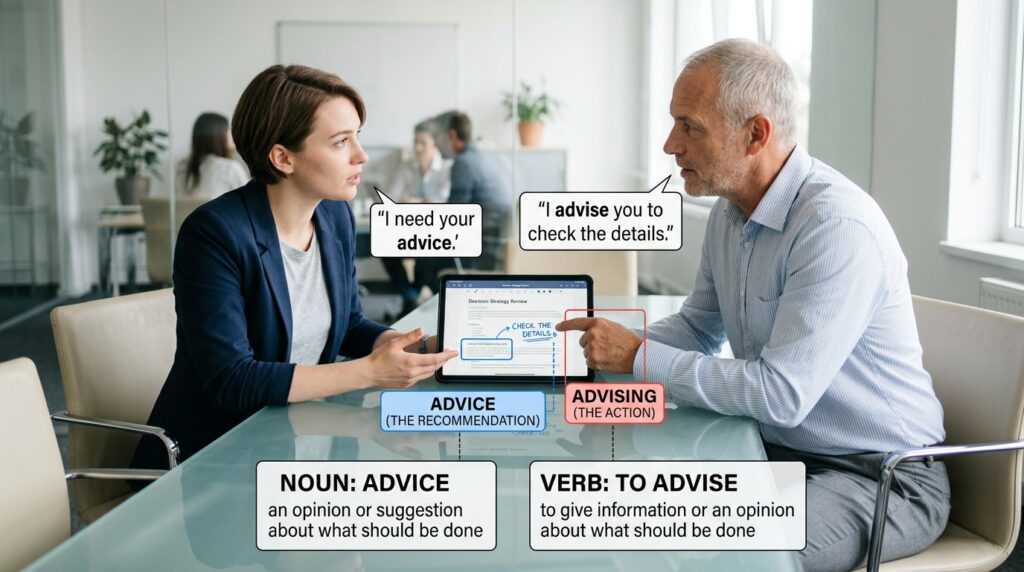
- I need your advice.
- She asked her supervisor for advice.
- We received useful advice before the interview.
- His advice helped me make a decision.
- They followed the doctor’s advice.
Advise commonly appears when someone is actively giving guidance.
Examples:
- I advise you to check the details.
- The instructor advised us to arrive early.
- The lawyer advised her against signing the contract.
- The manager advised employees of the schedule change.
Notice the difference:
She gave me advice.
The sentence focuses on the guidance.
She advised me.
The sentence focuses on the action of giving guidance.
Less Common or Special Usage
Advise can also mean to formally inform someone, especially in business, administrative, or official communication.
For example:
- Please advise us of any changes to your address.
- The airline advised passengers of the delay.
- Customers will be advised when their orders are ready.
Here, advise does not necessarily mean giving an opinion about what someone should do. It can mean inform or notify.
This is an important usage because learners sometimes assume that advise always means “give personal advice.” Its meaning can be broader in formal contexts.
SEE MORE: Requester vs Requestor: Which Spelling Is Correct?
Correct Examples
- I need some advice before I make a decision.
- My brother gave me useful advice about studying.
- She advised me to arrive before the meeting started.
- We asked our teacher for advice.
- The doctor advised him to get more rest.
- Thank you for your helpful advice.
- I would advise you to read the instructions carefully.
- Her advice saved us a lot of time.
- The manager advised the team to check the figures again.
- He decided to follow his father’s advice.
- The lawyer advised her against signing the document immediately.
- We received professional advice before starting the project.
- Can you advise me on the best way to prepare?
- She offered me some excellent advice.
- Please advise us of any changes to the schedule.
The important pattern is consistent: advice names the guidance, while advise describes giving it.
Incorrect vs Correct
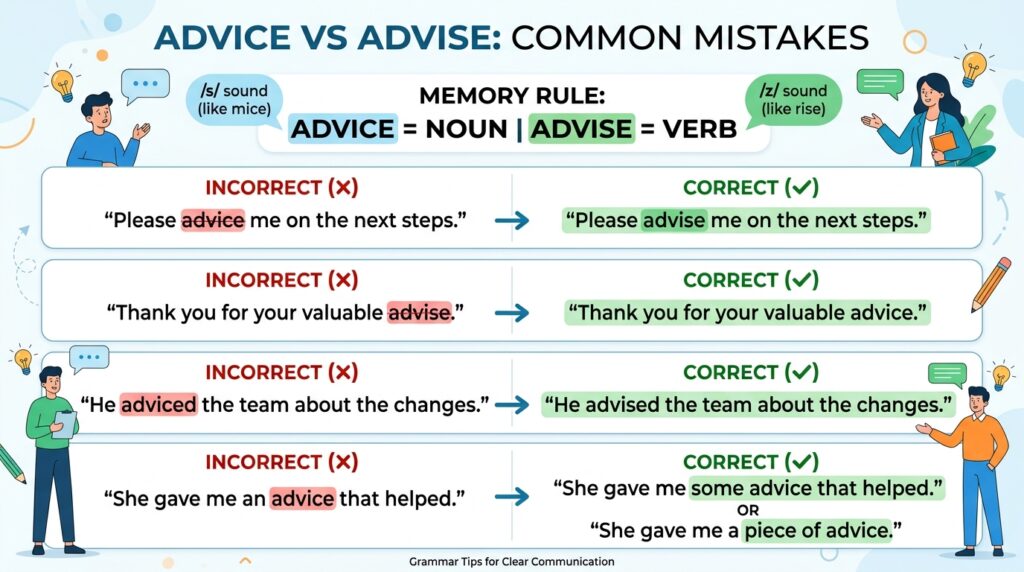
| ❌ Incorrect | ✅ Correct | Why |
|---|---|---|
| Please advice me. | Please advise me. | The sentence needs a verb. |
| I need your advise. | I need your advice. | The guidance is a noun. |
| She gave me good advise. | She gave me good advice. | “Gave” is followed by the noun. |
| I advice you to wait. | I advise you to wait. | “Advise” is the verb. |
| Thank you for your advise. | Thank you for your advice. | The word refers to guidance received. |
| The doctor advice me to rest. | The doctor advised me to rest. | A past action requires “advised.” |
| He adviced me to leave early. | He advised me to leave early. | The past form of “advise” is “advised.” |
| She gave me an advice. | She gave me some advice. | “Advice” is normally uncountable. |
| He gave me two advices. | He gave me two pieces of advice. | Use “pieces of advice” for individual recommendations. |
| My manager will advice us. | My manager will advise us. | “Will” requires the base verb. |
| I asked him for some advise. | I asked him for some advice. | “Some” can modify the uncountable noun “advice.” |
| She always advices her students. | She always advises her students. | The third-person singular verb is “advises.” |
These mistakes are especially easy to make because the words look almost identical. The most reliable solution is to identify the grammatical role before choosing the spelling.
Why People Make This Mistake
The confusion between advice and advise is understandable because the two words are closely related.
They Have Almost the Same Spelling
Only one letter changes:
advice
advise
That small visual difference is easy to overlook, particularly when writing quickly.
Their Meanings Are Closely Connected
Both words relate to guidance, recommendations, and suggestions.
If someone says:
“My teacher advised me to practice more.”
The teacher gave the student advice.
Because the concepts are so closely connected, learners may remember the meaning but forget which grammatical form is required.
The Pronunciation Is Similar but Not Identical
The final consonant changes.
advice ends with an /s/ sound.
advise ends with a /z/ sound.
So they are not pronounced exactly the same.
A useful comparison is:
- advice → sounds like ice at the end
- advise → ends with the sound heard in prize
This pronunciation difference can help with remembering the spelling, although grammar is usually the more dependable test when writing.
Learners May Treat Them as Interchangeable
A common assumption is:
“They both mean guidance, so either spelling should work.”
That is not correct.
English word choice depends not only on meaning but also on grammatical function. A noun cannot simply replace a verb because the two words have related meanings.
Common Mistakes
Mistake 1 — Writing “Please Advice Me”
This is one of the clearest examples.
❌ Please advice me.
✅ Please advise me.
The sentence asks someone to perform an action: to give guidance. Therefore, the verb advise is required.
Compare:
Please advise me about the next step.
with:
Please give me some advice about the next step.
Both are correct because the first uses a verb and the second uses a noun.
Mistake 2 — Writing “Your Advise”
❌ Thank you for your advise.
✅ Thank you for your advice.
Here, the word refers to the guidance itself. It is therefore a noun.
Mistake 3 — Writing “Adviced”
Because many English verbs form their past tense with -ed, learners sometimes write:
❌ He adviced me to wait.
The standard past tense is:
✅ He advised me to wait.
The spelling changes from advise to advised by adding -d, not by replacing the final s with c.
Other useful forms include:
- advise
- advises
- advised
- advising
Mistake 4 — Writing “An Advice”
In standard English, advice is normally an uncountable noun.
So these forms are generally not used when referring to individual recommendations:
❌ an advice
❌ two advices
Use:
✅ some advice
✅ a piece of advice
✅ two pieces of advice
✅ several pieces of advice
For example:
She gave me a piece of advice before my interview.
Mistake 5 — Confusing “Advises” and “Advice”
Look at the subject and grammatical role.
❌ My teacher advice students about study habits.
✅ My teacher advises students about study habits.
Here, advises is a present-tense verb with a third-person singular subject.
But:
My teacher gives students useful advice.
Here, advice is the noun.
Advice vs Advise in Real English
In real English, the most useful distinction is not simply “C versus S.” It is noun versus verb.
Correct and Natural
These are ordinary natural patterns:
- I need some advice.
- Can you give me some advice?
- She gave me good advice.
- He advised me to wait.
- I advise you to check the details.
- They advised us against taking the road.
Correct but Context-Dependent
Advise can also mean formally informing someone.
For example:
Please advise us of any changes.
This is especially common in professional or administrative communication.
It does not mean that advice is being used as a verb. The form remains advise because the word is functioning as a verb.
Incorrect
These forms are not standard for the intended meanings:
- Please advice me.
- Thank you for your advise.
- She adviced me to wait.
- He gave me an advice.
The easiest way to correct them is to identify whether the sentence needs a noun or a verb.
Comparison Table
| Feature | Advice | Advise |
|---|---|---|
| Part of speech | Noun | Verb |
| Basic meaning | Guidance or recommendation | Give guidance or recommend |
| Main function | Names the guidance | Describes giving guidance |
| Pronunciation ending | /s/ | /z/ |
| Common pattern | give/receive/ask for advice | advise someone to do something |
| Countability | Normally uncountable | Verb; not applicable |
| Past form | — | advised |
| Example | She gave me useful advice. | She advised me to wait. |
| Memory clue | -ice | -ise |
| Can it mean “inform”? | No | Yes, in some formal contexts |
One important point is that advice and advise are not British-versus-American alternatives. The noun/verb distinction is used in both major varieties of English.
Memory Trick
Use this simple sentence:
I give ADVICE, but I ADVISE you.
You can also connect the endings to their grammatical roles:
ADVICE = noun
ADVISE = verb
For pronunciation:
advice → /s/
advise → /z/
Another useful mental picture is:
Advice is the thing. Advise is the action.
If you are unsure, ask yourself:
“Am I naming the guidance, or am I describing the act of giving it?”
If you are naming the guidance, choose advice.
If you are describing the action, choose advise.
Real-Life Examples
At Work
Professional communication often uses both forms.
I would appreciate your advice on this proposal.
Here, the writer is asking for guidance.
Could you advise me on the next step?
Here, the writer is asking the other person to provide guidance.
Another example:
The manager advised the team to submit the report by Friday.
The verb advised describes the manager’s action.
In an Email
Both words commonly appear in emails:
Thank you for your advice regarding the project.
Here, advice is the noun.
Please advise us if the meeting time changes.
Here, advise is the verb meaning to inform.
A useful professional-writing habit is to check every occurrence of advice/advise before sending an important email.
In Conversation
Everyday conversation often uses advice:
Can I ask you for some advice?
Thanks for the advice.
That’s good advice.
But advise is also completely normal:
I’d advise you to wait.
I wouldn’t advise doing that.
The choice depends on the grammatical structure, not simply on whether the conversation is formal or informal.
At School or University
Students frequently use advice when asking teachers or instructors for guidance:
Could you give me some advice about my essay?
A teacher might respond:
I would advise you to organize your argument more clearly.
Again, the noun describes the guidance, while the verb describes the teacher’s action.
Expert Tips
- Look at the word before the blank.
If you see a structure such as “give,” “need,” “some,” “your,” or “for your,” advice is often required. - Look for an action.
If the sentence needs a verb meaning “recommend” or “give guidance,” use advise. - Remember the most useful pair:
give advice / advise someone. - Do not write “adviced.”
The correct past tense is advised. - Do not normally write “an advice.”
Say some advice or a piece of advice. - Listen for the final sound.
Advice ends with /s/, while advise ends with /z/. - Check the sentence, not just the meaning.
Both words relate to guidance, so meaning alone may not tell you which spelling is needed. - Remember that “advise” can mean “inform” in formal contexts.
For example, “Please advise us of any changes.”
Quick Summary
Advice and advise have closely related meanings, but they have different grammatical roles. Advice is a noun meaning guidance, a recommendation, or a suggestion. Advise is a verb meaning to give guidance, recommend something, or, in some formal contexts, inform someone. The simplest rule is: you give advice, but you advise someone. Advice ends with an /s/ sound, while advise ends with a /z/ sound. Also remember that advice is normally uncountable, so use some advice or a piece of advice, not “an advice.” For the past tense of advise, use advised, not “adviced.”
Frequently Asked Questions
Is advice a noun or a verb?
Advice is a noun. It refers to guidance, a recommendation, or a suggestion about what someone should do.
Example:
She gave me excellent advice.
Is advise a noun or a verb?
Advise is a verb. It means to give guidance, recommend an action, or sometimes formally inform someone.
Example:
I advise you to check the document.
What is the easiest way to remember advice vs advise?
Remember:
You give advice, but you advise someone.
“Advice” is the thing you give. “Advise” is the action of giving it.
Should I say “Please advice me” or “Please advise me”?
The correct form is:
Please advise me.
The sentence needs a verb, so advise is correct.
Is “Thank you for your advise” correct?
No. The correct sentence is:
Thank you for your advice.
The word refers to the guidance you received, so the noun advice is required.
Can I say “an advice”?
In standard English, advice is normally an uncountable noun, so an advice is not the usual form.
Use:
some advice
or:
a piece of advice
Can I say “advices”?
Normally, no, when you mean multiple recommendations. Use:
pieces of advice
For example:
She gave me three pieces of advice.
Is “adviced” correct?
No. The standard past-tense form of advise is advised.
Correct:
The teacher advised me to study more.
Do advice and advise have different pronunciations?
Yes. Advice ends with an /s/ sound, while advise ends with a /z/ sound.
The difference is small but useful as a memory aid.
Is “advise” only used for giving recommendations?
No. In formal or administrative contexts, advise can also mean inform or notify.
For example:
Please advise us of any changes.
Here, advise means to inform.
Is there a British and American difference between advice and advise?
No meaningful spelling difference exists here. Both British and American English use advice as the noun and advise as the verb.
Mini Quiz
| # | Question | Answer | Explanation |
|---|---|---|---|
| 1 | I need some ___ before I decide. (advice/advise) | advice | The sentence needs a noun for the guidance. |
| 2 | I would ___ you to check the address. (advice/advise) | advise | The sentence needs a verb. |
| 3 | She gave me useful ___. (advice/advise) | advice | “Gave me” is followed by the noun. |
| 4 | The doctor ___ him to rest. (advised/advice) | advised | The sentence describes a past action. |
| 5 | Which is correct: “an advice” or “a piece of advice”? | a piece of advice | Advice is normally uncountable. |
| 6 | Please ___ us of any changes. (advice/advise) | advise | Here “advise” means inform. |
| 7 | Which is correct: “Thank you for your advice” or “Thank you for your advise”? | Thank you for your advice. | The word is a noun referring to guidance. |
| 8 | Which is correct: “He adviced me” or “He advised me”? | He advised me. | The standard past tense is “advised.” |
| 9 | She always ___ her students to read carefully. (advice/advises) | advises | “Advises” is the present-tense verb for a third-person singular subject. |
| 10 | Complete: “You give ___, but you ___ someone.” | advice; advise | Advice is the noun; advise is the verb |