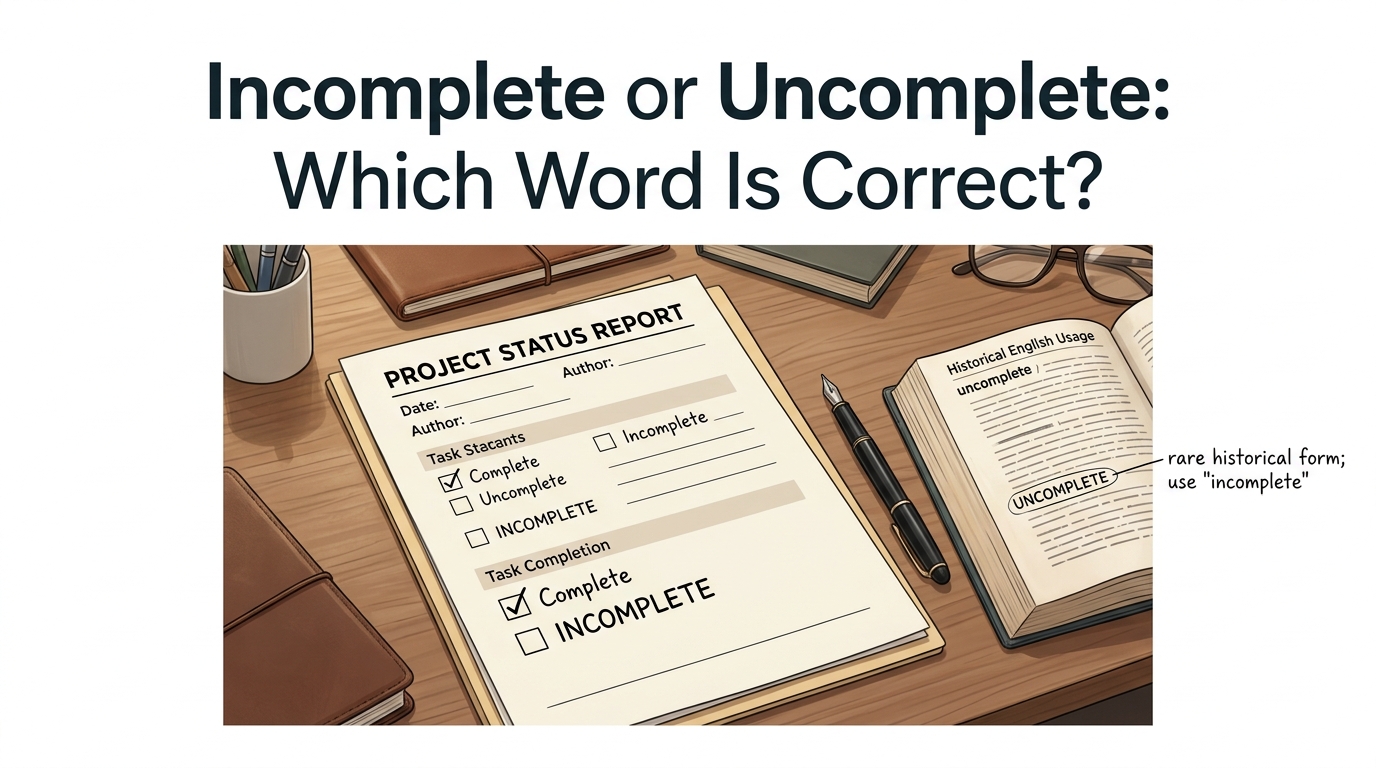
Incomplete or Uncomplete: Which Is Correct?
I researched the current search landscape for “Incomplete or Uncomplete” and checked the underlying dictionary/usage evidence before drafting. The important accuracy point is that incomplete is the established modern adjective, while uncomplete does exist in historical/dictionary records but is uncommon and is not the normal choice in contemporary English. Cambridge defines incomplete as “not having some parts, or not finished,” while historical dictionary evidence explicitly notes that incomplete is chiefly used.
Incomplete or Uncomplete: Which Word Is Correct?
If you are unsure whether to write incomplete or uncomplete, use incomplete in modern standard English. Incomplete means that something is not finished, is missing one or more parts, or is not whole. Uncomplete has appeared in older English and can still be found occasionally, but it is uncommon and is not the normal modern choice. For everyday, academic, and professional writing, incomplete is the safe and natural form.
Quick Answer
Incomplete is the standard word when you mean “not complete,” “not finished,” or “missing some parts.” For example, write “The application is incomplete,” not “The application is uncomplete.” Although uncomplete has historical dictionary evidence and occasional modern occurrences, it is rare. If you are writing an email, essay, report, application, or professional document, choose incomplete.
What Is the Difference Between Incomplete and Uncomplete?
Incomplete and uncomplete look as though they should be straightforward opposites of complete. The confusion comes from the fact that English uses both in- and un- to create negative meanings.
For example, English has:
- complete → incomplete
- happy → unhappy
- clear → unclear
- finished → unfinished
- known → unknown
- possible → impossible
- regular → irregular
Because un- is a common negative prefix, uncomplete can look perfectly logical at first sight. However, English word formation does not work like a mathematical formula in which you can attach a negative prefix to every adjective.
The established modern adjective is incomplete. It describes something that lacks a part, is not finished, or does not yet have everything required for completeness. Cambridge gives incomplete as an adjective meaning that something is missing parts or is not finished.
Uncomplete is a different case. It is not simply a meaningless invention: historical dictionaries record it, and older examples exist. Noah Webster’s 1828 dictionary, for example, defined uncomplete as “not complete; not finished; not perfect,” while specifically noting that incomplete was chiefly used.
That historical fact matters because saying “uncomplete is not a word” is too absolute. A more accurate explanation is that uncomplete is a rare or historical form, whereas incomplete is the normal standard form in contemporary English.
So, if your question is simply, “Which one should I use?” the practical answer is:
Use incomplete.
That is the form readers expect in ordinary modern English.
Why Does the Difference Matter?
Choosing the established word is especially important when your writing needs to sound clear and natural.
Imagine writing:
“Please check the form because it is uncomplete.”
The reader may understand your meaning, but the word uncomplete can make the sentence look unusual. The problem is not that the reader cannot understand the idea. The problem is that you have selected a form that is not the normal contemporary choice.
Now compare:
“Please check the form because it is incomplete.”
The second sentence uses the familiar adjective that readers normally expect.
This matters in situations such as:
- School assignments: unusual word choices can distract from your main idea.
- Business emails: established vocabulary makes communication clearer.
- Job applications: standard word choice helps your writing look polished.
- Academic writing: precise vocabulary is particularly important.
- Reports: readers need to understand whether information or work is missing.
- Technical documents: a familiar term reduces unnecessary ambiguity.
- Everyday messages: natural wording makes communication easier.
There is another useful distinction here. Incomplete does not always mean that something has simply stopped halfway through an action. It can also mean that something lacks information or parts.
For example:
“The report is incomplete.”
This could mean that the report has not been finished, or that important information is missing.
“The information is incomplete.”
Here, the information itself is missing some necessary details.
“The set is incomplete.”
This means one or more expected items are missing.
So incomplete is flexible enough to describe unfinished work, missing information, partial sets, incomplete explanations, incomplete records, and many other situations.
The Core Rule
When you mean “not complete,” “not finished,” or “missing some necessary parts,” use incomplete.
The easiest pattern to remember is:
complete → incomplete
Examples:
- The form is complete.
- The form is incomplete.
- The report is complete.
- The report is incomplete.
- The project is complete.
- The project is incomplete.
Do not assume that complete → uncomplete simply because un- often creates opposites.
English has many different ways to form negative words, and established vocabulary matters more than trying to build a new word from a general prefix rule.
How to Use Incomplete Correctly
Use incomplete when something lacks a required part, has not reached completion, or does not contain all the information needed to be considered complete.
When something is missing
The application is incomplete because two sections are blank.
The application exists, but it lacks required information.
When work is unfinished
The construction project is still incomplete.
The project has not reached its finished state.
When information is missing
The report is based on incomplete data.
The available data does not contain everything needed.
When an object lacks a part
The collection is incomplete without the final volume.
One expected item is missing.
When an explanation lacks necessary detail
His explanation was incomplete, so I asked another question.
The explanation did not provide all the information needed.
When a process has not finished
The review is incomplete because several documents still need to be checked.
The review is not yet finished.
A useful test
Ask:
“Is something necessary missing, or has the thing not reached completion?”
If the answer is yes, incomplete is often the correct choice.
Correct Examples
Here are original examples showing how incomplete works in different types of communication.
Conversation
“I can’t give you the final answer yet because my information is incomplete.”
The speaker does not have all the necessary information.
“Your application appears to be incomplete. Please provide the missing documents.”
This is appropriate professional wording.
School
“My assignment is incomplete because I still need to finish the final section.”
The assignment has not been fully completed.
Workplace
“The monthly report is incomplete because we haven’t received the sales figures from two branches.”
The missing figures prevent the report from being complete.
Academic writing
“The study provides an incomplete picture of the problem because the sample was limited.”
The research does not cover everything needed for a full picture.
Social media
“This story feels incomplete without knowing what happened next.”
The word works naturally in an informal context.
Text message
“My homework is still incomplete 😅. I’ll finish it tonight.”
The adjective is perfectly normal in casual communication.
Technical writing
“The database contains incomplete records for several customers.”
The analysis is not yet finished.
Everyday English
“The puzzle is incomplete because one piece is missing.”
The puzzle lacks one necessary component.
SEE TO READ:
Incomplete vs. Uncomplete: Incorrect vs. Correct
| ❌ Incorrect / Unusual | ✅ Correct | Why |
|---|---|---|
| The form is uncomplete. | The form is incomplete. | Incomplete is the established modern adjective. |
| My assignment is uncomplete. | My assignment is incomplete. | The assignment is not finished, so incomplete is the normal choice. |
| The report remains uncomplete. | The report remains incomplete. | Incomplete is the standard contemporary form. |
| This information is uncomplete. | This information is incomplete. | Some information is missing. |
| The application is uncomplete. | The application is incomplete. | Required information has not all been supplied. |
| The project is uncomplete. | The project is incomplete. | The project has not reached completion. |
| The sentence is uncomplete. | The sentence is incomplete. | A necessary part of the sentence is missing. |
| The collection is uncomplete. | The collection is incomplete. | The collection lacks one or more expected items. |
| Her explanation was uncomplete. | Her explanation was incomplete. | The explanation did not include enough information. |
| The record is uncomplete. | The record is incomplete. | The record does not contain all relevant information. |
| The building is uncomplete. | The building is incomplete. | The building has not been finished. |
| The analysis is uncomplete. | The analysis is incomplete. | Some necessary part of the analysis is still missing. |
The left-hand forms are marked as “incorrect” here because they are not the normal choices for contemporary standard English. That does not mean that uncomplete has never existed. Historical dictionary records show otherwise.
Why Do People Say “Uncomplete”?
The mistake is understandable because un- is one of the most familiar negative prefixes in English.
Consider:
- happy → unhappy
- clear → unclear
- fair → unfair
- finished → unfinished
- known → unknown
- certain → uncertain
A learner may therefore reason:
complete → uncomplete
That reasoning looks logical, but vocabulary is not built entirely from productive formulas.
English contains words that have developed through different historical paths. Some negative forms became established; others did not. The fact that un- works with one adjective does not guarantee that it works with another.
There is also a spelling problem. Incomplete and uncomplete have the same basic root, complete. When someone sees complete and wants its negative, uncomplete can feel like the obvious construction.
Phonetic similarity
The pronunciation of incomplete begins with an unstressed syllable, so learners who have mainly encountered the word in speech may not immediately connect the sound with its spelling.
Spelling overlap
Because both words contain complete, it is easy to focus on the prefix and overlook which complete form is actually established.
Overgeneralisation
Learners often learn a useful rule such as “add un- to make something negative.” The problem is applying a useful pattern too broadly.
Autocomplete and spellcheck
Digital tools can also create confusion. A word appearing in a search result or not being underlined by a particular system does not automatically establish that it is the normal word for formal modern English.
Translation interference
Learners whose first language forms opposites using a more predictable prefix system may naturally create uncomplete when translating the idea of “not complete.” This is a common kind of language-transfer problem: a pattern that works in one language does not necessarily work in English.
Common Mistakes Checklist
Mistake 1: Treating “un-” as a universal negative prefix
What happens: You assume that every adjective can take un- to mean “not.”
Why: English has many familiar examples such as unhappy and unfinished.
How to avoid it: Learn established word pairs individually. Use incomplete, not uncomplete, for ordinary modern English.
Mistake 2: Thinking “uncomplete” must be correct because “complete” is an adjective
What happens: You form the opposite mechanically.
Why: English word formation is not completely predictable.
How to avoid it: Check established usage rather than relying only on prefix logic.
Mistake 3: Confusing “incomplete” with “uncompleted”
These forms are related but should not be treated as identical constructions.
Incomplete is the established adjective:
The report is incomplete.
Uncompleted is a participial adjective formed from the verb complete:
The work remained uncompleted.
Uncompleted exists, although incomplete is often the simpler choice when you mean that something lacks completion or parts. Dictionary evidence also records uncompleted as meaning not completed or unfinished.
Mistake 4: Assuming a dictionary’s existence means equal everyday usage
A word can exist in a dictionary and still be rare, historical, technical, regional, or otherwise unusual.
That distinction is particularly important with uncomplete.
Incomplete in Real English
Grammatically correct and natural
“The application is incomplete.”
This is standard, clear, and natural modern English. A reader immediately understands that something required is missing or unfinished. Incomplete is the normal adjective for this meaning in ordinary conversation and writing. Modern dictionary evidence supports this use directly.
Grammatically possible but uncommon
“The application is uncomplete.”
The form uncomplete has historical documentation, so it is too strong to claim that the sequence has never existed in English. However, it is not the ordinary modern way to express this idea. Historical dictionary evidence specifically records uncomplete while noting that incomplete was chiefly used.
Natural everyday English
“The application is incomplete.”
This is the wording most suitable when you want your English to sound conventional and immediately familiar. It works in everyday speech, school writing, business communication, academic contexts, and professional documents. If you are deciding between the two forms without a special historical or literary reason, incomplete is the practical choice.
American vs. British English
There is no important AmE/BrE spelling distinction between incomplete and uncomplete that requires separate rules.
Incomplete is used in both American and British English.
There is, however, an additional American-English noun use worth knowing. In American educational contexts, an incomplete can refer to a temporary grade or status given when a student has not finished required coursework. Cambridge specifically identifies this noun use as American English.
For example:
“She received an incomplete for the course.”
This is different from the adjective:
“Her coursework is incomplete.”
Formal vs. Informal Usage
Incomplete works in both formal and informal English.
Formal
“The application was rejected because the documentation was incomplete.”
“The available evidence is incomplete.”
“The report remains incomplete pending further verification.”
Informal
“My homework is incomplete.”
“The story feels incomplete.”
“I haven’t finished it yet, so it’s incomplete.”
There is no need to replace incomplete with another form simply because the context is formal or informal.
Uncomplete, by contrast, should generally be avoided when you want conventional modern English. Its historical existence does not make it an equally suitable everyday alternative.
Incomplete vs. Uncomplete: Comparison Table
| Feature | Incomplete | Uncomplete |
|---|---|---|
| Word class | Adjective | Historically/rarely used as an adjective |
| Basic meaning | Not complete; missing parts; unfinished | Not complete; historical/rare usage |
| Modern standard usage | Established | Uncommon |
| Everyday English | Natural | Unusual |
| Academic writing | Appropriate | Generally avoid |
| Business writing | Appropriate | Generally avoid |
| School writing | Appropriate | Generally avoid |
| Formal documents | Appropriate | Generally avoid |
| Historical texts | Commonly encountered | May occur |
| Best choice for modern writing | Yes | No |
The key point is not that uncomplete has never been used. Rather, the two forms do not have equal status or frequency in modern English. Historical and dictionary evidence confirms that uncomplete has existed, while contemporary usage strongly favors incomplete.
Incomplete vs. Uncompleted
This is an important related distinction because uncompleted may look like the same mistake as uncomplete, but it has a different grammatical structure.
Incomplete
Incomplete is an adjective meaning that something is not complete, lacks something, or is unfinished.
The report is incomplete.
Uncompleted
Uncompleted is formed from the verb complete plus -ed and the negative prefix un-.
The uncompleted project was placed on hold.
The distinction can be useful when describing an action or process that was not completed.
Compare:
The report is incomplete.
This focuses on the report’s present state.
The report was left uncompleted.
This focuses more directly on the fact that the action of completing it did not happen.
In many ordinary situations, however, incomplete is the simpler and more natural choice.
Complete vs. Incomplete
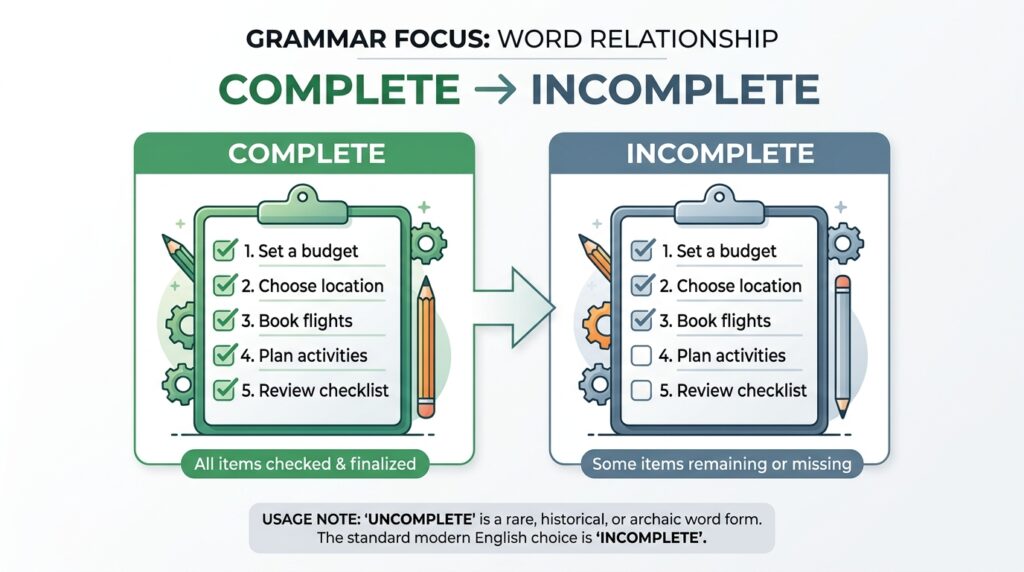
Understanding the opposite pair makes the rule easier to remember.
| Word | Meaning | Example |
|---|---|---|
| Complete | Whole, finished, or containing everything required | The application is complete. |
| Incomplete | Not whole, not finished, or missing something required | The application is incomplete. |
Complete
“The report is complete.”
Everything necessary has been included.
Incomplete
“The report is incomplete.”
Something necessary is missing, or the report has not reached its finished state.
The contrast is simple:
complete = finished/whole
incomplete = not finished/not whole
Real-Life Situations
Job interview
An interviewer asks whether you have submitted all required documents.
“Yes, my application is complete.”
If documents are missing:
“My application is incomplete. I still need to submit my certificate.”
Workplace meeting
A manager asks about a project.
“The project is still incomplete because the testing phase hasn’t finished.”
Professional email
“Please note that your application is incomplete because the signed form is missing.”
Text message
“My assignment is incomplete. I’ll send it after dinner.”
School exam
A student leaves several questions unanswered.
“My answer sheet is incomplete.”
Academic paper
“The evidence is incomplete, so further research is required.”
Online form
“The form is incomplete. Please fill in the required fields.”
Construction
“The building remains incomplete because the final stage of construction has not begun.”
These examples show why incomplete is so useful: it can describe missing information, unfinished work, absent parts, and unfinished processes.
How to Remember Incomplete
Use this simple memory rule:
Complete has “incomplete” as its established negative form.
Think:
COMPLETE → INCOMPLETE
Do not try to create the opposite automatically by adding un-.
A second memory trick is:
If something is missing, it is incomplete.
For example:
- Missing information → incomplete information
- Missing pages → incomplete document
- Missing pieces → incomplete set
- Unfinished work → incomplete work
- Missing details → incomplete explanation
This is more useful than memorizing a complicated rule about prefixes.
Quick Practice Quiz
Choose incomplete, uncomplete, or uncompleted.
- The application is ______ because two documents are missing.
- The building is still ______.
- The team submitted an ______ report.
- The artist left the painting ______.
- The form is ______, so please complete the final section.
- The project remained ______ after funding was withdrawn.
- The information provided was ______.
- The assignment is ______ because I haven’t finished the final paragraph.
Answers
- incomplete
- incomplete
- incomplete
- uncompleted can be used, though unfinished may be more natural depending on the intended meaning.
- incomplete
- uncompleted
- incomplete
- incomplete
The quiz demonstrates an important point: uncomplete and uncompleted should not be treated as interchangeable simply because they look similar. Incomplete is the normal adjective for the state of lacking completion or necessary parts, while uncompleted can describe something that has not been completed.
FAQ
Is “uncomplete” a real word?
Yes, uncomplete has historical dictionary evidence and appears in older English. However, it is uncommon in contemporary English. For normal modern writing, incomplete is the established choice.
Is “incomplete” grammatically correct?
Yes. Incomplete is a standard adjective meaning not finished, not whole, or lacking some parts.
Can I use “uncomplete” in an essay?
It is better to use incomplete in a normal modern essay. Uncomplete may be encountered in historical or unusual contexts, but it is not the conventional contemporary choice.
What is the opposite of incomplete?
The direct opposite is complete.
The report is incomplete.
The report is complete.
Is “uncompleted” correct?
Yes. Uncompleted is a valid adjective meaning not completed or unfinished. It is different from uncomplete.
Should I say “incomplete” or “unfinished”?
Both can be correct, but they are not always identical in emphasis. Incomplete can mean that something lacks parts or information, while unfinished often focuses more directly on work or an activity that has not been finished.
Can I say “the work is incomplete”?
Yes. This is completely natural English.
Can “incomplete” describe information?
Yes. For example:
“The information is incomplete.”
This means that some necessary information is missing.
Is “incomplete” used in American English?
Yes. It is standard in American English. American English also uses an incomplete as a noun for a temporary academic grade/status in some educational contexts.
Is “incomplete” used in British English?
Yes. Incomplete is also standard in British English.
Why “uncomplete ” LOOKS logical?
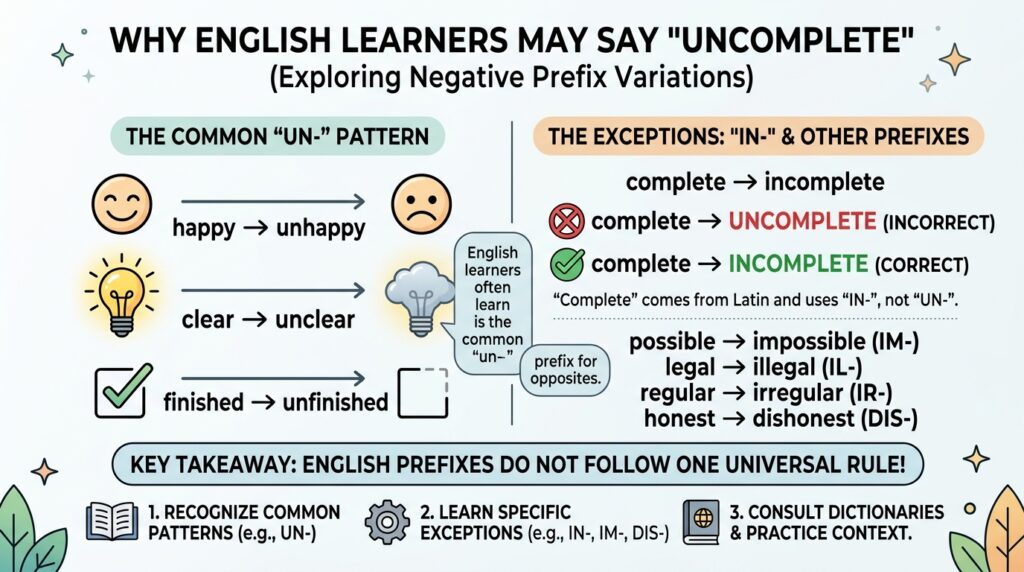
Because English frequently uses un- to create negative words, such as unhappy, unclear, and unfinished. But English does not apply that pattern to every adjective. Established vocabulary determines which forms are conventional.
What should I write instead of “uncomplete”?
In most cases, write incomplete. Depending on the exact meaning, unfinished, uncompleted, partial, or not finished may also work.
Quick Summary
Incomplete is the standard modern English word for something that is not finished, not whole, or missing one or more necessary parts. Uncomplete has historical dictionary evidence and occasional uses, but it is uncommon and is not the normal contemporary choice. Therefore, in school assignments, business emails, academic writing, professional documents, and everyday communication, use incomplete. Remember the basic pair: complete → incomplete. Also distinguish incomplete from uncompleted: incomplete describes a state of lacking completion or necessary parts, while uncompleted is a participial adjective meaning that something has not been completed. When in doubt, choose incomplete.