
Esoteric Meaning Explained Simply with Examples
The word esoteric often feels mysterious the very first time you come across it. You might see it in books, philosophy discussions, or even spiritual content and instantly wonder what it actually means. Interestingly, this word itself carries a sense of “hidden depth,” which is why it is not commonly used in everyday conversation but appears in more intellectual or specialized contexts. In simple terms, esoteric refers to something that is understood by only a small group of people who have special knowledge or interest in that subject. It is not meant for general understanding, which makes it feel exclusive, deep, and sometimes even secretive.
In today’s search trends, people often look up phrases like “what does esoteric mean in simple words” or “esoteric meaning with examples”, showing that users want both clarity and real-life usage. This article will break down everything in a natural, human-like way so you can fully understand the concept without confusion. We will also explore how the word is used in philosophy, spirituality, literature, and modern language, along with comparisons and examples that make learning easy and practical.
Meaning & Definition

Simple Definition
The word esoteric means something that is intended for or understood by only a small group of people who have special knowledge or interest.
Deeper Explanation
In deeper linguistic and semantic understanding, esoteric refers to knowledge that is not widely accessible or easily understood by the general public. It is often linked with advanced learning, hidden meanings, or specialized teachings that require background understanding. This is why it is commonly used in academic, philosophical, and spiritual discussions.
When users search “esoteric meaning in simple words”, they usually want a very clear explanation. So simply put, esoteric means hidden, specialized, or understood by a few people only. It is the opposite of something obvious or widely known.
Background
Origin of the Word
The word esoteric comes from the Greek word “esōterikos”, which means “inner” or “belonging to the inside.” This origin itself reflects the idea that the knowledge is meant for insiders only, not outsiders.
Historical Usage
Historically, esoteric knowledge was associated with ancient schools of philosophy, mystery traditions, and secret teachings. Only selected students or followers were allowed access to this knowledge. Over time, the word expanded into modern language and is now used in philosophy, religion, literature, and even everyday speech to describe anything difficult to understand or limited to experts.
Usage in Different Contexts
1. Academic & Intellectual Context
In academic language, esoteric refers to complex theories or ideas that only experts in a field can fully understand. For example, advanced mathematics or theoretical physics can be described as esoteric because they are not easily understood by the general public.
2. Everyday Language Context
In daily usage, people often use esoteric to describe anything confusing or too complex. For example, a very technical manual or complicated explanation might be called esoteric if it is hard to follow.
3. Philosophical Context
In philosophy, esoteric knowledge refers to deep truths that are believed to be understood only through higher learning or intellectual development. It often contrasts with simple, surface-level understanding.
What Does Esoteric Mean in Simple Words
In the simplest terms, esoteric means:
👉 Something that is understood by very few people
👉 Knowledge that is hidden or specialized
👉 Ideas that are not meant for general public understanding
For example, if someone explains advanced quantum theory in detail, most people would find it esoteric because it requires special knowledge to understand.
Esoteric Meaning with Examples in Sentences
Understanding becomes easier when we see it in real usage:
- The professor’s lecture on quantum physics was so esoteric that only a few students could follow it.
- Ancient spiritual texts often contain esoteric meanings hidden within symbolic language.
- His explanation of the financial model was highly esoteric and difficult for beginners.
- Some philosophers write in an esoteric style that requires deep study to understand.
These examples show how the word is used when something is not easily accessible or is intellectually complex.
Esoteric vs Exoteric Difference Explained
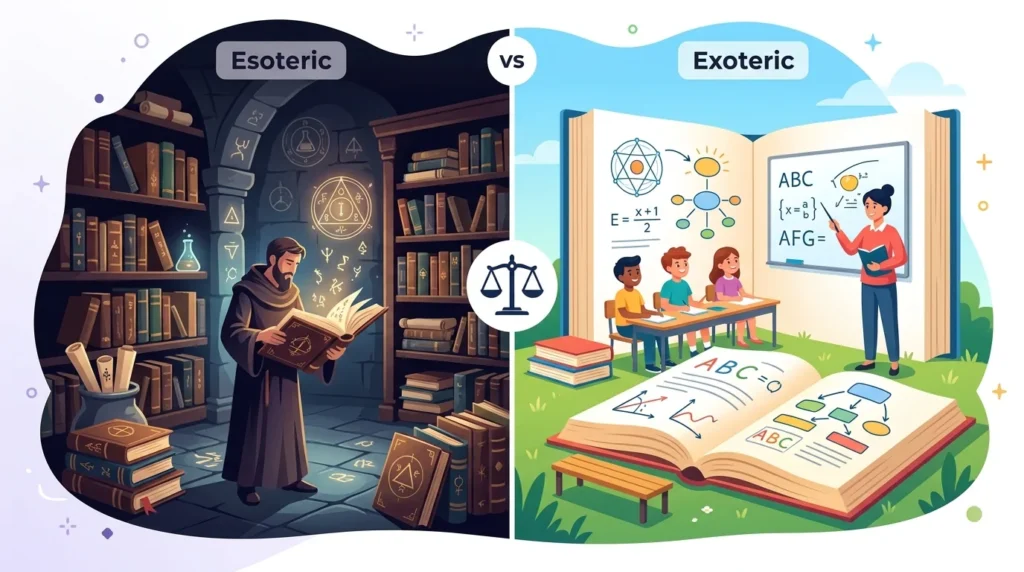
Esoteric
- Meant for a small, specialized group
- Hidden or deep knowledge
- Requires advanced understanding
Exoteric
- Meant for general public
- Easy to understand
- Open and widely accessible
👉 Simple difference:
Esoteric = inner/hidden knowledge
Exoteric = outer/open knowledge
For example, religious teachings can have both:
- Exoteric: simple moral teachings for everyone
- Esoteric: deeper symbolic meanings for advanced followers
See Also: Contingent Meaning Explained: Simple Guide & Examples
What is Esoteric Knowledge in Philosophy
In philosophy, esoteric knowledge refers to ideas that are not immediately visible or understandable. It often represents deeper truths about existence, reality, and consciousness that require intellectual effort or spiritual insight to understand.
Philosophers may use esoteric concepts to express complex ideas about life, reality, and human thought. These ideas are usually not meant for casual reading but for serious study and reflection. This is why many philosophical texts feel abstract or difficult—they contain esoteric layers of meaning.
Esoteric Meaning in Spirituality and Religion
In spiritual and religious contexts, esoteric knowledge refers to hidden or inner teachings that are only revealed to advanced followers or initiates. These teachings often include symbolic meanings, rituals, or spiritual truths that are not openly explained to everyone.
For example:
- In some traditions, sacred texts have both surface meanings and deeper esoteric interpretations.
- Spiritual practices may involve hidden meanings understood only through experience or guidance.
This makes esoteric knowledge an important concept in understanding spiritual depth and mystical traditions.
Is Esoteric a Positive or Negative Word
The word esoteric is neutral, but its meaning can feel either positive or negative depending on context.
Positive Meaning
- Deep knowledge
- Advanced understanding
- Intellectual richness
Negative Meaning
- Too complicated
- Hard to understand
- Excluding general audience
So, when someone says something is esoteric, they may either admire its depth or criticize its complexity.
Synonyms of Esoteric with Meanings
- Obscure – not clearly understood
- Cryptic – having hidden meaning
- Arcane – known by few people
- Abstruse – difficult to understand
- Recondite – little known or complex
- Mysterious – not easily explained
- Complex – complicated in structure or idea
These synonyms help in understanding the semantic range of the word.
How to Use Esoteric in a Sentence Correctly
To use esoteric correctly, always apply it to something that is hard to understand or limited to experts.
Examples:
- The theory is too esoteric for beginners.
- She enjoys reading esoteric philosophical texts.
- The topic became esoteric after the advanced explanation began.
Tip: Don’t use it for simple or everyday things.
Esoteric Meaning Origin Greek Word Explanation
The word comes from Ancient Greek “esōterikos”, meaning “inner” or “within.” This reflects the idea that esoteric knowledge is meant for people who are “inside” a group or circle of understanding. Over time, it entered Latin and then English, keeping its original meaning related to hidden or inner knowledge.
This origin is important because it shows that the word has always been connected to secrecy, depth, and specialized understanding.
See Also: Platonic Meaning Explained: Simple Guide & Examples
What Does Esoteric Language Mean in Literature
In literature, esoteric language refers to writing that is difficult to understand because it uses deep symbolism, complex vocabulary, or hidden meanings. Such writing is often aimed at educated readers or those familiar with the subject.
Writers may use esoteric language to:
- Add depth to storytelling
- Hide symbolic meanings
- Target a specific intellectual audience
This is why some books feel confusing at first—they often contain esoteric layers that require interpretation.
Frequently Asked Questions
What does esoteric mean in simple words?
Esoteric means something understood by only a small group of people with special knowledge.
Is esoteric a negative word?
Not always. It can be positive (deep knowledge) or negative (too complicated).
What is an example of esoteric knowledge?
Advanced scientific theories or spiritual teachings that only experts understand.
What is the opposite of esoteric?
The opposite is exoteric, meaning open and easy to understand.
Where is esoteric used most?
It is commonly used in philosophy, spirituality, literature, and academic discussions.
Conclusion
Understanding the meaning of esoteric becomes much easier when we break it down into simple ideas, real examples, and different contexts. In essence, esoteric refers to knowledge, language, or concepts that are intended for a limited group of people who have special understanding or deeper insight. Whether it appears in philosophy, spirituality, literature, or academic discussions, the core idea remains the same—something hidden, specialized, or not easily accessible to everyone.
In everyday usage, the word can describe anything complex or difficult to understand, but it also carries a sense of depth and intellectual richness. Learning words like esoteric helps improve vocabulary and makes it easier to understand advanced content in books, articles, and conversations. If you enjoy exploring meanings of such complex terms in a simple and engaging way, platforms like Punz Trend can help you discover more clear and SEO-friendly explanations of difficult words.
See Also: Cantab Meaning: Definition, CV Usage & Cambridge Guide