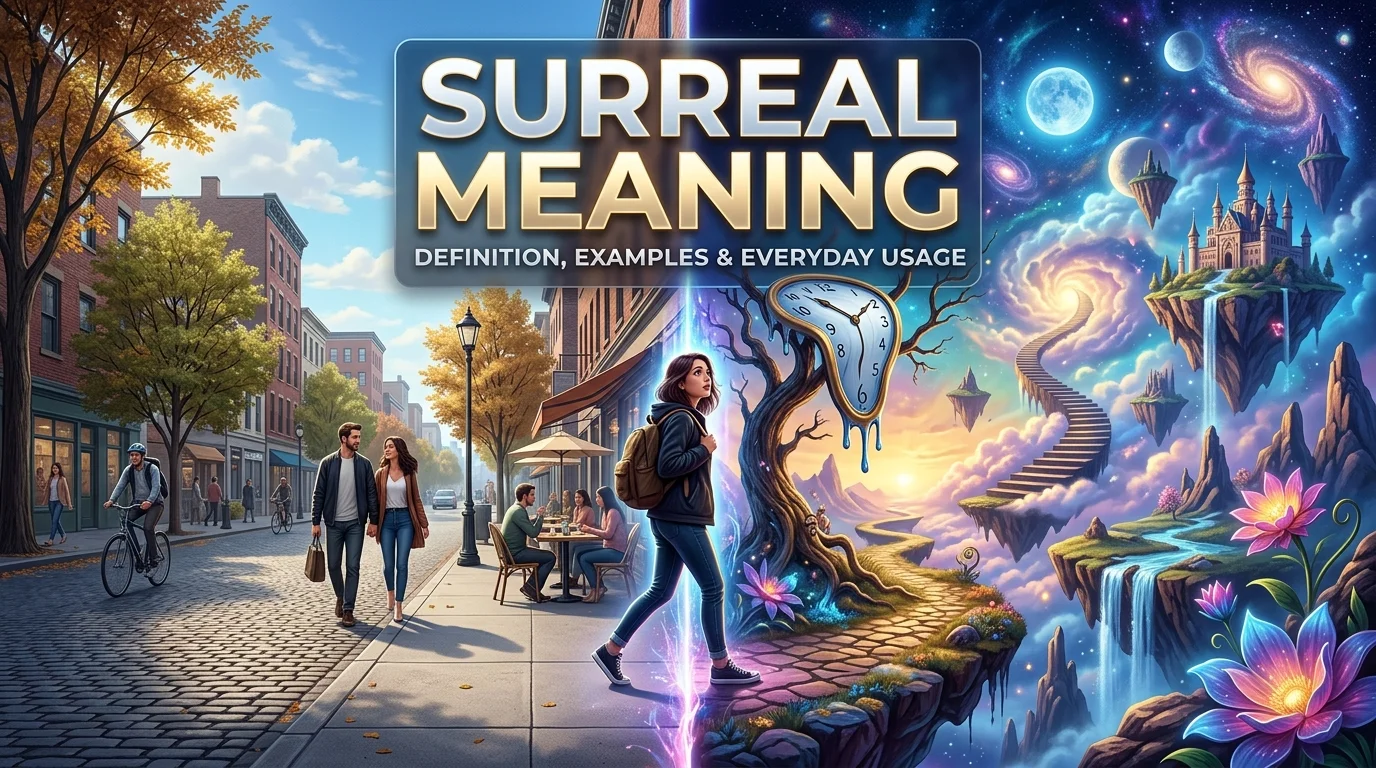
Surreal Meaning: Definition, Examples & How to Use It
Some moments in life are so unusual, emotional, or unbelievable that words like strange or unreal don’t fully describe them. That’s when people often use the word surreal. Whether it’s meeting your favorite celebrity, achieving a lifelong dream, witnessing an extraordinary event, or experiencing something that feels like a dream, the expression “it felt surreal” has become a common part of modern English. If you’ve searched for the surreal meaning, you’re probably trying to understand why this word is used in conversations, books, movies, art, psychology, and even social media. Although it’s a popular word, many English learners confuse it with terms like unreal, abstract, or bizarre, leading to incorrect usage.
This comprehensive guide explains what does surreal mean, its definition in simple English, how it is used in everyday conversations, text messages, art, psychology, dreams, and literature. You’ll also discover the difference between surreal vs unreal, understand why people say something feels surreal, and learn how to use the word naturally in sentences. Whether you’re expanding your English vocabulary, improving your writing, or simply curious about the word, this article covers every important aspect of the surreal meaning with practical examples and easy-to-understand explanations.
Meaning & Definition
The surreal meaning refers to something that feels dreamlike, strange, unbelievable, or so extraordinary that it doesn’t seem completely real. It describes experiences, situations, emotions, or images that blur the line between reality and imagination. Although something surreal may actually happen in real life, it feels so unusual that the mind struggles to process it normally.
In English, surreal is an adjective used to describe people, places, events, emotions, artwork, conversations, or experiences that appear almost like a dream. Unlike words such as fake or imaginary, surreal doesn’t necessarily mean something isn’t real. Instead, it suggests that reality feels unusually strange, magical, or difficult to believe. This is why people often say things like, “Winning the championship felt surreal,” or “Seeing snow in the desert was a surreal experience.” The emphasis is on the emotional feeling rather than whether the event actually happened.
Another important aspect of the surreal definition is its connection to imagination and perception. Something can be completely real while still feeling surreal because it is unexpected, emotionally overwhelming, or visually extraordinary. Understanding this subtle difference helps English learners use the word naturally in both spoken and written communication.
Background
To understand the surreal meaning more deeply, it’s helpful to know where the word comes from. The term surreal is closely connected to Surrealism, an influential artistic and literary movement that emerged in the early twentieth century. Artists and writers associated with this movement wanted to explore imagination, dreams, subconscious thoughts, and symbolic imagery rather than ordinary reality. Their work often featured unusual combinations of objects, impossible landscapes, and dreamlike scenes that challenged traditional ways of seeing the world.
Over time, the word surreal moved beyond the world of art and became part of everyday English. Today, people commonly use it to describe unforgettable experiences, emotional moments, surprising events, or situations that seem almost impossible despite being real. This modern usage has made the word one of the most expressive ways to describe moments that leave people amazed, shocked, or speechless. Whether discussing personal achievements, travel experiences, sporting events, or emotional life moments, surreal now represents far more than an artistic style—it captures the feeling of reality becoming almost dreamlike.
Because of its rich history, the word also appears frequently in literature, film, photography, psychology, and creative writing. Understanding this background helps explain why the surreal meaning in art, surreal meaning in psychology, and everyday conversations all share the common idea of blending reality with imagination.
Usage in Different Contexts
One reason the surreal meaning is sometimes confusing is that it changes slightly depending on the context in which it’s used. In everyday conversations, people usually describe an experience as surreal when it feels unbelievable or emotionally overwhelming. For example, someone who wins a major award, witnesses a rare natural event, or reunites with a loved one after many years may describe the moment as surreal because it feels almost like a dream. In text messages and social media, the word is often used to express amazement after unexpected events, such as “Last night was absolutely surreal.”
In art and literature, surreal refers to creative works that combine reality with fantasy, symbolism, and dreamlike imagery. In psychology, the word may describe experiences that temporarily feel disconnected from ordinary reality, especially during highly emotional or stressful situations. Even in movies and photography, directors and artists intentionally create surreal scenes using unusual lighting, impossible perspectives, or symbolic visuals to evoke wonder and curiosity. These different contexts all share one central idea: something that feels extraordinary enough to challenge a person’s normal sense of reality.
Understanding context is essential because surreal doesn’t always describe fantasy. Many surreal experiences actually happen in real life—they simply feel too incredible to believe. In the following sections, we’ll explore what does surreal mean, surreal meaning in English, surreal meaning in text, surreal meaning in simple words, surreal meaning with examples, and how to use surreal in a sentence, before diving deeper into its meaning in art, psychology, dreams, and modern communication.
What Does Surreal Mean?
If you’ve searched what does surreal mean, you’re looking for more than a dictionary definition. In everyday English, surreal describes something that feels so extraordinary, dreamlike, or unbelievable that it seems almost impossible, even if it actually happened. The word is commonly used when people experience moments that are emotionally overwhelming, visually unusual, or completely unexpected.
For example, imagine meeting your childhood hero, watching the Northern Lights for the first time, or hearing your name announced as the winner of a life-changing award. These events are real, but they may feel so incredible that your mind struggles to believe they’re happening. That’s exactly what people mean when they say, “It felt surreal.” The word captures the emotional experience of reality feeling almost like a dream.
Unlike words such as imaginary or fake, surreal doesn’t mean something is false. Instead, it describes how an event feels to the person experiencing it. This emotional dimension is what makes surreal one of the most expressive words in modern English.
Surreal Meaning in English
The surreal meaning in English is having the strange, dreamlike, or unreal quality of something that seems beyond ordinary reality. It is an adjective used to describe experiences, emotions, places, artwork, conversations, and situations that feel extraordinary or difficult to believe.
Native English speakers frequently use surreal when talking about memorable life events. Someone may describe graduating from university, becoming a parent, traveling to an iconic destination, or witnessing a historic moment as surreal because the experience feels larger than life. The word can also describe artistic works that combine realistic elements with impossible or imaginative scenes.
Examples include:
- Winning the championship felt surreal after years of hard work.
- Walking through the empty city at sunrise created a surreal atmosphere.
- The movie’s surreal visuals made every scene unforgettable.
- Seeing my favorite musician perform live was a surreal experience.
These examples show that surreal often expresses amazement, wonder, disbelief, and emotional intensity rather than fantasy alone.
Surreal Meaning in Text
The surreal meaning in text is almost identical to its everyday English meaning, but in digital conversations it usually expresses shock, excitement, or emotional disbelief. On social media, messaging apps, and online discussions, people often use the word after experiencing something unexpected or unforgettable.
For example, someone might text:
- “Last night still feels surreal.”
- “I can’t believe it happened—it was so surreal.”
- “Meeting the team in person was surreal.”
- “Watching the final live was absolutely surreal.”
In these examples, the speaker isn’t saying the event was fake. Instead, they’re expressing that it felt almost too incredible to be real. Because social media encourages people to share emotional experiences, the word surreal has become increasingly common in captions, comments, and personal stories.
When used in text messages, the word usually carries a positive tone, although it can also describe shocking or emotional situations, depending on the context.
Surreal Meaning in Simple Words
If you’re looking for the surreal meaning in simple words, the easiest explanation is:
Surreal means something feels so amazing, strange, or unbelievable that it seems like a dream.
Imagine waking up one morning to discover you’ve won an international competition, unexpectedly seeing someone you haven’t met in twenty years, or standing in front of one of the world’s most famous landmarks for the first time. Even though these events are real, they may feel unreal because they’re far beyond your normal daily experiences.
A simple way to remember the word is:
Surreal = Real but feels like a dream.
This short definition helps English learners understand why people use the word to describe extraordinary moments rather than imaginary ones.
Surreal Meaning with Examples
Learning the surreal meaning with examples makes it much easier to understand how native English speakers naturally use the word.
Here are several examples from different situations:
- Walking onto the Olympic stage felt surreal.
- The view from the mountain looked so surreal that it seemed like a painting.
- After hearing the good news, everything felt surreal for the rest of the day.
- The museum displayed surreal artwork filled with dreamlike images.
- It was surreal to see my childhood home after so many years.
- Watching the eclipse in person was a surreal experience.
- The silence after the storm created a surreal atmosphere.
- Graduating from college felt surreal because the journey happened so quickly.
- The photographer captured a surreal landscape that looked almost imaginary.
- Meeting my favorite author was one of the most surreal moments of my life.
These examples demonstrate that surreal can describe emotions, scenery, memories, achievements, artistic creations, and once-in-a-lifetime experiences.
See Also: Debauchery Meaning in English: Definition & Examples
How to Use Surreal in a Sentence
Understanding how to use surreal in a sentence helps you communicate more naturally in both spoken and written English. Since surreal is an adjective, it usually describes an experience, event, atmosphere, feeling, image, or artistic work.
Here are natural examples:
- The entire experience felt surreal from beginning to end.
- It was surreal standing on the stage in front of thousands of people.
- The forest looked surreal under the bright moonlight.
- The artist created a surreal painting inspired by dreams.
- Winning my first award was a surreal moment I’ll never forget.
- The abandoned amusement park had a surreal appearance.
- The conversation became surreal after the unexpected announcement.
- The documentary used surreal imagery to represent human emotions.
- Everything happened so quickly that the day felt surreal.
- The beautiful ice caves created a surreal landscape unlike anything I’d ever seen.
When using the word, remember that surreal is most appropriate when describing experiences or visuals that feel extraordinary, dreamlike, emotionally powerful, or beyond ordinary expectations. It is commonly used in conversations, travel stories, creative writing, journalism, reviews, literature, photography, movies, and social media because it captures a feeling that simpler words often cannot express.
Surreal Meaning in Art
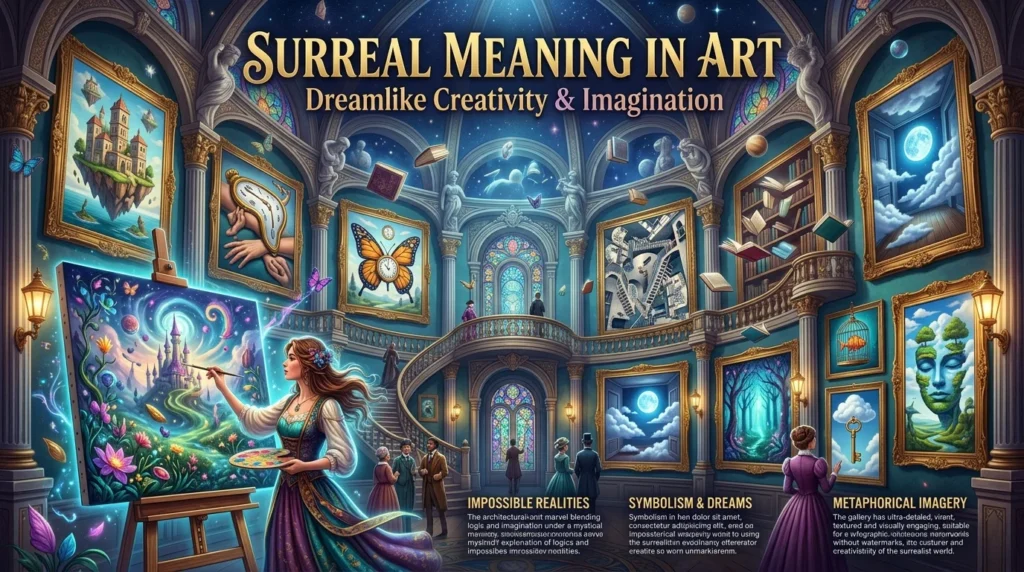
The surreal meaning in art is closely connected to the creative movement known as Surrealism, which explores the world of dreams, imagination, and the subconscious mind. Instead of showing reality exactly as it appears, surreal art combines ordinary objects with impossible or unexpected elements to create scenes that feel mysterious, symbolic, and dreamlike. A painting may feature floating buildings, melting clocks, animals in unusual places, or landscapes that couldn’t exist in real life.
Artists use surreal imagery to encourage viewers to think beyond logic and explore emotions, memories, and hidden thoughts. Rather than presenting a clear message, surreal artwork often invites personal interpretation. This is why surreal art feels fascinating—it challenges our understanding of reality while encouraging creativity and imagination. Even today, surreal styles continue to influence digital art, photography, advertising, fashion, films, and graphic design, making the word relevant far beyond traditional painting.
Surreal Meaning in Psychology
The surreal meaning in psychology relates to how people perceive reality during highly emotional, stressful, or life-changing experiences. Psychologists recognize that certain moments can feel dreamlike even though they are completely real. This sensation often occurs because the brain needs time to process unexpected events, whether they are joyful or difficult.
For example, winning a major competition, surviving an accident, becoming a parent, or hearing life-changing news can all feel surreal. During these moments, people sometimes describe feeling detached from reality or unable to believe what is happening. This doesn’t necessarily indicate a psychological problem. Instead, it is often a temporary emotional response to an extraordinary experience. Understanding this perspective explains why the word surreal frequently appears in discussions about emotions, perception, memory, and human behavior.
Surreal Meaning in Dreams
The surreal meaning in dreams refers to dream experiences that seem unusual, symbolic, impossible, or beyond the normal rules of reality. Dreams often combine familiar people, places, and events in unexpected ways, creating scenes that feel strange yet meaningful. This dreamlike quality is one reason the word surreal became associated with imagination and creativity.
People often describe dreams as surreal because they may involve flying through cities, talking animals, changing landscapes, or impossible situations that somehow feel completely natural while dreaming. Even after waking up, these dreams can remain vivid and emotionally powerful. Writers, artists, and filmmakers frequently use surreal dream sequences to represent hidden fears, hopes, memories, or subconscious thoughts, making dreams one of the strongest inspirations behind surreal creative expression.
Surreal vs Unreal Meaning
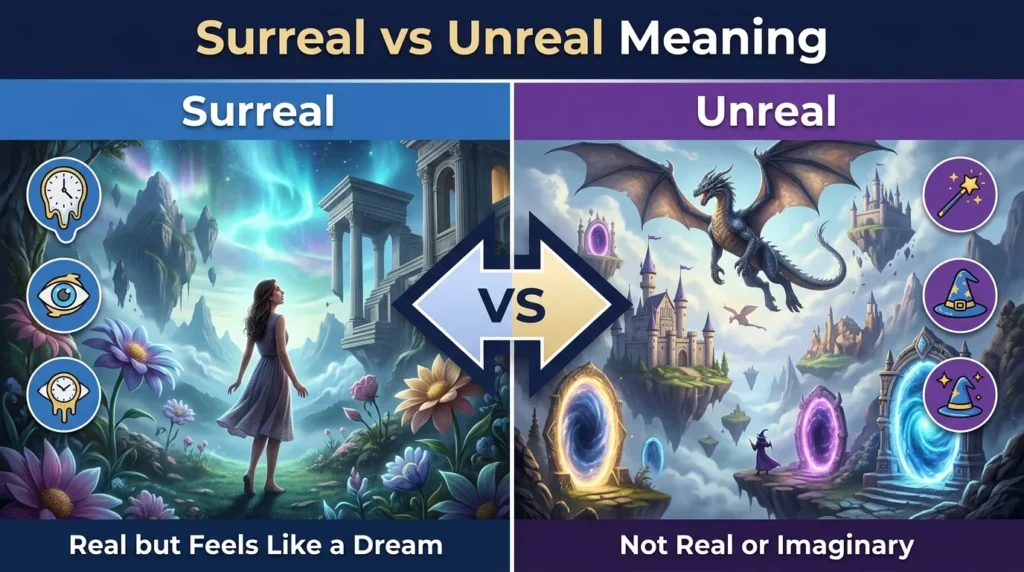
Many English learners confuse surreal vs unreal meaning, but these words describe different ideas.
Unreal usually means something is not real, imaginary, fake, or impossible. It can also be used informally to describe something amazing, but its primary meaning relates to reality itself.
Surreal, however, describes something that is real but feels so extraordinary or dreamlike that it seems unreal. The event actually happens, but the emotional experience makes it difficult to believe.
For example:
- Seeing dragons flying over a city would be unreal because dragons don’t exist.
- Meeting your favorite actor unexpectedly at a small café might feel surreal because the event is real but emotionally overwhelming.
Remember this simple distinction:
- Unreal = Not real.
- Surreal = Real, but feels like a dream.
This difference is one of the most important aspects of understanding the surreal meaning.
Surreal vs Abstract
Another common comparison is surreal vs abstract. Although both terms are frequently used in art, they describe different creative approaches.
Abstract art focuses on shapes, colors, patterns, and forms rather than realistic objects. It may not represent recognizable scenes at all.
Surreal art, on the other hand, often includes realistic objects arranged in impossible, dreamlike, or unexpected ways. The objects themselves remain recognizable, but their combinations create strange and imaginative scenes.
For example, a painting made entirely of colorful geometric shapes is abstract. A painting showing fish swimming through the sky above floating houses is surreal.
While both styles encourage creativity, surrealism emphasizes dreams, symbolism, imagination, and subconscious ideas, whereas abstraction focuses more on visual expression and artistic form.
See Also: Naive Meaning: Definition, Examples & Easy Explanation
Why Do People Say Something Feels Surreal?
One of the most searched questions is “Why do people say something feels surreal?” The answer lies in human emotion and perception.
People use the word surreal when an experience feels too incredible, emotional, or unexpected to process immediately. The brain naturally compares extraordinary experiences with ordinary life. When something exceeds those expectations, reality temporarily feels dreamlike.
Examples include:
- Graduating after years of study.
- Winning a championship.
- Becoming a parent.
- Witnessing a natural wonder.
- Reuniting with someone after decades.
- Achieving a lifelong dream.
These experiences are completely real, yet they often leave people saying, “It still feels surreal.” The expression communicates amazement, gratitude, disbelief, and emotional intensity all at once, which is why it has become so popular in modern English.
Can Something Be Surreal and Real at the Same Time?
Yes. This is one of the biggest misconceptions that many dictionary websites don’t fully explain. A situation can be completely real while still feeling surreal.
For example, imagine hearing your name announced as the winner of an international award. Nothing about the event is imaginary—it truly happened. However, because it exceeds your expectations and carries deep emotional significance, it may feel almost impossible to believe. That’s what makes the experience surreal.
The same applies to witnessing rare natural events, meeting someone you’ve admired for years, or achieving a goal you’ve worked toward for decades. The event exists in reality, but your emotional response gives it a dreamlike quality. Understanding this distinction helps you use the word much more accurately in conversations and writing.
Surreal in Movies, Photography, and Literature
The word surreal is widely used beyond everyday conversations. In movies, directors often create surreal scenes using unusual lighting, impossible perspectives, symbolic imagery, or dream sequences to represent a character’s emotions or subconscious thoughts.
Photography also embraces surreal techniques by combining realistic images with creative editing, reflections, unusual compositions, or visual illusions. These photographs appear believable at first glance but reveal impossible details upon closer inspection.
In literature, authors use surreal descriptions to blur the boundaries between dreams and reality. Readers may encounter impossible landscapes, symbolic events, or magical situations that represent deeper emotional or psychological themes. This creative use of surreal imagery encourages imagination while allowing audiences to interpret the work in their own unique way.
Common Mistakes When Using the Word “Surreal”
Many English learners misunderstand the surreal meaning, leading to common usage mistakes.
Some frequent errors include:
- Using surreal when they simply mean beautiful.
- Thinking surreal always means fake.
- Confusing surreal with abstract.
- Using surreal to describe every unusual situation.
- Assuming surreal only refers to art.
- Forgetting that surreal usually involves a strong emotional or dreamlike feeling.
The easiest way to avoid these mistakes is to remember that surreal describes real or imagined experiences that feel strangely dreamlike, extraordinary, or beyond ordinary reality.
Frequently Asked Questions
What does surreal mean?
Surreal means something that feels dreamlike, extraordinary, or so unusual that it seems almost unreal.
What is the surreal meaning in English?
In English, surreal describes experiences, emotions, or images that feel strangely unreal despite often being completely real.
What does surreal mean in text?
In text messages, surreal usually expresses amazement, disbelief, or emotional shock after an unforgettable experience.
What is the surreal meaning in simple words?
In simple words, surreal means real but feels like a dream.
What is a surreal experience?
A surreal experience is a real event that feels unbelievable, magical, or emotionally overwhelming.
How do you use surreal in a sentence?
Example: Winning the competition felt surreal after years of preparation.
What does surreal mean in art?
In art, surreal refers to dreamlike images that combine reality with imagination and symbolic elements.
What is the difference between surreal and unreal?
Unreal means not real, while surreal means something is real but feels unbelievably dreamlike.
What is the difference between surreal and abstract?
Surreal art uses recognizable objects in impossible situations, while abstract art focuses on shapes, colors, and forms rather than realistic subjects.
Why do people say something feels surreal?
People use the word because extraordinary experiences often feel difficult to believe, even when they actually happen.
Can dreams be surreal?
Yes. Dreams are often described as surreal because they combine imagination, symbolism, emotions, and impossible situations.
Is surreal a positive or negative word?
It can be either. Most often, it has a positive meaning when describing unforgettable experiences, but it can also describe strange or unsettling situations depending on the context.
Conclusion
Understanding the surreal meaning goes far beyond memorizing a dictionary definition. The word captures the unique feeling of experiencing something so extraordinary, emotional, or unexpected that reality itself seems dreamlike. Whether you’re exploring what does surreal mean, learning the surreal meaning in English, understanding the surreal meaning in psychology, or comparing surreal vs unreal and surreal vs abstract, the central idea remains the same: a surreal experience is one that blurs the line between reality and imagination in a memorable way.
Because the word appears in conversations, social media, literature, art, films, photography, and psychology, learning its correct meaning helps you communicate more naturally and confidently. By understanding its different contexts and practical examples, you’ll know exactly when to use surreal in both speaking and writing.
If you enjoy learning the meanings of English words, internet slang, idioms, modern expressions, and advanced vocabulary, Punz Trend is a great place to continue your learning journey. You’ll find detailed, easy-to-understand guides, practical examples, and well-researched explanations that make expanding your English vocabulary both simple and enjoyable.
See Also: ENM Meaning: Ethical Non Monogamy Explained Simply