MK Meaning in Text: What Does MK Mean in Chat, Social Media & Dating?
If someone sends you just “MK”, it can be surprisingly hard to tell what they mean. Is it simply “okay”? Are they annoyed? Are they ending the conversation? Or does it mean something different when it comes from a girl or a guy?
The good news is that MK meaning in text is usually simple: “okay,” “alright,” or “mm-kay.” It is a short, informal way to acknowledge what someone has said. However, the tone can change depending on the conversation, punctuation, emojis, and relationship between the people chatting. Current search results consistently treat “okay” or “mm-kay” as the primary texting meaning, while noting that context can make it sound neutral, friendly, dry, or dismissive.
Meaning & Definition
MK is a casual texting abbreviation most commonly used to mean “okay,” “alright,” “got it,” or “I understand.” It is generally an informal acknowledgment rather than a separate secret code. Someone may type “MK” because they want to reply quickly, confirm that they understood something, or move the conversation forward without writing a complete sentence.
The expression is closely related to “mm-kay” or “m’kay,” a conversational pronunciation of “okay.” In digital communication, it has been shortened even further to “MK” or “mk.” The exact tone is not fixed. A message such as “MK 😊” can feel relaxed, while “mk.” after an argument may feel much colder. Several current explanations of the term emphasize that the surrounding conversation is more useful for interpreting the tone than the letters themselves.
What Does MK Mean in Text?
MK usually means “okay,” “alright,” or “mm-kay.” It is a casual shorthand used to acknowledge a message, agree with something, show understanding, or give a short response.
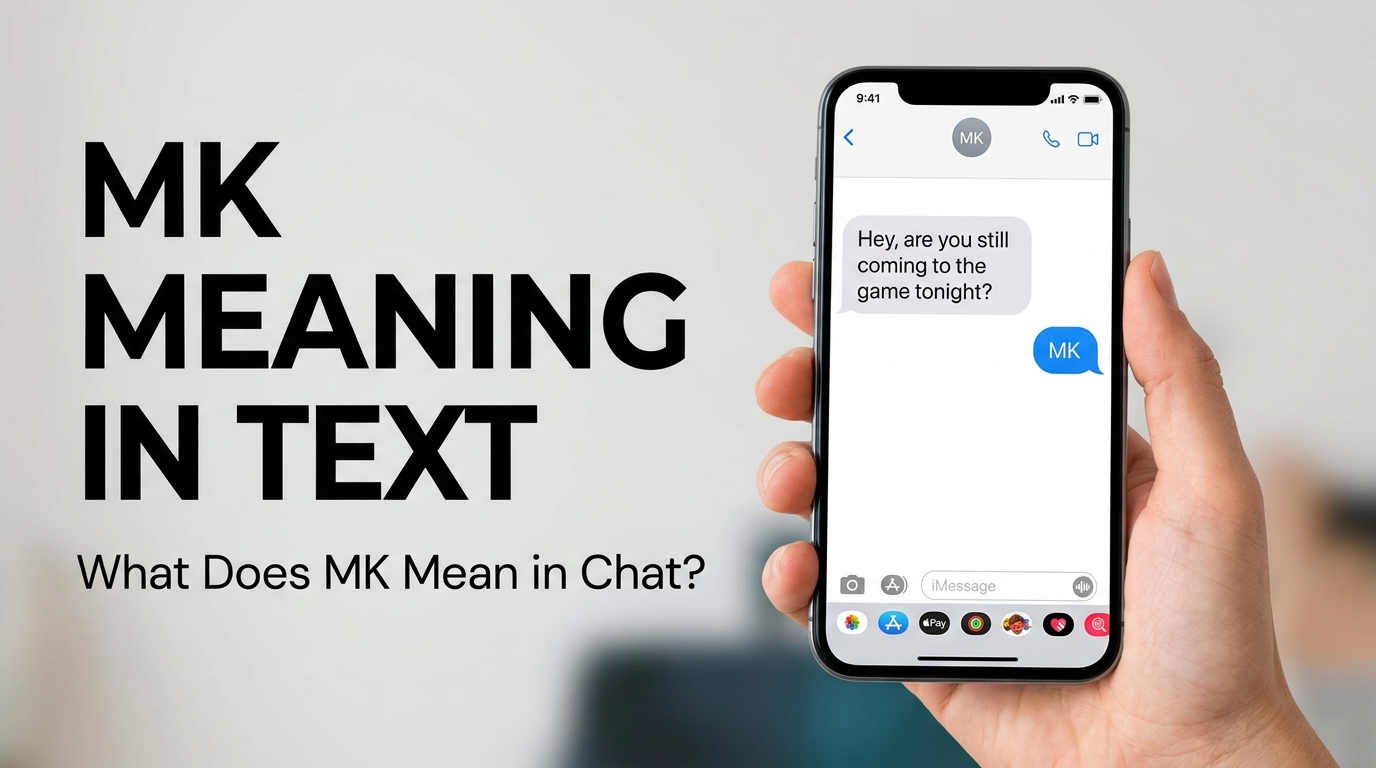
For example:
Person A: “I’ll meet you at 7 tonight.”
Person B: “MK.”
Here, MK simply means “Okay” or “Got it.”
The important point is that MK does not automatically mean someone is angry, flirting, ignoring you, or upset. Its tone depends on what was said before it, how the person normally texts, and whether they add punctuation or emojis. A single “mk” should not be treated as proof of someone’s feelings.
Background / Origin
The modern texting form MK is generally understood as a shortened version of “mm-kay,” “m’kay,” or “okay.” “M’kay” became recognizable in informal speech and popular culture before people began using shortened versions in online conversations. Some explanations specifically connect its popularity with the catchphrase “m’kay” associated with Mr. Mackey from South Park, although the broader expression also fits naturally into everyday spoken English.
As texting became faster and more informal, people began dropping unnecessary letters and using compact expressions such as “k,” “ok,” “kk,” and “mk.” MK is useful because it can sound slightly more conversational than a bare “K” while remaining shorter than “okay.” Today, it appears in ordinary text messages, DMs, social-media conversations, gaming chats, and other informal digital communication. Current search results show that many explanations now describe it as a casual acknowledgment rather than a term with one complicated hidden definition.
Usage in Different Contexts
General Usage
In everyday conversation, MK is mainly used as a quick acknowledgment. Someone might send it after receiving instructions, agreeing to a plan, understanding an explanation, or deciding not to continue a particular topic. For example, if a friend says, “Don’t forget to bring your charger tomorrow,” replying “MK” simply means “Okay, I got it.”
The expression can also be used when someone does not have much else to add. This is why its tone sometimes feels difficult to read. “MK” is short enough to end a conversation, but it does not necessarily indicate a negative emotion. If the sender normally uses short messages, there may be nothing unusual about it. Context is therefore more reliable than trying to assign a fixed emotional meaning to the abbreviation.
Formal vs. Informal Usage
MK is primarily informal. It is appropriate for friends, casual chats, DMs, gaming conversations, and relaxed social communication. It is generally better to write “Okay,” “Understood,” or “Thanks” in professional emails, applications, workplace messages, academic communication, or formal customer-service conversations.
For example, replying “MK” to your manager may sound overly casual even if you mean nothing negative by it. On the other hand, replying “MK, see you at 8” to a friend is completely normal. The difference is not the basic meaning; it is the communication setting and the relationship between the people involved.
MK Meaning on Social Media Platforms
- WhatsApp → On WhatsApp, MK normally means “okay,” “alright,” or “got it.” It can be used to confirm plans or acknowledge a message. A longer reply, emoji, or follow-up question can make the response feel warmer, while a standalone “mk.” may appear more abrupt.
- Snapchat → On Snapchat, MK is usually casual shorthand for “okay” or “mm-kay.” Because Snapchat conversations are often quick and informal, short replies are common. The meaning should be understood from the message immediately before it rather than from “MK” alone.
- TikTok → In TikTok comments, replies, or DMs, MK can function as a quick acknowledgment. Someone might use it to say “okay,” “I get it,” or “alright.” The platform does not give the abbreviation a special universal meaning; the surrounding conversation determines what the sender intends.
- Instagram → On Instagram, especially in DMs, MK usually carries the same basic meaning: “okay” or “alright.” An emoji such as “mk 😂” can make the message feel playful, whereas “mk.” may appear more serious or final. These are tone differences, not separate dictionary definitions.
Other Meanings in Different Fields
Because MK is an abbreviation, it can mean completely different things outside casual texting. Context is essential.
- Medical → In medical writing, “MK” can be used as an abbreviation for different terms depending on the specialty, institution, or document. It should not automatically be interpreted as “okay” when it appears in medical material.
- Physics → In physics and technical contexts, letter combinations such as “MK” may appear as symbols, abbreviations, or part of a named system. The exact meaning depends on the subject and notation being used.
- Technology → In technology, MK can refer to product names, model numbers, software projects, technical abbreviations, or other identifiers. Therefore, seeing “MK” in a technical document does not necessarily mean “okay.”
The key distinction is simple: in casual texting, MK usually means “okay”; in specialized fields, the surrounding subject determines its meaning.
Also Read: 280+ Taco Puns
Examples of MK in Sentences
- Example 1: “I’ll pick you up at 6:30.” → “MK 👍”
Here, the person is simply confirming that they understand the plan. - Example 2: “Please send me the assignment when you finish.” → “mk, I’ll send it tonight.”
This is a straightforward acknowledgment and does not necessarily carry any negative emotion. - Example 3: “I think we should talk about this tomorrow.” → “MK.”
Because the message is short and includes a period, it could feel more serious or final, but the context is still needed before assuming the sender is annoyed. - Example 4: “You better not forget our movie plan 😂” → “MK 😂”
The emoji makes the exchange feel more playful, showing why punctuation and surrounding messages can affect how MK is perceived.
Common Misconceptions
- Misconception 1: MK always means someone is angry.
Not necessarily. It usually means “okay” or “alright.” A cold tone is possible, but it depends on context. - Misconception 2: MK has a special meaning when a girl sends it.
There is no separate standard definition for girls. A girl can use MK for the same basic reason anyone else can: to say “okay,” acknowledge something, or respond briefly. - Misconception 3: MK always means the person wants to end the conversation.
It can sometimes function as a conversation-ending response, but that is not guaranteed. Look at what happens afterward and how the person normally communicates.
Similar Terms & Alternatives
- Okay — A direct and neutral way to show agreement or understanding.
- OK — A standard short form of “okay.”
- K — A very short acknowledgment that can sometimes sound more abrupt.
- KK — Often a casual version of “okay, okay” or “got it.”
- Mmkay — A conversational spelling closely related to MK.
- Alright — A slightly fuller alternative that can sound more natural in ordinary conversation.
- Got it — Clearly communicates understanding.
- Sure — Usually expresses agreement or willingness.
- Yep — A casual way to confirm something.
How to Respond to MK When Someone Uses It
The easiest approach is not to overthink the abbreviation. If the conversation is normal, you can respond normally. If you are unsure whether the person sounds annoyed or simply busy, look at the larger conversation instead of asking what “MK” secretly means.
- Response 1: “Okay, sounds good!” — Friendly and positive.
- Response 2: “Got it 👍” — Simple and natural.
- Response 3: “Cool, see you then.” — Useful when you are confirming a plan.
If the conversation feels tense, you can also ask a direct question rather than guessing: “Everything okay?” That gives the other person a chance to explain their tone.
Difference Between MK and Similar Terms
| Term | Usual meaning | Typical tone |
|---|---|---|
| MK | Okay / alright / mm-kay | Casual, context-dependent |
| OK | Okay | Neutral |
| K | Okay | Can feel very brief |
| KK | Okay / got it | Casual and friendly |
| Sure | Yes / agreed | Cooperative |
| Got it | I understand | Clear and direct |
| Alright | Okay / accepted | Neutral and conversational |
The biggest difference is often tone rather than meaning. “K” can feel more abrupt because it is extremely short, while “Got it” explicitly communicates understanding. “MK” sits somewhere in the middle: casual, compact, and highly dependent on context.
MK Meaning From a Girl
When a girl sends “MK,” the basic meaning is still usually “okay,” “alright,” or “mm-kay.” There is no universal female-specific definition hidden inside the abbreviation. If someone searches for “MK meaning from a girl,” they are often trying to understand the tone of a particular conversation rather than the dictionary meaning of the term.
For example, “mk 😊” may feel relaxed because of the emoji, while “mk.” after a disagreement may feel more distant. But those interpretations come from the complete interaction, not from the fact that the sender is a girl.
If you are talking to someone you like, avoid assuming that “MK” automatically means she is annoyed, losing interest, or flirting. Look at whether she continues the conversation, asks questions, uses her normal texting style, or gives additional context. The surrounding behavior provides more information than two letters.
MK Meaning From a Guy
When a guy sends “MK,” it normally means the same thing: “okay,” “alright,” or “mm-kay.” Gender does not create a separate standard meaning for the abbreviation. A guy might use it to acknowledge a plan, agree with something, show that he understands, or give a quick response.
For instance, if you write, “I’ll call you after dinner,” and he replies “MK,” the most straightforward interpretation is simply “Okay.” If the conversation has been tense and he suddenly changes from detailed messages to one-word replies, the overall change in communication may be worth noticing—but “MK” itself does not prove why the tone changed.
This is especially important in dating conversations. It is easy to read too much into short messages, but a person’s communication pattern over time is more informative than one abbreviation.
Relevance in Online Conversations & Dating Apps
MK is particularly relevant in modern online communication because texting encourages short, fast responses. On dating apps, DMs, Snapchat, WhatsApp, and other messaging services, people often communicate in fragments rather than complete sentences. “MK” fits naturally into that environment because it acknowledges the other person without requiring a longer reply.
In dating conversations, however, tone can be harder to interpret because text does not include voice, facial expression, or body language. A message such as “mk” might simply mean “okay,” while the same response after an emotional discussion could feel more distant. That does not mean the abbreviation itself has changed definition. Instead, the conversation has changed the way the response is perceived.
If you receive MK from someone you are dating, consider the full exchange. Did they continue talking? Did they ask another question? Did they use emojis? Do they normally send short replies? Did the conversation involve a disagreement? These details can help you understand the situation without automatically assigning a hidden romantic or negative meaning to the abbreviation.
Frequently Asked Questions
1. What does MK mean in texting?
MK usually means “okay,” “alright,” or “mm-kay.” It is an informal acknowledgment used in casual conversations.
2. Is MK rude in a text?
Not necessarily. It can sound neutral, friendly, or slightly dismissive depending on context, punctuation, and the relationship between the people communicating.
3. What does MK mean from a girl?
It usually means “okay,” “alright,” or “got it.” There is no separate standard meaning simply because a girl sent it.
4. What does MK mean from a guy?
It generally means “okay,” “alright,” or “mm-kay.” The tone depends on the conversation rather than the sender’s gender.
5. Is MK the same as OK?
They are usually similar in meaning, but MK can sound more conversational or casual because it is associated with “mm-kay.” The exact tone depends on how it is used.
Conclusion
MK meaning in text is usually simple: “okay,” “alright,” “got it,” or “mm-kay.” It is a casual abbreviation commonly used when someone wants to acknowledge a message quickly without typing a longer response. You may see it in ordinary text messages, WhatsApp conversations, Snapchat chats, TikTok interactions, Instagram DMs, and other informal online conversations.
The most important thing to remember is that MK does not automatically mean someone is angry, annoyed, flirting, ignoring you, or trying to end the relationship. Tone comes from the complete conversation. Punctuation, emojis, the previous message, and the person’s usual communication style can all influence how “MK” feels.
The same basic meaning applies when MK comes from a girl or a guy. Outside texting, however, MK can have specialized meanings in areas such as medicine, physics, technology, and other fields. So, whenever you see it, check the context first. In everyday chat, though, the safest starting point is simple: MK = okay.