
Enigma Meaning: Definition, Examples & Complete Guide
Have you ever met someone who feels impossible to fully understand—someone whose thoughts, actions, or personality remain slightly hidden no matter how well you know them? That sense of mystery and curiosity is exactly what the word “enigma” represents. The keyword enigma meaning is widely searched because people want to understand not just the definition of the word, but also how it is used in personality description, psychology, literature, and everyday conversation.
In simple terms, an enigma refers to something or someone that is puzzling, mysterious, or difficult to interpret. It could describe a person with complex emotions, a situation with unclear answers, or even a concept that challenges understanding. Today, in the world of SEO, AI Overview, and semantic search, understanding “enigma” in depth is important because users don’t just search for definitions—they search for real meaning, examples, and context.
If you enjoy learning clear and simple explanations of words, meanings, and concepts, you can also explore more helpful guides on Punz Trend, where complex topics are broken down into easy, human-friendly explanations designed for better understanding and learning.
Meaning & Definition
The enigma meaning in English refers to something that is mysterious, confusing, or not easily understood. It is often used for situations, ideas, or people that cannot be explained in a straightforward way.
In simple words, an enigma is something that makes you think deeply because its meaning is not clear on the surface. It can be a riddle, a confusing event, or a person whose behavior is hard to read.
When we talk about an enigma meaning in simple words, it means “a mystery that is hard to solve or understand.” This makes it a powerful word in both everyday language and literature because it expresses deep complexity in a single term.
The word is also commonly used in personality descriptions. When someone says a person is an enigma, they mean that the person is difficult to understand emotionally or mentally, often showing unpredictable or layered behavior.
Background
The origin of the word enigma comes from ancient Greek, where it meant “a riddle” or “puzzling statement.” Over time, the word entered the English language and became widely used in literature, psychology, and general communication.
One of the most important historical connections to the term is its use in cryptography and wartime communication. The famous Enigma Machine was a complex coding system used during World War II, which created messages that were extremely difficult to decode. The machine was eventually broken by mathematician Alan Turing, which became a turning point in modern computing and intelligence history.
This historical background strengthened the modern meaning of enigma as something deeply complex, hidden, or difficult to decode. Today, the word is used not just for machines or codes but also for human behavior, emotions, and abstract ideas.
Usage in Different Contexts
The word enigma is used in multiple contexts depending on meaning and intention. In everyday English, it is often used to describe a person or situation that is not easy to understand. For example, someone with unpredictable emotions or unclear intentions may be called an enigma.
In psychology, enigma is used to describe complex human behavior that cannot be easily categorized. It is linked with personality analysis and emotional depth, where individuals may show different layers of behavior depending on their environment.
In literature, the term is used to create mystery and depth in storytelling. Writers often describe characters as enigmas to keep readers curious and engaged. This adds emotional tension and psychological depth to stories.
In modern communication, especially on social media and conversations, calling someone an enigma usually means they are intriguing, mysterious, or emotionally complex. It can be both positive and neutral depending on context.
What is the Meaning of Enigma in English
In English, enigma simply means something that is difficult to understand or explain. It is used when a clear answer is not available, and the situation requires deeper thinking or interpretation.
Enigma Meaning in Simple Words
In simple words, enigma means “a mystery or puzzle that is hard to solve.” It can be a person, situation, or idea that is confusing but interesting at the same time.
What Does Enigma Mean in a Person

When someone is called an enigma, it means their personality is hard to read or understand. They may show different emotions, behave unpredictably, or keep their thoughts private. Such people often attract curiosity because others cannot easily figure them out.
See Also: Introvert Meaning: Definition, Traits & Psychology Guide
Enigma Meaning with Example Sentences
- She is an enigma; no one really knows what she is thinking.
- The situation remains an enigma even after investigation.
- His behavior is an enigma to his friends.
- The artist was always seen as an enigma in the industry.
Enigma Definition in Psychology
In psychology, enigma refers to human behavior or personality patterns that are complex, layered, or not easy to interpret. It often relates to emotional depth, hidden thoughts, and cognitive complexity. Psychologists use this concept to study why people behave differently in different situations.
Is Enigma a Positive or Negative Word?
Enigma is a neutral word. It can be positive or negative depending on context. If used positively, it means mysterious and interesting. If used negatively, it may mean confusing or unclear behavior. Most often, it is used in a neutral or slightly positive way.
What is an Enigmatic Person
An enigmatic person is someone who is difficult to understand fully. They may be quiet, private, emotionally deep, or unpredictable. These individuals often attract attention because others feel curious about their thoughts and personality.
Enigma Meaning in Literature
In literature, enigma is used to create mystery, suspense, and emotional depth. Authors use enigmatic characters to keep readers engaged and curious. These characters often have hidden motives or unexplained backgrounds.
Famous Examples of Enigma People or Characters
- Sherlock Holmes (mysterious intelligence and behavior)
- Alan Turing (historical genius with complex personality)
- Various fictional anti-heroes in literature and films
These examples show how enigma is often used to describe individuals who are intellectually or emotionally complex.
How to Use Enigma in a Sentence
- The ancient painting remains an enigma to historians.
- He is an enigma who never reveals his true feelings.
- The scientist’s discovery was an enigma for decades.
See Also: Habibi Meaning: English, Arabic, Text & Relationship Use
Difference Between Enigma and Mystery
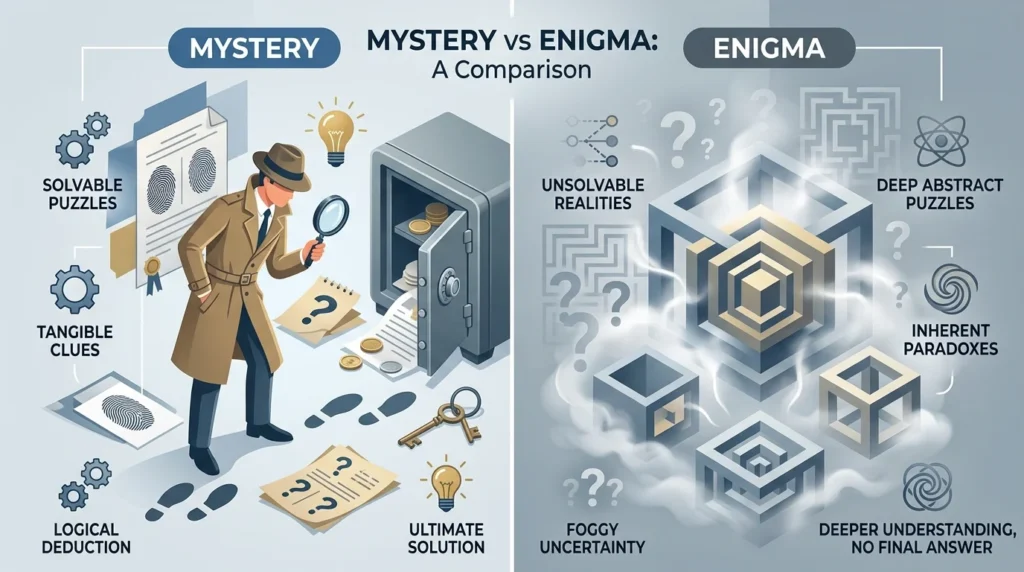
Although both words are similar, there is a slight difference. A mystery is something unknown that can often be solved, while an enigma is more complex and may remain partially or fully unexplained even after analysis. An enigma feels deeper and more intellectually challenging than a simple mystery.
Frequently Asked Questions
What does enigma mean in simple English?
It means something or someone that is difficult to understand or explain.
Is enigma used for people?
Yes, it is often used to describe mysterious or hard-to-read personalities.
What is an example of enigma?
A person whose thoughts and emotions are not easily understood can be called an enigma.
Is enigma a positive word?
It is neutral and can be positive or negative depending on context.
What is the origin of enigma?
It comes from Greek, meaning “riddle” or “puzzle.”
Conclusion
Understanding the enigma meaning helps you see how language captures mystery, complexity, and human depth in a single word. Whether used in psychology, literature, or everyday life, enigma represents something that challenges understanding and invites curiosity.
From mysterious personalities to historical code-breaking machines like the Enigma device, the word continues to hold strong relevance in modern language. It reminds us that not everything in life is meant to be simple—some things are designed to make us think deeper.
If you enjoy learning meanings, definitions, and simple explanations of complex words like this, you can explore more content on Punz Trend, where knowledge is made easy, engaging, and SEO-friendly for readers worldwide.
See Also: 111 Angel Number Meaning: Spiritual & Manifestation Guide