

Ditto Meaning in English: Definition, Uses & Examples
The English language is full of short words and expressions that make conversations quicker and more natural, and ditto is one of the most common examples. You may have seen someone reply with “ditto” in a text message, WhatsApp chat, social media comment, or everyday conversation and wondered what they actually meant. Although the word is small, its meaning often confuses English learners because it can replace an entire sentence with just a single word. Whether someone is agreeing with a compliment, sharing the same opinion, or expressing similar feelings, ditto provides a simple and friendly way to avoid repeating the same words.
If you’ve searched for the ditto meaning, this guide will help you understand every aspect of the word. You’ll learn what does ditto mean, its definition in English, how it’s used in text messages, chats, WhatsApp conversations, and relationships, as well as the difference between ditto vs same. We’ll also explain when should you use ditto, whether saying ditto is considered polite or rude, and provide plenty of real-life examples to help you use it naturally. By the end of this article, you’ll feel confident using ditto in both casual conversations and written communication.
Meaning & Definition
The ditto meaning is “the same,” “I agree,” “me too,” or “the same applies to me.” It is used to avoid repeating words that someone else has already said. Instead of saying the exact same sentence again, a person can simply reply with ditto to show that they share the same opinion, feeling, response, or statement.
In English, ditto can function as both a noun and an adverb depending on the context, but in everyday conversations it is most commonly used as an informal expression of agreement. For example, if one friend says, “I had an amazing weekend,” the other might simply respond, “Ditto!” to mean, “I had an amazing weekend too.” Likewise, if someone says, “It was nice meeting you,” replying with “Ditto” politely communicates “It was nice meeting you too.”
The beauty of the word lies in its simplicity. Rather than repeating identical information, ditto makes conversations shorter, smoother, and more natural. Because of this, it has become especially popular in text messages, social media, online chats, and informal spoken English.
Background
Understanding the ditto meaning becomes even more interesting when you explore the word’s history. The term ditto originated from the Italian word detto, which means “said” or “already mentioned.” It was originally used in bookkeeping and written records to indicate that the same information should be repeated without writing it again. Instead of copying identical words multiple times, writers simply used a ditto mark or the word ditto to save time and space.
As English evolved, the word gradually moved beyond accounting and official documents into everyday speech. People began using ditto during conversations to express agreement or indicate that they shared the same thoughts, opinions, or experiences. Today, although ditto marks are still occasionally used in tables and lists, the word is far more common in casual communication than in formal writing.
Modern technology has made ditto even more popular. It now appears regularly in text messages, WhatsApp chats, Instagram comments, online forums, and social media discussions because it provides a quick and friendly way to say “same here,” “me too,” or “I feel exactly the same.”
Usage in Different Contexts
One reason the ditto meaning can seem confusing is that its exact meaning changes slightly depending on the situation. In everyday conversations, ditto usually expresses agreement. If someone says they enjoyed a movie or had a wonderful vacation, replying with “ditto” means you had the same experience or feel the same way. This makes conversations more natural without unnecessary repetition.
In digital communication, including text messages, chats, WhatsApp, and social media, ditto is often used as a quick response to compliments, greetings, wishes, or opinions. For example, if someone texts, “Hope you have a great day,” replying with “Ditto!” means “I hope you have a great day too.” In relationships, friends may use it to express shared emotions or mutual appreciation, while in professional settings, the word is used much less frequently because more formal expressions such as “I agree,” “Likewise,” or “The same applies” are generally preferred.
Understanding the context is important because ditto doesn’t always mean exactly “same.” Sometimes it expresses agreement, sometimes it repeats a previous statement, and other times it simply acknowledges shared feelings. In the following sections, we’ll explore what does ditto mean, ditto meaning in English, ditto meaning in text, ditto meaning in chat, ditto meaning in WhatsApp, and how to use ditto in a sentence, before covering professional usage, relationship contexts, and common mistakes that many competitors overlook.
What Does Ditto Mean?
If you’ve searched what does ditto mean, the simplest answer is that ditto means “the same,” “me too,” “I agree,” or “the same applies to me.” It is a convenient way to avoid repeating words that someone has already said. Instead of saying the entire sentence again, you simply reply with ditto to show that your thoughts, feelings, or experiences are identical.
For example, if someone says, “I love traveling,” you can reply, “Ditto!” This tells the other person that you also love traveling without repeating the full sentence. Likewise, if a friend says, “It was great talking to you,” responding with “Ditto” means “It was great talking to you too.” The word saves time while keeping conversations friendly and natural.
Although ditto is informal, it is widely understood by native English speakers. It appears frequently in spoken English, digital conversations, and social media because it quickly communicates agreement or shared feelings without unnecessary repetition.
Ditto Meaning in English
The ditto meaning in English is “the same as what has just been said” or “I share the same opinion, feeling, or response.” It is commonly used in conversations when two people want to express identical thoughts without repeating the same words.
Unlike many vocabulary words, ditto isn’t used to describe an object or action. Instead, it functions as a conversational shortcut. Native English speakers often use it after compliments, greetings, opinions, or emotional statements.
For example:
- “Have a wonderful weekend!” — “Ditto!”
- “I’m excited about the concert.” — “Ditto!”
- “It was nice meeting you.” — “Ditto.”
- “I completely agree with your opinion.” — “Ditto.”
These examples show that ditto naturally replaces phrases such as “me too,” “same here,” “likewise,” or “I agree.” Because of its simplicity, the word remains popular in everyday English despite having existed for centuries.
Ditto Meaning in Text
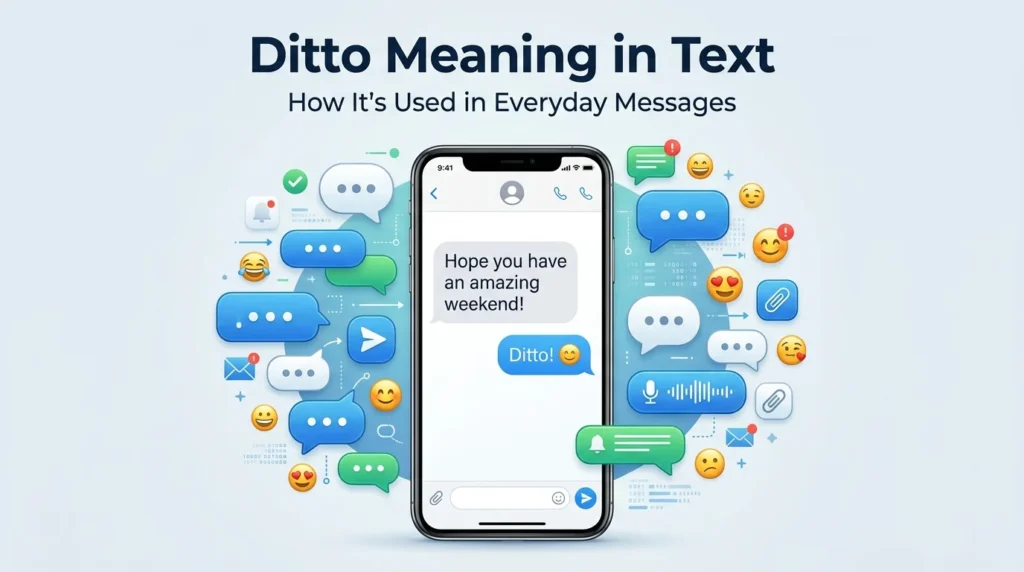
The ditto meaning in text is one of the most common reasons people search for this word. In text messages, ditto usually means “same,” “me too,” “I feel the same,” or “I agree with what you just said.” It’s commonly used to keep conversations short while still expressing agreement or shared emotions.
Here are some examples:
Friend: “I can’t wait for the weekend.”
You: “Ditto!”
Friend: “Hope you have an amazing day.”
You: “Ditto 😊”
Friend: “That movie was incredible.”
You: “Ditto!”
In texting, ditto often feels warmer and more personal than simply replying with “same.” Many people use it because it sounds friendly and conversational rather than overly formal.
Ditto Meaning in Chat
The ditto meaning in chat is very similar to its use in text messages. Whether you’re chatting on Messenger, Discord, Slack, Telegram, or another platform, ditto signals that you share the same opinion, reaction, or feeling as the previous speaker.
For example:
Person A: “I’m really looking forward to the holidays.”
Person B: “Ditto!”
Person A: “Thanks for helping today.”
Person B: “Ditto. I enjoyed working together.”
In group chats, ditto is especially useful because it prevents multiple people from repeating identical responses. Instead of typing the same sentence again, users simply write ditto, making conversations cleaner and easier to read.
Because online communication values speed and simplicity, ditto remains a popular expression across many messaging platforms.
See Also: Surreal Meaning: Definition, Examples & How to Use It
Ditto Meaning in WhatsApp
The ditto meaning in WhatsApp is exactly the same as its meaning in everyday conversations, but it has become especially popular because WhatsApp users often exchange quick replies.
Someone might send:
“Happy Birthday! Wishing you all the best.”
The receiver may respond:
“Thank you! Ditto for your upcoming birthday!”
Or:
Friend: “Good luck with your interview tomorrow!”
You: “Ditto! Hope your presentation goes well too.”
People also use ditto when responding to compliments, good wishes, congratulations, or expressions of appreciation. Since WhatsApp conversations are generally informal, ditto feels natural, friendly, and easy to understand.
Adding an emoji such as 😊, ❤️, or 👍 after ditto is also common because it makes the reply feel even warmer.
How to Use Ditto in a Sentence
Understanding how to use ditto in a sentence helps you communicate naturally in both speaking and writing. Although ditto often appears as a standalone response, it can also be included within complete sentences.
Here are several natural examples:
- “I absolutely loved the book.” — “Ditto!”
- “It was wonderful meeting your family.” — “Ditto.”
- “Everyone agreed, and my answer was ditto.”
- “She simply smiled and replied, ‘Ditto.'”
- “When he wished me good luck, I said, ‘Ditto.'”
- “My feelings are ditto.” (Less common but grammatically acceptable in informal contexts.)
- “They all shared the same opinion, so several people replied with ‘Ditto.'”
- “Instead of repeating her answer, she simply said, ‘Ditto.'”
When using ditto, remember that it works best in casual conversations, friendly emails, text messages, WhatsApp chats, and social media interactions. In formal business writing, academic papers, or professional reports, expressions like “Likewise,” “I agree,” or “The same applies” are usually more appropriate. Understanding this distinction helps you use ditto confidently while choosing the right expression for every situation.
Ditto Meaning in Relationships
The ditto meaning in relationships is usually warm, affectionate, and positive. People often use ditto to express the same feelings without repeating exactly what their partner has said. It can communicate agreement, appreciation, affection, or shared emotions in a simple and natural way. Because the word means “the same to you” or “I feel the same,” it often appears in casual conversations between couples, close friends, and family members.
For example, if one partner says, “I miss you,” replying with “Ditto ❤️” means “I miss you too.” Similarly, if someone says, “I love spending time with you,” a response of “Ditto” expresses the same feeling without repeating the sentence word for word. However, context matters. During emotional or heartfelt conversations, some people may prefer hearing the full words “I love you too” instead of simply “Ditto,” as complete expressions can sometimes feel more personal and sincere.
Is Saying Ditto Rude?
A common question is “Is saying ditto rude?” In most situations, no. Saying ditto is generally considered polite, friendly, and completely acceptable in casual conversations. It simply shows that you share the same opinion, feeling, or response as the other person. Native English speakers regularly use it among friends, family, classmates, and colleagues in informal settings.
However, there are situations where ditto may not be the best choice. In highly emotional conversations, formal business communication, or professional emails, replying only with “Ditto” can sometimes sound too brief or less thoughtful. For example, if someone writes a heartfelt thank-you message or expresses deep sympathy, responding with a full sentence usually feels more genuine than simply saying ditto.
So, the answer depends on the context:
- Casual conversations: ✅ Perfectly polite.
- Friendly chats: ✅ Common and natural.
- Professional communication: ⚠️ Better to use more formal alternatives.
- Emotional conversations: ⚠️ Full responses often feel warmer.
Ditto vs Same
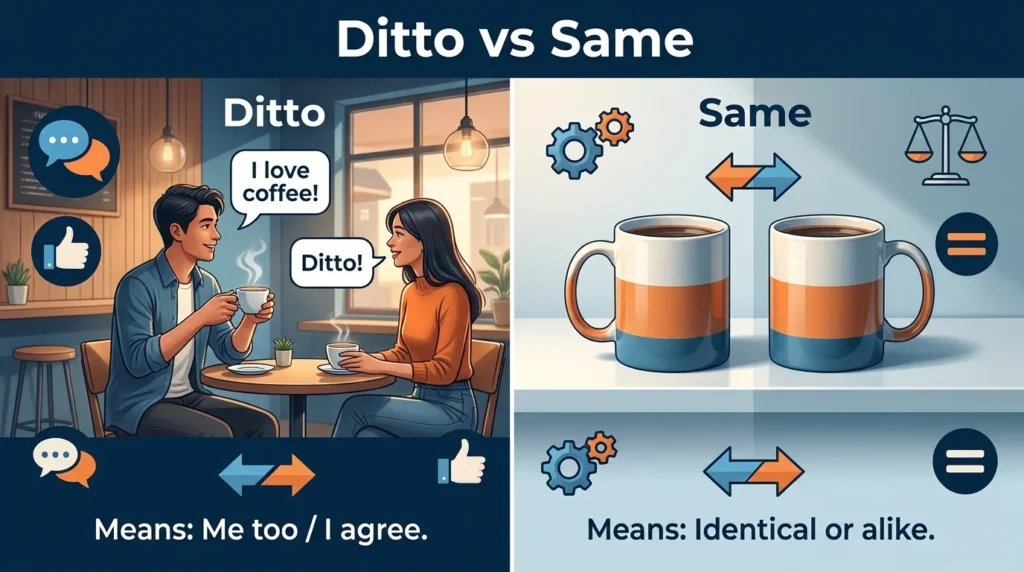
Many English learners compare ditto vs same, but they are not identical.
The word same is an adjective used to describe two or more things that are identical or alike. It can be used in many different grammatical situations.
Ditto, on the other hand, is an expression used to avoid repeating what someone has already said. It functions as a conversational shortcut rather than simply describing similarity.
For example:
- We bought the same laptop. ✅
- Ditto! (Meaning: I did too / I agree / Same here.) ✅
You cannot replace every use of same with ditto. Likewise, you cannot always replace ditto with same. The first describes similarity, while the second repeats or agrees with a previous statement.
A simple way to remember:
- Same = Identical.
- Ditto = The same applies to me.
When Should You Use Ditto?
Knowing when should you use ditto helps you sound more natural in English conversations. The word works best whenever someone has already expressed exactly what you want to say.
Appropriate situations include:
- Agreeing with someone’s opinion.
- Returning compliments.
- Responding to greetings.
- Sharing the same experience.
- Replying to good wishes.
- Expressing similar emotions.
- Casual text messages.
- Social media conversations.
- Friendly chats.
For example:
Friend: “Hope you have an amazing vacation.”
You: “Ditto!”
Instead of repeating the same sentence, ditto keeps the conversation simple while still expressing the same thought.
See Also: Debauchery Meaning in English: Definition & Examples
When Should You Avoid Using Ditto?
Although ditto is useful, there are situations where it isn’t the best choice. One area that many competitors fail to explain is when you should avoid using ditto.
Avoid using ditto in:
- Academic writing.
- Formal business reports.
- Legal documents.
- Job applications.
- Official presentations.
- Serious apologies.
- Sympathy messages.
- Sensitive emotional conversations.
For example, if someone sends a professional email thanking you for your contribution to an important project, replying only with “Ditto” may appear too casual. Instead, writing “Likewise, it was a pleasure working with you” creates a more professional impression.
Choosing the appropriate response based on the situation is an important communication skill that improves both written and spoken English.
Ditto in Professional Communication
Although ditto occasionally appears in workplace conversations, it is much less common in formal business communication.
In casual office chats, colleagues may use ditto when agreeing with an idea or expressing shared opinions. However, in professional emails, presentations, client meetings, or official documents, alternatives such as “Likewise,” “I agree,” “The same applies,” or “I share that view” sound more polished.
For example:
Informal:
“Great working with you!”
“Ditto!”
Professional:
“It was a pleasure working with you as well.”
Using the right level of formality demonstrates professionalism while maintaining clear communication.
Why People Reply with “Ditto”
Many people wonder why people reply with “ditto” instead of repeating the original sentence.
The answer is simple: it saves time while keeping conversations natural.
People choose ditto because it:
- Avoids repetition.
- Shows agreement quickly.
- Sounds friendly.
- Keeps conversations flowing.
- Expresses shared feelings.
- Works well in texting and online messaging.
This is one reason why ditto remains popular despite being an old English word. Even in today’s digital world, its meaning is immediately understood by most native speakers.
Common Mistakes When Using Ditto
Learning the ditto meaning also means avoiding common mistakes.
Some frequent errors include:
- Using ditto in highly formal writing.
- Thinking ditto only means same.
- Using ditto before anyone has made a statement.
- Confusing ditto with likewise.
- Replying with ditto during emotional conversations where a complete response is more appropriate.
- Assuming ditto can replace every sentence.
The easiest way to avoid these mistakes is to remember that ditto always refers back to something someone has already said.
Frequently Asked Questions
What does ditto mean?
Ditto means “the same,” “me too,” “I agree,” or “the same applies to me.”
What is the ditto meaning in English?
In English, ditto is used to avoid repeating a statement that someone else has already made.
What does ditto mean in text?
In text messages, ditto usually means “same here,” “me too,” or “I feel the same.”
What does ditto mean in chat?
In chats, ditto expresses agreement or shared feelings without repeating the previous message.
What does ditto mean in WhatsApp?
On WhatsApp, ditto is commonly used to return greetings, compliments, wishes, or opinions by saying “the same to you.”
How do you use ditto in a sentence?
Example: “It was wonderful meeting you.” — “Ditto!”
Is saying ditto rude?
No. In casual conversations, ditto is generally polite and friendly. However, formal or emotional situations may require a more complete response.
What is the difference between ditto and same?
Same describes similarity, while ditto repeats or agrees with a previous statement.
When should you use ditto?
Use ditto when you want to express the same opinion, feeling, greeting, or response without repeating it.
Can you use ditto in professional emails?
It’s usually better to use phrases like “Likewise,” “I agree,” or “The same applies” in professional communication.
Conclusion
Understanding the ditto meaning is more than learning a simple English word. It helps you communicate naturally, avoid unnecessary repetition, and express agreement in a friendly and efficient way. Whether you’re exploring what does ditto mean, learning the ditto meaning in English, understanding the ditto meaning in text, chat, or WhatsApp, or comparing ditto vs same, the key idea remains consistent: ditto means “the same,” “me too,” or “I agree with what you just said.”
Because the word is widely used in conversations, social media, messaging apps, and everyday English, knowing when to use it—and when to choose a more formal alternative—will improve your communication skills. By understanding its meaning, context, examples, and common mistakes, you’ll be able to use ditto confidently in both spoken and written English.
If you’re interested in learning more English vocabulary, internet slang, texting expressions, and modern language trends, Punz Trend is a great resource to explore. You’ll find detailed, easy-to-understand guides with practical examples that help you build confidence in everyday English while staying up to date with the latest expressions and meanings.
See Also: Caveat Meaning: Definition, Examples & Legal Usage