Then vs Than: Difference, Rules, Examples & Quiz
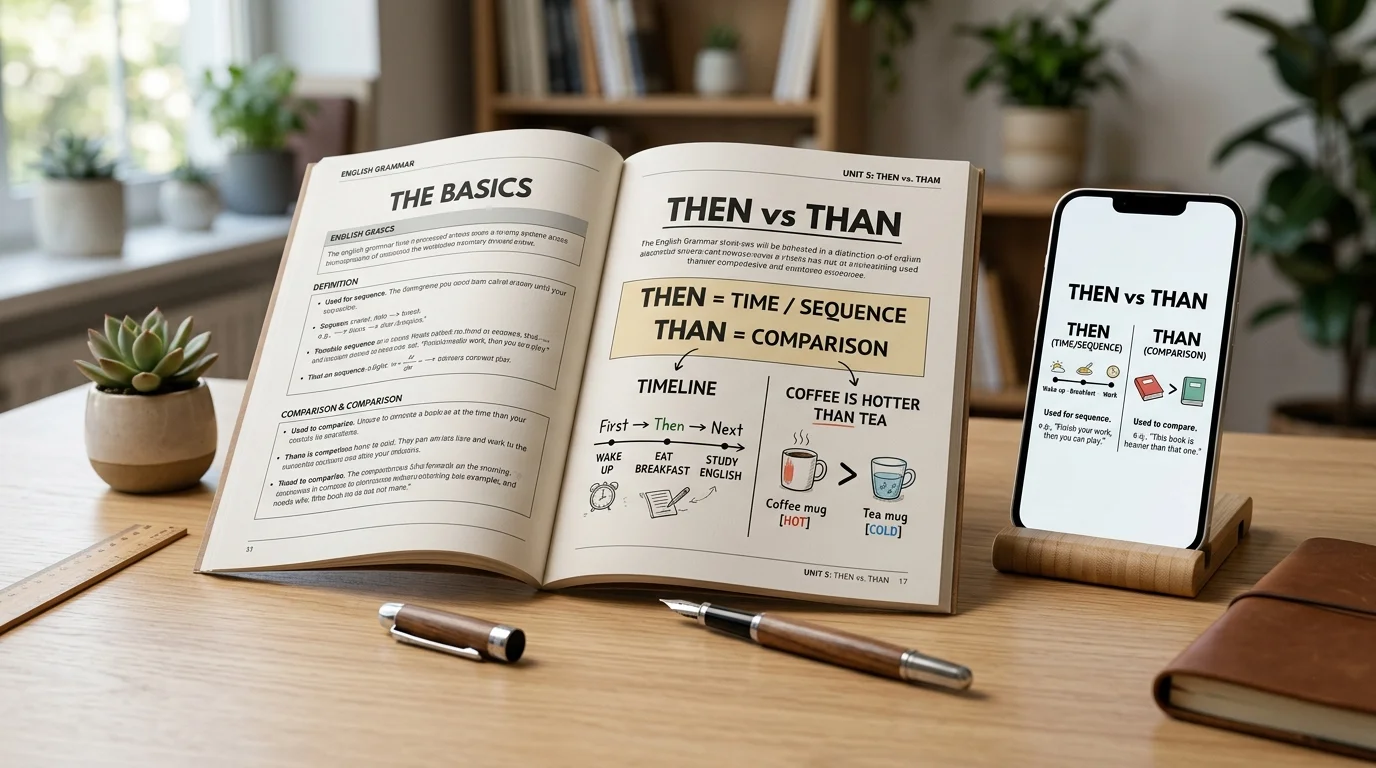
Then and than have different jobs in English. Use then when you mean a time, sequence, or result, such as “We ate dinner, then watched a movie.” Use than when comparing people, things, amounts, or ideas, such as “This book is better than that one.” The easiest rule is: then = time/order; than = comparison.
What Then vs Than Means
Then and than are two different English words that happen to look and sound very similar. The spelling difference is only one letter, but their grammatical functions are different. Understanding what each word does in a sentence is much more reliable than trying to remember the spelling by appearance alone.
Then generally relates to time, sequence, order, or a resulting situation. It can mean “at that time,” “next,” or “after that.” For example, in “I finished my homework and then went outside,” then tells us what happened next. In “I lived there back then,” it refers to a particular time in the past. It can also appear in conditional constructions: “If you are ready, then we can leave.” Here, it introduces the result of the condition.
Than, by contrast, is used primarily to make a comparison. It connects one person, object, amount, quality, action, or idea with another. You see it in expressions such as “taller than,” “more expensive than,” “less complicated than,” “better than,” and “rather than.” For example, “My new laptop is faster than my old one” compares two laptops.
The difference becomes particularly important in writing because the two words can sound close in quick speech. A person might know exactly what they mean but type the wrong spelling automatically. That is why sentences such as “She is taller then me” and “Finish this than call me” are common errors. The solution is not to memorize hundreds of examples. Instead, identify the function of the word.
Ask yourself one question: Am I talking about when something happens or what happens next? If yes, you probably need then. If you are comparing one thing with another, you probably need than.
The Main Difference
The central difference between then and than is simple:
- Then = time, sequence, order, or result
- Than = comparison
Consider these two sentences:
We finished lunch, then we went back to work.
Here, then tells us the order of two events. Lunch happened first; returning to work happened afterward.
The afternoon shift is busier than the morning shift.
Here, than connects two things being compared: the afternoon shift and the morning shift.
This distinction works across many everyday situations. If you are describing a process, then can show the next step: “Open the file, then select Print.” If you are comparing quantities, than is appropriate: “The new file is larger than the old one.”
Then can also refer directly to a time. “I was a student then” means “I was a student at that time.” Similarly, “Things were different back then” refers to an earlier period.
Than often follows comparative words. These include more, less, better, worse, bigger, smaller, faster, slower, older, younger, easier, harder, taller, shorter, earlier, later, and many others.
For example:
- This route is shorter than the other one.
- The second option is more practical than the first.
- She arrived earlier than I expected.
- This exercise is harder than it looks.
There are also expressions in which than introduces a comparison even when a traditional adjective such as “better” or “larger” is not present. “I would rather walk than wait” compares two alternatives. “More than 100 people attended” uses than in a quantity expression.
The important point is that the words should not be treated as interchangeable spellings. They represent different grammatical functions in modern standard English.
The Core Rule
The Rule in Simple English
Use then when the sentence is about time, order, what happens next, or a resulting situation.
Use than when the sentence is about comparison.
A useful shortcut is:
THEN → When? What happens next? What happened at that time?
THAN → Compared with what or whom?
For example:
- “Call me then.” → refers to a time.
- “Finish the report, then send it.” → shows sequence.
- “I was younger then.” → refers to an earlier time.
- “This report is clearer than the old one.” → comparison.
- “She runs faster than I do.” → comparison.
- “I would rather email than call.” → comparison between alternatives.
The rule is based on meaning, not on the number of words in the sentence or the position of the word.
Why the Rule Works
The two words perform different jobs in contemporary standard English. Then is primarily associated with time and sequence, while than introduces comparison. Their similar appearance can make the distinction seem harder than it actually is.
There is also a useful historical reason for the confusion: the two words have a shared history. Their modern distinction developed over time, so their resemblance is not simply accidental. However, modern English normally treats them as separate forms with different functions. For present-day writing, the practical distinction is clear: use then for time or sequence and than for comparison.
Another reason the mistake persists is pronunciation. In rapid everyday speech, unstressed words can have reduced vowel sounds, making the distinction less obvious to the ear. This means a person can understand the sentence perfectly while still choosing the wrong spelling when writing it.
How to Use It
Common Usage
Then is especially common in three situations.
1. Talking about a time
- I was living in Lahore then.
- We did not have smartphones back then.
- I didn’t understand the problem then.
In these sentences, then can often be replaced with “at that time.”
2. Showing sequence
- First, save the document, then close the program.
- She finished her coffee and then left.
- Check the address, then press Send.
Here, then can often be replaced with “next” or “after that.”
3. Showing a result in a conditional statement
- If you are finished, then you can leave.
- If the weather improves, then we will go outside.
- If that is your decision, then I will respect it.
In this use, then helps connect a condition with its consequence.
Than is most common when making comparisons.
- This phone is cheaper than that one.
- Ali is taller than his brother.
- The second plan is more detailed than the first.
- I would rather wait than rush.
It also appears with quantities:
- The meeting lasted less than an hour.
- More than 500 customers visited the store.
- She has known him for more than ten years.
Less Common or Special Usage
Then has a few uses that learners sometimes overlook. It can appear before a noun to describe someone’s former position or status:
The then manager approved the proposal.
This means the person was the manager at that time, not necessarily the manager now.
It can also appear in conversational expressions:
What do you suggest, then?
Here, then does not simply mean “next.” It can refer to the situation or conclusion being discussed.
Than also appears in established expressions such as other than, meaning “except” or “apart from”:
Everyone attended other than Sara.
It also occurs in rather than:
We decided to walk rather than take a taxi.
These uses are still connected to comparison or contrast, so they should be learned as part of the broader function of than, rather than treated as unrelated exceptions.
Correct Examples
Here are natural examples showing the different functions of then and than:
- We finished the meeting and then went for lunch.
- I was much younger then.
- First read the instructions, then start the exercise.
- If you agree, then we can move forward.
- Things were very different back then.
- This phone is lighter than my previous one.
- Sarah is more experienced than James.
- The blue route is shorter than the red route.
- I would rather work from home than commute every day.
- The new version performs better than the old version.
- We need fewer than twenty chairs.
- He arrived later than expected.
- Send me the document, then I will review it.
- This problem is easier than it first appeared.
- Finish your breakfast, then get ready for school.
- I don’t remember the details from then.
- The second proposal is less expensive than the first.
- She chose tea rather than coffee.
- If the payment arrives today, then we can ship the order.
- The final result was better than we expected.
Notice that then moves the reader through time, sequence, or consequence, while than creates a relationship of comparison.
Incorrect vs Correct
| ❌ Incorrect | ✅ Correct | Why |
|---|---|---|
| She is taller then me. | She is taller than me. | The sentence compares height. |
| Finish this than call me. | Finish this then call me. | The sentence shows sequence. |
| This option is better then the other one. | This option is better than the other one. | “Better” introduces a comparison. |
| We ate dinner, than watched TV. | We ate dinner, then watched TV. | The second event happens afterward. |
| He is older then his sister. | He is older than his sister. | Two people’s ages are compared. |
| First open the app, than sign in. | First open the app, then sign in. | The sentence gives steps in order. |
| I was happier back than. | I was happier back then. | “Back then” refers to an earlier time. |
| This costs more then I expected. | This costs more than I expected. | The cost is being compared with an expectation. |
| Call me than you arrive. | Call me when you arrive. | Neither “then” nor “than” is correct here; “when” expresses the intended time. |
| She works faster then I do. | She works faster than I do. | “Faster than” is a comparison. |
| We can discuss it than. | We can discuss it then. | “Then” refers to that later time. |
| I would rather stay then leave. | I would rather stay than leave. | “Rather than” is the correct comparison/alternative structure. |
The ninth example is especially useful because not every sentence containing a time idea should automatically use then. English has other words for time relationships, including when, while, before, and after. The goal is to identify the exact grammatical function rather than mechanically choosing between two spellings.
Why People Make This Mistake
The confusion between then and than is understandable because the words are visually and phonetically similar. They begin with the same three letters, contain only one different vowel, and are both extremely common in everyday English.
Pronunciation can make the problem worse. In careful pronunciation, the words have different vowel sounds, but fast conversational speech can reduce or blur unstressed sounds. A learner may therefore recognize the intended meaning without clearly hearing which vowel belongs in the written form.
Another problem is that both words frequently occur in short, familiar sentence patterns. Someone may type “better then” simply because their fingers produce a familiar sequence automatically. The error is not necessarily caused by a lack of understanding of the sentence.
There is also a visual-memory problem. When reading quickly, the brain often recognizes words as complete patterns rather than processing every individual letter. Because then and than have nearly identical visual shapes, they can be confused during fast writing.
Learners may also overgeneralize a simple rule. For example, after learning that then is associated with time, they might incorrectly use it in every sentence involving a time-related idea. But “She arrived earlier than expected” is a comparison, not a sequence. Likewise, “Call me when you arrive” needs when, not then or than.
The best solution is therefore to focus on the relationship between the words in the sentence. You can also learn more about common English grammar mistakes to improve your everyday writing.
Common Mistakes
Mistake 1 — Writing “better then”
One of the most recognizable errors is:
❌ This is better then that.
The correct form is:
✅ This is better than that.
The word better establishes a comparison. You are comparing two things, so than is required.
Mistake 2 — Using “than” for the next action
Consider:
❌ Finish your work, than go home.
The correct sentence is:
✅ Finish your work, then go home.
The second action comes after the first. Then means “next” or “after that.”
Mistake 3 — Confusing “back then” with “back than”
The established phrase is:
✅ People communicated differently back then.
Here, then refers to a previous time.
Mistake 4 — Forgetting that “rather than” uses “than”
The correct structure is:
I would rather read than watch television.
The phrase rather than expresses a choice or comparison between alternatives.
Mistake 5 — Assuming every time-related sentence needs “then”
This is a subtler error:
❌ Call me than you get home.
The natural sentence is:
✅ Call me when you get home.
The choice is not always between then and than. Sometimes another word is grammatically required.
Then vs Than in Real English
In real English, the distinction is usually straightforward because the two words perform different functions. The challenge is mostly in recognizing that function quickly.
Then is natural when speakers move through a timeline:
I finished work, then went home.
It is also natural when referring to a particular period:
I didn’t own a car back then.
And it can appear in conditional reasoning:
If you are ready, then let’s begin.
Than is natural whenever one item is measured, judged, preferred, or contrasted against another:
This route is safer than the other one.
She speaks more confidently than she did last year.
I’d rather wait than make a rushed decision.
There is an important distinction between correctness and naturalness. For example, “She is taller than me” is extremely common in everyday English. In formal grammatical discussion, you may also encounter “She is taller than I am.” Both can be appropriate, depending on context and style. The important point for then vs than is that than remains the comparison word in either structure.
Similarly, “If you agree, then we can continue” is grammatically correct, but in casual conversation English speakers may simply say “If you agree, we can continue.” The omission of then does not turn then into an incorrect word; it simply shows that some grammatical constructions have optional elements depending on context.
The most useful approach is therefore not to ask, “Which word sounds right?” but rather:
What job is this word performing?
If it marks time, sequence, or a consequence, then is appropriate. If it introduces a comparison, than is appropriate.
Comparison Table
| Feature | Then | Than |
|---|---|---|
| Main function | Time, sequence, order, or result | Comparison |
| Typical meaning | At that time; next; after that | Compared with |
| Common patterns | first…then; and then; back then; if…then | more than; better than; less than; rather than |
| Grammatical role | Mainly an adverb; can have other functions | Usually a conjunction or preposition |
| Used for comparisons? | No | Yes |
| Used to show sequence? | Yes | No |
| Example | Finish this, then send it. | This is easier than that. |
| Memory clue | E in then → time | A in than → comparison |
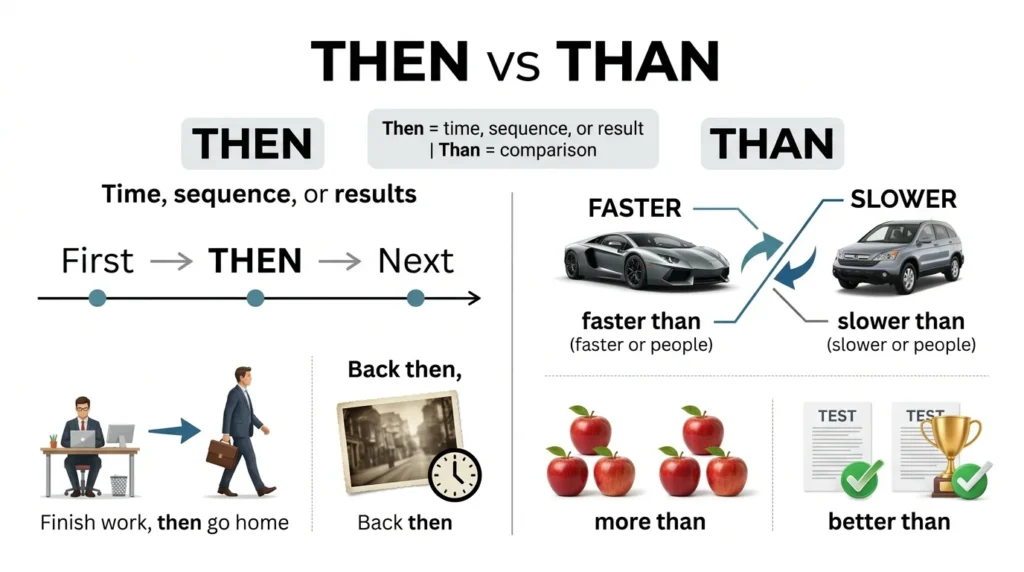
Memory Trick
Use this simple memory trick:
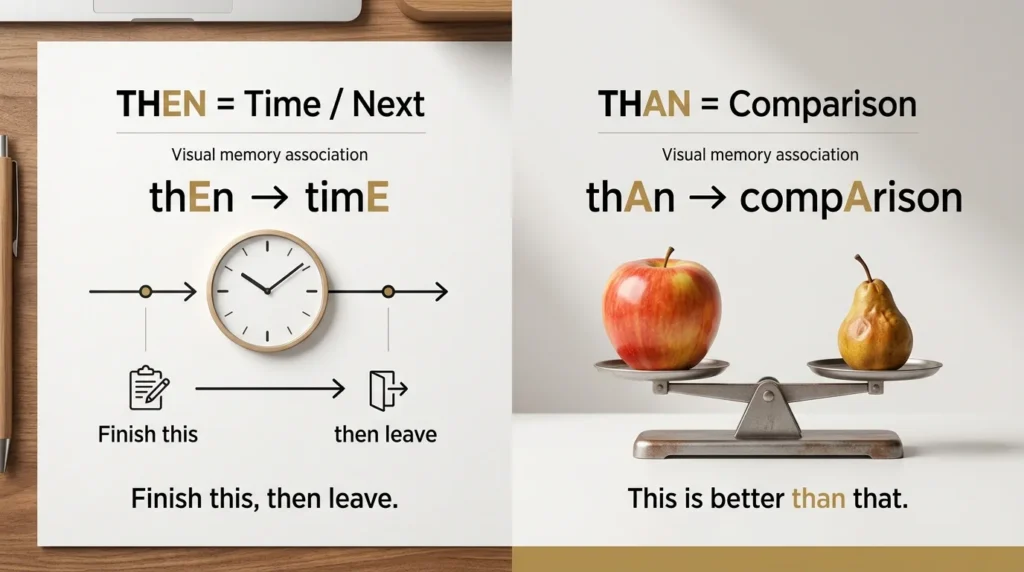
THEN = TimE
THAN = compArison
The important letters are different:
- thEn → timE
- thAn → compArison
You can also use the swap test.
If you can replace the word with “next” or “after that,” choose then.
Finish the form, then submit it.
Finish the form, after that submit it.
If the sentence compares two things, choose than.
This form is easier than the old one.
Another useful question is:
“Am I comparing?”
If the answer is yes, choose than.
If you are talking about when something happens, what happens next, or what follows from a condition, choose then.
Real-Life Examples
At Work
In workplace communication, then is useful for describing steps:
Review the figures, then send the report to the manager.
Than appears when comparing results, costs, or performance:
This approach is more efficient than the previous one.
In an Email
You might write:
I will review the document and then send my comments.
Or:
The revised proposal is clearer than the original version.
In professional writing, choosing the correct word is particularly useful because a small spelling error can distract from an otherwise clear message.
In Conversation
Everyday speech contains both words constantly:
We can have coffee first, then go shopping.
Your new phone is much faster than mine.
I was more nervous back then.
I’d rather stay home than drive in this weather.
At School or University
Students frequently use than when comparing ideas:
This explanation is clearer than the one in the textbook.
They use then to describe a sequence:
First identify the main argument, then examine the evidence.
The same distinction applies in essays, assignments, presentations, and classroom conversation.
Expert Tips
- Look at the meaning before the spelling. Ask what the word is doing in the sentence.
- Use “next” as a test for then. If “next” or “after that” works, then is probably correct.
- Look for comparison words. Words such as better, worse, more, less, faster, slower, older, younger, easier, and harder frequently appear with than.
- Memorize common pairs. Learn expressions such as better than, more than, less than, rather than, back then, since then, and first…then as complete patterns.
- Do not force a choice between then and than. Sometimes the correct word is something else. “Call me when you arrive” is a good example.
- Read the whole sentence aloud. If the sentence is a comparison, hearing the structure may help you notice what is being compared.
- Proofread high-risk phrases. During editing, specifically search for then and than. Their similarity makes them easy to overlook.
- Remember function, not appearance. The spelling is easier to remember once the grammatical job is clear.
Quick Summary
Then and than are not alternative spellings of the same modern word. Then is mainly used for time, sequence, order, and consequences: “We finished dinner, then watched a movie.” Than is used to make comparisons: “The movie was better than I expected.” When you are unsure, identify the relationship in the sentence. If the idea is when, next, or after that, use then. If the idea is compared with, use than. Remember the spelling clues: thEn connects with timE, while thAn connects with compArison. This simple distinction will prevent most then/than mistakes. For more helpful explanations, check out our guide to commonly confused English words.
Frequently Asked Questions
Is “better then” correct?
No, not when you are making a comparison. The correct phrase is “better than.”
This option is better than the other one.
Than introduces the comparison.
Is “better than” always the correct phrase?
When better is followed by the thing or person being compared, than is the correct word.
She is better than me at chess.
Is “then” related to time?
Yes. One of its main functions is to refer to a particular time.
I lived there then.
It can also show sequence or a result.
Can “then” mean “next”?
Yes. This is one of its most common uses.
First mix the ingredients, then bake the cake.
Here, then means approximately “next” or “after that.”
Can “than” be used without a comparative adjective?
Yes. Than appears in several comparison structures, including expressions such as rather than, more than, and less than.
I would rather walk than wait.
Is “rather then” correct?
No, when you mean “instead of,” the standard expression is rather than.
I would rather read than watch television.
Is “back then” correct?
Yes. Back then means “at that time in the past.”
Back then, we did not have smartphones.
Is “if then” correct?
Yes, if…then is a standard conditional structure.
If the weather improves, then we can go outside.
In many sentences, then can be omitted without changing the basic conditional meaning:
If the weather improves, we can go outside.
Do “then” and “than” sound the same?
Not exactly in careful pronunciation. They have different vowel sounds, but in fast or reduced speech the distinction can become less noticeable. This similarity contributes to their frequent confusion in writing.
Is “then” ever used before a noun?
Yes. It can describe a person’s former status or position.
The then director approved the plan.
This means the person was the director at that time.
What is the fastest way to remember then vs than?
Think:
THEN = time or next
THAN = comparison
Or remember:
thEn → timE
thAn → compArison
Mini Quiz
| # | Question | Answer | Explanation |
|---|---|---|---|
| 1 | This car is faster ___ that one. | than | The sentence compares two cars. |
| 2 | Finish your homework, ___ you can play. | then | It shows the next step. |
| 3 | We lived there back ___. | then | “Back then” refers to a past time. |
| 4 | She is more experienced ___ her colleague. | than | “More experienced” introduces a comparison. |
| 5 | First save the file, ___ close the program. | then | The word shows sequence. |
| 6 | I would rather wait ___ rush. | than | “Rather than” compares two alternatives. |
| 7 | Which sentence is correct: “He is older then me” or “He is older than me”? | He is older than me. | The sentence compares ages. |
| 8 | Which word means “after that” in “We ate, ___ we left”? | then | “Then” shows that leaving happened afterward. |
| 9 | The journey took less ___ two hours. | than | “Less than” expresses a comparison of amount. |
| 10 | If you are ready, ___ we can begin. | then | “Then” introduces the result of the condition. |