
Debauchery Meaning in English: Definition & Examples
The English language is filled with words that carry deeper meanings than they first appear, and debauchery is one of them. If you’ve searched for the debauchery meaning, chances are you’ve encountered the word in a book, news article, religious text, historical document, or conversation and wanted to understand what it really means. While many people associate debauchery only with excessive drinking or immoral behavior, the word has a much broader definition that includes reckless indulgence, lack of self-control, and a lifestyle driven by excessive pleasure. Understanding the meaning behind this term is important because it frequently appears in literature, discussions about ethics and morality, psychology, history, and even modern media.
In this comprehensive guide, you’ll discover what does debauchery mean, its definition in simple English, biblical interpretation, literary significance, psychological perspective, and real-life examples. You’ll also learn how to use the word correctly in sentences, understand the difference between debauchery and indulgence, explore whether debauchery is considered a sin, and see how the concept applies to modern society. Whether you’re improving your English vocabulary, studying literature, reading the Bible, or simply expanding your knowledge, this article covers every aspect of debauchery meaning in a clear, engaging, and easy-to-understand way.
Meaning & Definition
The debauchery meaning refers to excessive indulgence in pleasure, immoral behavior, or a lifestyle marked by a lack of self-control and moral restraint. The word is commonly used to describe actions or habits that involve overindulgence in activities such as drinking, partying, gambling, or other behaviors considered morally or socially excessive. It often carries a negative connotation because it suggests that a person has allowed pleasure to outweigh responsibility, discipline, or ethical values.
In modern English, debauchery is a noun that describes a pattern of behavior rather than a single action. Someone may engage in occasional enjoyment without it being considered debauchery. However, when pleasure becomes excessive, reckless, or destructive, the behavior may be described as debauched. Importantly, the word isn’t limited to one specific activity. It can refer to any lifestyle characterized by moral corruption, uncontrolled desires, or repeated self-indulgence.
Although many dictionaries define debauchery simply as immoral conduct or excessive pleasure, the concept is much broader. It also reflects themes of vice, temptation, hedonism, moral decay, and the consequences of abandoning self-discipline. Because of this, the word appears in discussions about ethics, philosophy, religion, psychology, and literature as well as everyday English vocabulary.
Background
To fully understand the debauchery meaning, it’s helpful to explore where the word originated. The term comes from the French word débaucher, meaning to lead away from work, duty, or proper conduct. Over time, it entered the English language and gradually evolved to describe behavior that pulls a person away from moral principles, responsibility, or self-control in pursuit of excessive pleasure.
Historically, the concept of debauchery has appeared across different civilizations, cultures, and religions. Ancient societies often used similar terms to criticize uncontrolled lifestyles associated with luxury, intoxication, gambling, or reckless living. During the Middle Ages and later centuries, writers and philosophers frequently used the word to describe individuals whose pursuit of pleasure caused personal or social decline. As literature evolved, debauchery became a recurring theme representing temptation, moral conflict, and the consequences of excess.
Today, the meaning has expanded beyond historical and religious contexts. Modern discussions may use the word when talking about addiction, celebrity scandals, irresponsible lifestyles, excessive consumerism, or unethical behavior. Although society’s attitudes toward pleasure have changed over time, the core idea behind debauchery remains remarkably consistent: the loss of balance through excessive indulgence.
Usage in Different Contexts
One reason the debauchery meaning can seem confusing is that the word appears in many different contexts, each adding a slightly different nuance. In everyday English, it usually refers to a lifestyle of excessive pleasure or irresponsible behavior. In literature, authors often use debauchery to symbolize moral decline, temptation, or the destructive effects of uncontrolled desires. In religious discussions, particularly when exploring the debauchery meaning in the Bible, the word frequently represents sinful behavior, lack of self-control, and actions that separate individuals from spiritual values.
The term is also used in psychology, philosophy, and ethics to examine how human desires influence decision-making and behavior. Psychologists may discuss excessive indulgence as part of broader conversations about impulse control, addiction, and behavioral patterns, while philosophers often debate the balance between pleasure and virtue. In modern society, journalists and commentators sometimes use debauchery to describe celebrity lifestyles, extravagant parties, corruption, or public scandals involving reckless behavior.
It’s important to understand that debauchery doesn’t automatically refer to one specific action such as drinking or partying. Instead, it describes a repeated pattern of excessive indulgence that affects personal character, relationships, reputation, or well-being. Context plays a significant role in determining exactly what kind of behavior is being described. In the following sections, we’ll explore what does debauchery mean, debauchery meaning in English, debauchery meaning in the Bible, debauchery meaning with examples, debauchery meaning in simple words, and how to use the word naturally in real-life conversations and writing.
What Does Debauchery Mean?
If you’ve searched what does debauchery mean, you’re looking for more than a simple dictionary definition. In everyday English, debauchery refers to a way of living that is dominated by excessive pleasure, lack of self-control, and behavior that is widely considered morally or socially irresponsible. Rather than describing one isolated action, the word usually refers to a repeated pattern of excessive indulgence that can negatively affect a person’s character, relationships, health, or reputation.
A person living a life of debauchery often places immediate pleasure above responsibility, discipline, or ethical values. This could involve excessive drinking, reckless partying, gambling, substance abuse, or other forms of uncontrolled behavior. However, the word is broader than these examples alone. Debauchery represents the idea of allowing desires and temptations to control one’s decisions instead of wisdom and self-discipline. That is why the term frequently appears in discussions about morality, ethics, human behavior, and self-control, making it an important word in advanced English vocabulary.
Debauchery Meaning in English
The debauchery meaning in English is the practice of excessive indulgence in pleasure or immoral behavior, especially when it reflects a lack of moral restraint or self-discipline. It is a noun that describes a lifestyle or pattern of conduct rather than a single event.
In modern English, the word often carries a strong negative tone because it suggests that someone has allowed pleasure to become excessive or destructive. Native English speakers may use it when discussing historical figures, fictional characters, celebrity lifestyles, or situations involving repeated irresponsible behavior. While the word is not commonly used in casual conversations, it frequently appears in literature, journalism, religious texts, and academic discussions.
Examples include:
- The novel tells the story of a wealthy man whose life of debauchery led to his downfall.
- Historians described the ruler’s reign as one marked by luxury and debauchery.
- The documentary explored how debauchery affected the city’s reputation.
- Years of debauchery eventually damaged his health and relationships.
These examples demonstrate that debauchery is usually associated with long-term behavior rather than a single mistake or poor decision.
Debauchery Meaning in the Bible

The debauchery meaning in the Bible is closely connected with sinful behavior, moral corruption, and living without self-control. In many biblical passages, the word is used to describe actions that focus excessively on worldly pleasures while ignoring spiritual values and moral responsibilities.
Biblical teachings often associate debauchery with behaviors such as drunkenness, sexual immorality, wild living, and uncontrolled desires. Rather than condemning enjoyment itself, Scripture warns against allowing pleasure to become the controlling force in a person’s life. The emphasis is on maintaining self-discipline, wisdom, and spiritual integrity instead of pursuing reckless indulgence.
From a biblical perspective, debauchery is viewed as the opposite of virtues such as self-control, humility, faithfulness, and righteousness. This understanding explains why the word frequently appears in religious discussions about ethical living, repentance, and personal transformation. Even readers who are studying the Bible purely for language or historical purposes benefit from understanding how the term is used within its original context.
Debauchery Meaning with Examples
Understanding the debauchery meaning with examples makes it much easier to recognize how the word is used in real-life situations. Since debauchery describes a pattern of excessive indulgence, the examples usually involve repeated behavior rather than isolated incidents.
Consider these examples:
- The prince’s life of debauchery eventually caused him to lose the respect of his people.
- The novel portrays a society consumed by greed, luxury, and debauchery.
- After years of debauchery, he decided to change his lifestyle completely.
- Critics argued that the film glamorized debauchery instead of showing its consequences.
- The city became famous for its nightlife, gambling, and debauchery.
- His constant pursuit of pleasure slowly turned into a life of debauchery.
- The philosopher warned that unchecked debauchery destroys both character and discipline.
- Many historical empires declined after periods of widespread corruption and debauchery.
These examples show that the word is often used when discussing literature, history, ethics, religion, and social behavior rather than everyday casual conversations.
Debauchery Meaning in Simple Words
If you want the debauchery meaning in simple words, think of it as living in a way that focuses too much on pleasure without considering responsibility or consequences. It describes a lifestyle where a person repeatedly overindulges in activities that may be harmful to themselves or others.
Imagine someone who constantly chooses partying over work, spends money recklessly without planning for the future, or repeatedly gives in to harmful temptations despite knowing the consequences. These situations help explain the basic idea behind debauchery. The focus isn’t on enjoying life occasionally—it’s on losing balance because pleasure becomes more important than self-control, discipline, or ethical behavior.
A simple way to remember the word is this:
Debauchery = Excessive pleasure + Lack of self-control + Ignoring moral or personal responsibility.
This straightforward explanation helps English learners understand the concept without needing complicated dictionary definitions.
How to Use Debauchery in a Sentence
Knowing how to use debauchery in a sentence helps you apply the word correctly in formal writing, literature discussions, and advanced English conversations. Since debauchery is a noun, it usually refers to a person’s lifestyle, behavior, or period of excessive indulgence.
Here are natural examples:
- The king became known for his years of debauchery and extravagance.
- The author used debauchery as a symbol of moral decline in the novel.
- His wealth allowed him to live a life of luxury and debauchery.
- The documentary examined how debauchery influenced the fall of ancient civilizations.
- Religious leaders warned against the dangers of debauchery and uncontrolled desire.
- The character abandoned a life of debauchery in search of redemption.
- Many classic novels portray debauchery as a path toward personal destruction.
- The article criticized modern culture for encouraging excessive indulgence and debauchery.
- A lifestyle of debauchery often damages relationships and personal well-being.
- The speaker argued that true happiness comes from balance rather than debauchery.
When using this word, remember that it is best suited for formal writing, academic discussions, literature analysis, historical contexts, religious studies, and advanced English vocabulary. Because it carries a strong negative meaning, it should be used thoughtfully and only when describing genuine patterns of excessive or morally irresponsible behavior rather than ordinary enjoyment or entertainment.
See Also: Naive Meaning: Definition, Examples & Easy Explanation
Is Debauchery a Sin?
One of the most frequently asked questions is “Is debauchery a sin?” The answer depends on the religious or philosophical framework being discussed. In Christianity, debauchery is generally regarded as sinful because it represents a lifestyle driven by uncontrolled desires rather than self-control, wisdom, and obedience to moral principles. Biblical teachings repeatedly encourage believers to avoid excessive indulgence and instead pursue virtues such as discipline, humility, kindness, and righteousness.
It’s important to understand that religious teachings do not usually condemn enjoyment itself. Celebrating, relaxing, or appreciating life’s pleasures isn’t considered wrong. The concern arises when pleasure becomes excessive, harmful, or begins to control a person’s decisions. In that sense, debauchery represents more than a single action—it reflects a pattern of behavior that places personal gratification above moral responsibility. Even outside religious contexts, many ethical systems recognize that a life without moderation can lead to harmful consequences for both individuals and society.
Debauchery vs Immorality
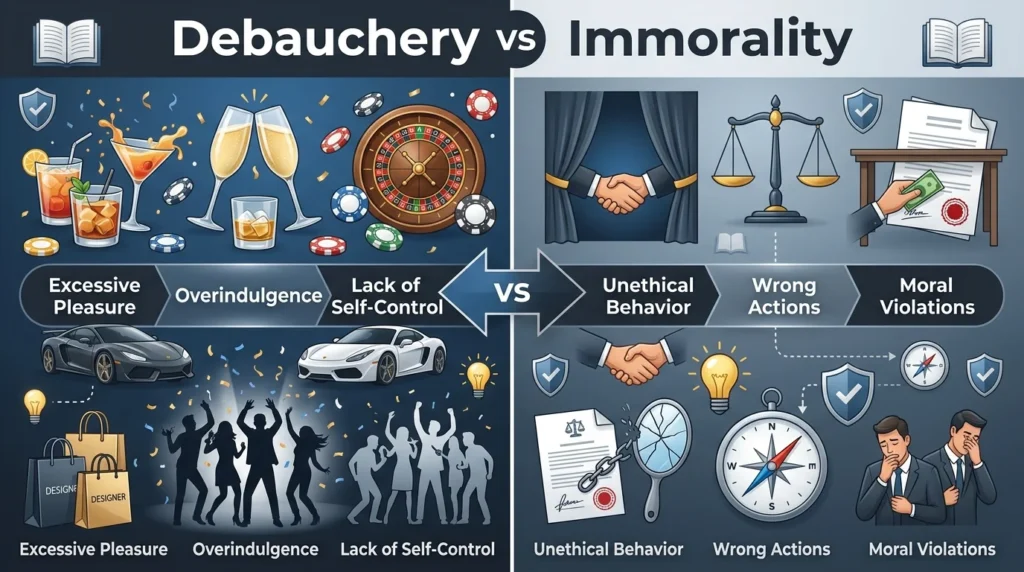
Although these words are closely related, debauchery vs immorality is an important distinction to understand. Immorality is a broad term referring to behavior that violates accepted moral or ethical standards. It can include dishonesty, cruelty, corruption, theft, or many other actions considered wrong.
Debauchery, however, is much more specific. It refers to excessive indulgence in pleasure, uncontrolled desires, and reckless living that often results in moral decline. In other words, debauchery can be one form of immoral behavior, but not every immoral act is debauchery.
For example, lying to someone for personal gain may be immoral, but it isn’t necessarily debauchery. On the other hand, repeatedly engaging in excessive drinking, reckless partying, gambling, or other destructive behaviors without self-control may accurately be described as debauchery. Understanding this difference helps writers and English learners choose the correct word depending on the context.
Debauchery Meaning in Literature
The debauchery meaning in literature often extends beyond its dictionary definition. Authors frequently use the concept as a symbol of temptation, moral decline, corruption, or the destructive consequences of uncontrolled desires. Instead of describing pleasure alone, literary works often portray debauchery as a turning point that reveals flaws in a character’s personality or values.
Classic novels, historical fiction, and dramatic works commonly feature characters whose pursuit of wealth, luxury, power, or pleasure eventually leads to personal downfall. In these stories, debauchery serves as both a character trait and a warning about the dangers of excess. Writers also use it to contrast innocence with corruption, discipline with indulgence, or virtue with vice.
Because literature often explores human nature, the word appears in discussions about ethics, psychology, and social values as well. Understanding how debauchery functions symbolically allows readers to appreciate themes that go far beyond the surface meaning of the word.
What Is the Difference Between Debauchery and Indulgence?
Many people confuse these two terms, but there is an important difference between debauchery and indulgence. Indulgence simply means allowing yourself to enjoy something pleasurable. This could be eating your favorite dessert, taking a relaxing vacation, or celebrating a special occasion. Moderate indulgence is generally considered a normal part of life.
Debauchery, however, describes excessive indulgence that lacks balance, self-control, or responsibility. It usually involves repeated behavior rather than occasional enjoyment. The focus is on excess rather than pleasure itself.
For example:
- Enjoying a slice of cake at a birthday party is indulgence.
- Constant overeating despite serious health consequences may reflect debauchery if it forms part of a broader pattern of reckless self-indulgence.
The same principle applies to many other areas of life. Moderate enjoyment becomes debauchery only when excessive pleasure consistently replaces discipline, responsibility, or moral judgment.
Debauchery Meaning in Modern Society
The debauchery meaning in modern society has expanded beyond traditional religious or historical discussions. Today, the word is often used to describe lifestyles characterized by excessive consumption, irresponsible behavior, or relentless pursuit of pleasure without considering long-term consequences.
Modern media sometimes associates debauchery with celebrity scandals, extravagant parties, substance abuse, gambling addiction, or unethical behavior driven by fame and wealth. At the same time, social commentators also use the term more broadly to discuss consumerism, excessive materialism, or lifestyles that prioritize instant gratification over personal growth.
However, it’s important not to use the word carelessly. Simply enjoying entertainment, travel, or celebrations doesn’t qualify as debauchery. The defining characteristic remains excess—when pleasure consistently becomes destructive, irresponsible, or harmful to oneself or others. This balanced understanding reflects how the word is interpreted in contemporary English.
Psychological Causes of Debauchery
From a psychological perspective, debauchery is not simply about seeking pleasure. Various emotional, environmental, and behavioral factors may contribute to excessive indulgence. Some individuals turn to unhealthy behaviors as a way of coping with stress, loneliness, anxiety, trauma, or unresolved emotional struggles. Others may be influenced by peer pressure, social expectations, or environments where reckless behavior is normalized.
Psychologists also study how impulse control, reward systems, and decision-making affect human behavior. When people repeatedly choose immediate pleasure over long-term well-being, these patterns can become habits that are difficult to break. This doesn’t excuse harmful behavior, but it helps explain why some individuals develop destructive lifestyles.
Understanding these psychological influences encourages compassion while emphasizing personal responsibility. It also highlights the importance of emotional intelligence, healthy coping strategies, and self-awareness.
Consequences of a Debauched Lifestyle
A lifestyle of debauchery often produces consequences that extend far beyond temporary pleasure. While excessive indulgence may seem enjoyable in the short term, long-term patterns of reckless behavior frequently affect physical health, emotional well-being, relationships, finances, and reputation.
Common consequences may include:
- Damaged personal relationships.
- Financial instability.
- Poor physical and mental health.
- Addiction or dependency.
- Loss of trust and credibility.
- Reduced productivity.
- Emotional distress.
- Legal or professional difficulties in some situations.
Many works of literature, philosophy, and history emphasize these consequences to illustrate that lasting happiness usually depends on moderation, responsibility, and self-discipline rather than constant indulgence.
See Also: ISTG Meaning: What Does ISTG Mean in Text & Chat?
Can a Person Change from a Debauched Lifestyle?
Yes. One important aspect that many competitors overlook is that debauchery does not define a person’s future. Throughout history, literature, psychology, and religious teachings all include examples of individuals who transformed their lives after recognizing the negative effects of excessive indulgence.
Positive change often begins with self-awareness. Once people acknowledge unhealthy patterns, they can gradually replace them with healthier habits, stronger relationships, better decision-making, and greater emotional control. Professional counseling, supportive communities, education, and personal discipline can all contribute to lasting improvement.
This perspective reminds readers that while debauchery may describe past behavior, it doesn’t have to determine someone’s future. Personal growth and meaningful change remain possible for anyone willing to learn from experience.
Common Misconceptions About Debauchery
Many misunderstand the debauchery meaning, leading to incorrect assumptions about how the word should be used.
Some common misconceptions include:
- Debauchery only refers to alcohol or partying.
- Every enjoyable activity is debauchery.
- Debauchery always involves criminal behavior.
- Only wealthy people can live a life of debauchery.
- Debauchery and hedonism always mean the same thing.
- One mistake automatically makes someone debauched.
In reality, the word describes a consistent pattern of excessive, irresponsible indulgence, not occasional enjoyment or isolated poor decisions.
Frequently Asked Questions
What does debauchery mean?
Debauchery means excessive indulgence in pleasure or immoral behavior that reflects a lack of self-control and moral restraint.
What is the debauchery meaning in English?
In English, debauchery refers to a lifestyle of reckless pleasure, moral corruption, or repeated overindulgence.
What does debauchery mean in the Bible?
In the Bible, debauchery generally refers to sinful behavior involving uncontrolled desires, drunkenness, immorality, and lack of self-discipline.
Is debauchery a sin?
In Christian teaching, debauchery is generally considered sinful because it places excessive pleasure above moral and spiritual responsibility.
What is an example of debauchery?
A person who repeatedly pursues reckless partying, excessive drinking, gambling, and irresponsible behavior despite harmful consequences may be described as living a life of debauchery.
How do you use debauchery in a sentence?
Example: The novel portrays a wealthy nobleman whose life of debauchery eventually leads to tragedy.
What is the difference between debauchery and indulgence?
Indulgence refers to enjoying something pleasurable in moderation, while debauchery involves excessive, uncontrolled, and often destructive indulgence.
Is debauchery the same as immorality?
No. Debauchery is one specific form of immoral behavior focused on excessive pleasure, while immorality includes many different unethical actions.
Can debauchery affect society?
Yes. Widespread irresponsible behavior can influence families, communities, public health, and social values.
Is debauchery illegal?
Not necessarily. Debauchery is primarily a moral or behavioral concept. However, some actions associated with excessive indulgence may violate laws depending on the situation.
What is the opposite of debauchery?
Common opposites include virtue, moderation, discipline, self-control, temperance, and integrity.
Can someone recover from a life of debauchery?
Yes. Through self-awareness, personal responsibility, healthy habits, and support, many people successfully transform their lives.
Conclusion
Understanding the debauchery meaning requires looking beyond a simple dictionary definition. While the word generally refers to excessive indulgence, moral corruption, or reckless behavior driven by uncontrolled desires, its meaning changes slightly depending on the context. Whether you encounter it in English vocabulary, literature, history, psychology, ethics, or the Bible, the central idea remains the same: a lifestyle where excessive pleasure replaces balance, responsibility, and self-control.
Learning what does debauchery mean, exploring the debauchery meaning in English, understanding the debauchery meaning in the Bible, and comparing debauchery vs immorality or debauchery vs indulgence gives you a complete understanding of this advanced English word. Instead of viewing it as just another vocabulary term, you can appreciate its historical, cultural, literary, and psychological significance.
If you enjoy learning the meanings of advanced English words, internet slang, idioms, and modern expressions, Punz Trend is an excellent place to expand your vocabulary. The site offers detailed, easy-to-understand guides with practical examples, helping you master both everyday language and complex terms with confidence.