Lose vs Loose: Difference, Meaning, Examples & Quiz
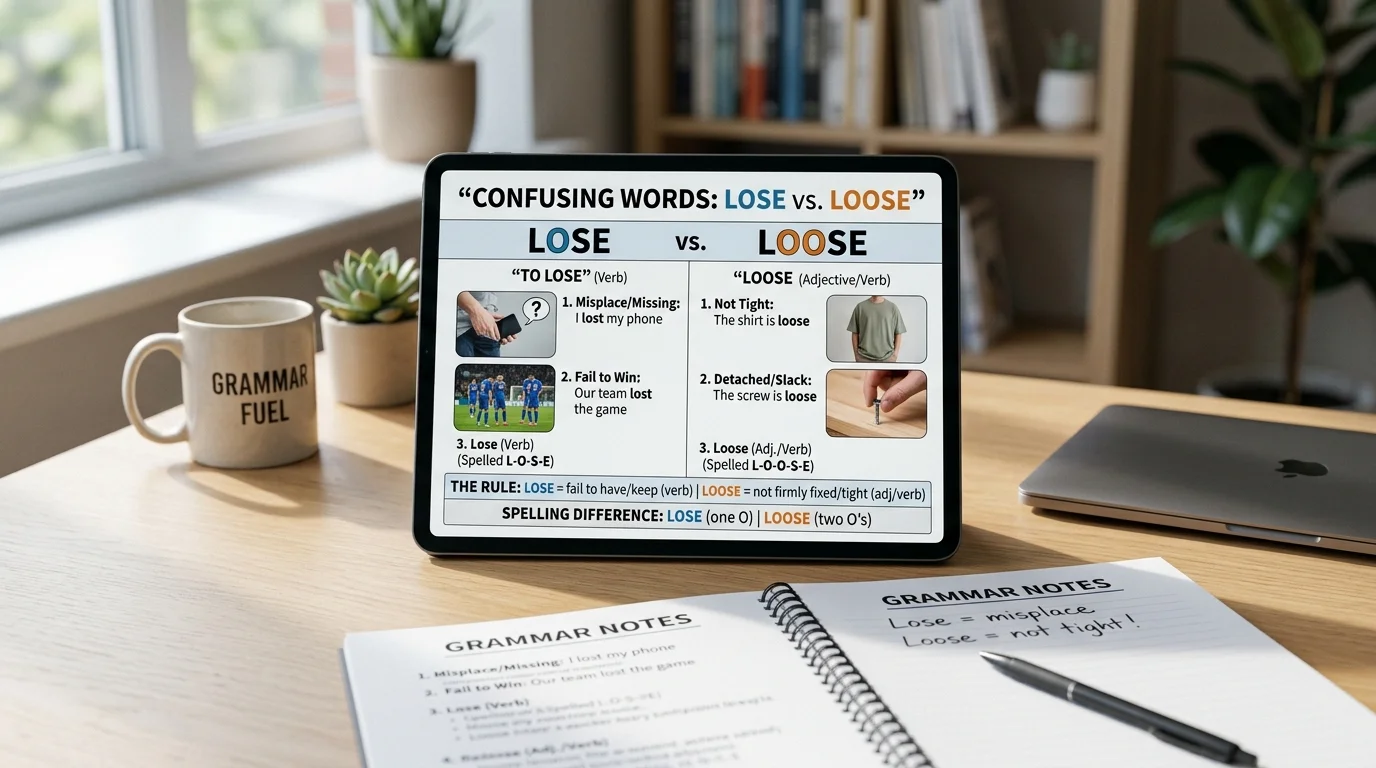
Lose and loose have different meanings and grammatical roles. Lose is usually a verb meaning to misplace something, no longer have something, fail to win, or be deprived of something: “I don’t want to lose my keys.” Loose is usually an adjective meaning not tight, not firmly fixed, or free: “My shoes are loose.” The extra o in loose is important.
What Lose vs Loose Means
Lose and loose are two different English words that are frequently confused because they look almost identical. The difference is only one extra o, but that extra letter changes both the pronunciation and the meaning.
Lose is primarily a verb. It describes an action or change involving no longer having something, failing to keep something, being unable to find something, or failing to win. For example, if you cannot find your phone, you might say, “I think I lost my phone.” If a team is defeated, you can say, “They lost the match.” If someone wants to become lighter, the correct expression is “lose weight.”
Loose is usually an adjective. It describes something that is not tight, not firmly attached, not closely fitted, or not securely contained. For example, “My shirt is loose” means the shirt has plenty of extra space. “The screw is loose” means it is not firmly tightened. “The dog got loose” means the dog escaped from restraint.
There is also a less common but legitimate verb loose, meaning to release or set free. For example, “The hunters loosed the dogs.” This should not be confused with lose, which has a completely different meaning. In everyday situations where you mean “make something less tight,” loosen is normally the more natural verb.
The most important distinction is therefore:
Lose = no longer have, misplace, fail, or be defeated.
Loose = not tight, not firmly fixed, or free.
Once you identify the meaning, the spelling becomes much easier. If you can replace the word with misplace, fail to keep, or fail to win, you need lose. If you can replace it with not tight, not firmly fixed, or free, you probably need loose.
You can also learn more about common English grammar mistakes to improve your everyday writing.
The Main Difference
The simplest way to understand lose vs loose is to look at their meaning and grammatical role.
| Word | Basic idea | Example |
|---|---|---|
| Lose | No longer have something, fail to win, or fail to keep something | I don’t want to lose my wallet. |
| Loose | Not tight, not firmly fixed, or free | This jacket is too loose. |
Lose describes something happening or an action being taken. It is therefore generally used as a verb.
Be careful not to lose your passport.
Our team cannot afford to lose this game.
She doesn’t want to lose her job.
Loose, on the other hand, normally describes a condition or quality.
The door handle is loose.
These trousers are too loose.
The dog is loose in the garden.
The words also have different pronunciations. Lose has a voiced z sound, while loose has an unvoiced s sound. You can hear the difference in pairs such as choose/lose and goose/loose. This pronunciation difference is useful because the spelling difference is easy to overlook when writing quickly.
Another important distinction is the related word loosen. If you want to say that someone makes something less tight, loosen is generally the natural verb:
Please loosen the knot.
Not:
❌ Please loose the knot.
However, loose itself can be a verb meaning “release,” particularly in literary or formal contexts:
The soldiers loosed the horses.
So loose is not exclusively an adjective, even though that is by far its most common role in everyday use.
The Core Rule
The Rule in Simple English
Use lose when something is gone, missing, no longer possessed, or not won.
Use loose when something is not tight, not firmly fixed, or free.
A quick meaning test works well:
Lose → “I no longer have it.”
I might lose my phone.
Loose → “It isn’t tight.”
My phone case is loose.
You can also remember the most common patterns:
- lose a game
- lose your keys
- lose money
- lose weight
- lose interest
- lose hope
- lose confidence
- loose clothing
- loose screws
- loose teeth
- loose wires
- loose change
- loose hair
Why the Rule Works
The words belong to different word families.
The lose family includes forms such as:
- lose
- loses
- losing
- lost
- loss
- loser
The loose family includes:
- loose
- looser
- loosest
- loosen
- loosely
This is useful because related words can reveal which meaning you need.
For example:
I don’t want to lose weight.
The related noun is loss, as in “weight loss.”
But:
These clothes are loose.
The related verb is loosen, meaning to make something less tight.
The distinction is therefore not simply an extra-letter spelling rule. The extra o is part of a different word with a different meaning and grammatical history. Modern English keeps the two forms distinct.
How to Use It
Common Usage
Lose is commonly used in several situations.
1. Misplacing something
I always lose my keys.
Don’t lose your passport.
She lost her phone at the airport.
2. Failing to win
Our team cannot lose another match.
They lost the final.
Nobody wants to lose the competition.
3. No longer having something
He lost his job last year.
She doesn’t want to lose her customers.
We could lose the opportunity if we wait too long.
4. Becoming lighter in weight
She wants to lose weight.
He has lost five kilograms.
This is one of the most commonly misspelled expressions. “Lose weight” is correct; “loose weight” is not.
5. No longer experiencing something
I don’t want to lose hope.
He lost interest in the project.
She was afraid of losing confidence.
Loose is commonly used to describe something that has extra space or is not securely attached.
The shirt is loose.
One of the buttons is loose.
The screw has become loose.
It can also mean free from restraint:
The horse broke loose.
The dog got loose from its leash.
Less Common or Special Usage
The verb loose does exist, but it is much less common than the adjective loose in ordinary modern English.
When used as a verb, loose means to release, unleash, or set free:
The archer loosed an arrow.
They loosed the dogs from their enclosure.
This is different from loosen, which means to make something less tight:
She loosened the knot.
He loosened his tie.
So these three words should not be treated as interchangeable:
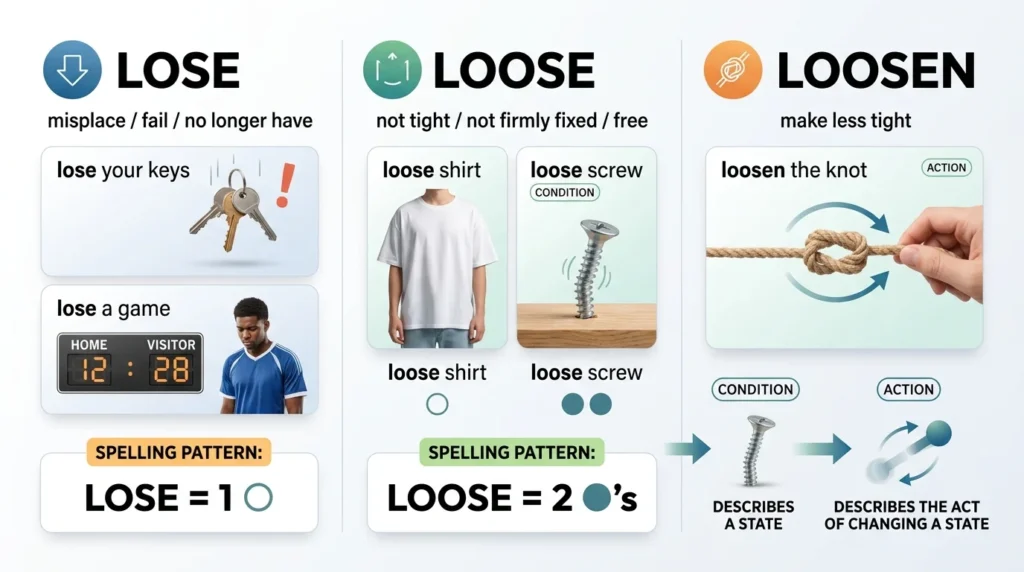
- lose = misplace, no longer have, fail
- loose = not tight, free, or released
- loosen = make less tight
This distinction is particularly important because “loose” can occasionally function as a verb, but it does not become an alternative spelling of lose.
Correct Examples
- I don’t want to lose my wallet again.
- Our team cannot afford to lose this match.
- She is trying to lose weight.
- Don’t lose hope after one rejection.
- He lost interest in the project.
- I always seem to lose my headphones.
- This shirt is too loose around the waist.
- The screw is loose, so tighten it.
- She prefers loose clothing in hot weather.
- One of the wires has become loose.
- The dog broke loose from its leash.
- His shoes are too loose to run comfortably.
- The tooth feels loose.
- Some loose papers were scattered across the desk.
- The knot became loose after several hours.
- He doesn’t want to lose his place in the queue.
- We could lose valuable data if we don’t back it up.
- The handle is loose and needs to be repaired.
- She lost her train of thought during the presentation.
- The horse got loose and ran across the field.
These examples show why choosing the word based only on spelling is unreliable. First determine what the sentence means; then choose the corresponding word.
Incorrect vs Correct
| ❌ Incorrect | ✅ Correct | Why |
|---|---|---|
| I don’t want to loose my keys. | I don’t want to lose my keys. | The keys may no longer be found or kept. |
| I need to loose weight. | I need to lose weight. | Weight is something you can reduce or lose. |
| Don’t loose hope. | Don’t lose hope. | “Lose hope” is the correct expression. |
| We might loose the game. | We might lose the game. | The team may fail to win. |
| She loosed her phone yesterday. | She lost her phone yesterday. | “Lost” is the past tense of lose. |
| I always loose my wallet. | I always lose my wallet. | “Lose” means misplace. |
| My shirt is too lose. | My shirt is too loose. | The shirt is not tight. |
| The screw is lose. | The screw is loose. | The screw is not firmly fixed. |
| These shoes are lose around my feet. | These shoes are loose around my feet. | The shoes do not fit tightly. |
| The dog got lose. | The dog got loose. | “Loose” means free from restraint. |
| Please lose the knot. | Please loosen the knot. | “Loosen” means make the knot less tight. |
| The archer loosed the arrow. | The archer loosed the arrow. | This is actually correct: “loose” can be a verb meaning release. |
The last example is intentionally different. It shows why a simple rule such as “loose is always an adjective” is too broad. Loose can function as a verb in certain contexts, although that use is much less common in everyday English. The important point is that loose, even as a verb, does not mean “misplace” or “fail to win.”
Why People Make This Mistake
The confusion between lose and loose is mainly a spelling and pronunciation trap. The words share the letters l-o-s-e, and the only visible difference is an additional o in loose.
That small visual difference is easy to overlook when writing quickly. A person may know exactly what they want to say but type loose instead of lose, particularly in familiar phrases such as “lose weight,” “lose hope,” or “lose the game.”
Pronunciation contributes to the problem too. Although the words do not have identical pronunciations, they share the long oo vowel. The final consonant differs: lose ends with a /z/ sound, while loose ends with an /s/ sound. In rapid speech, especially for learners, that distinction may not be immediately obvious.
Another source of confusion is the extra o itself. English spelling contains many words where adding or removing a letter changes meaning, but learners cannot always predict which spelling corresponds to which grammatical function.
The problem is especially visible in phrases such as:
- lose weight
- lose hope
- lose a game
- loose clothes
- loose change
- loose tooth
Because the surrounding words can look similar across sentences, writers may focus on sound rather than meaning.
The solution is to ask what is happening.
If something is being lost, use lose.
If something is not tight or not firmly fixed, use loose.
If you mean make something less tight, use loosen.
Common Mistakes
Mistake 1 — “Loose weight”
This is probably one of the most recognizable examples.
❌ I want to loose weight.
✅ I want to lose weight.
Weight is something you can lose, not something that is “not tight.”
A useful connection is weight loss. If the noun is loss, the verb is lose.
Mistake 2 — “Loose the game”
A team does not “loose” a game when it fails to win.
❌ We might loose the game.
✅ We might lose the game.
The word describes failure to win, so the verb lose is required.
Mistake 3 — “My clothes are lose”
When clothing has too much space or does not fit tightly, use loose.
❌ My shirt is lose.
✅ My shirt is loose.
Here, loose is an adjective describing the shirt’s fit.
Mistake 4 — “I am loosing”
The correct form of lose in the continuous tense is losing, with one o:
✅ I am losing weight.
✅ She is losing interest.
❌ I am loosing weight.
Loosing is a real word, but it comes from the verb loose and means releasing or setting free. It is not the normal spelling of the -ing form of lose.
Mistake 5 — “The screw is lose”
A screw that is not firmly attached is loose.
❌ The screw is lose.
✅ The screw is loose.
The sentence describes a condition, not an action of misplacing something.
Mistake 6 — Confusing “loose” with “loosen”
If you mean “make less tight,” use loosen.
❌ Please loose the belt.
✅ Please loosen the belt.
The distinction is:
loose = already not tight
loosen = make less tight
Lose vs Loose in Real English
In real English, lose and loose are not interchangeable. The context usually makes their meanings very different.
When people talk about losing something, the word can refer to physical possessions:
I lost my wallet.
But it can also describe abstract things:
She lost confidence.
He lost interest.
We lost an opportunity.
They lost control of the situation.
So lose is much broader than simply “misplace an object.” It can describe losing possession, opportunity, ability, control, interest, hope, time, or a competition.
Loose generally describes a physical or figurative condition involving a lack of tightness, attachment, control, or restriction:
The cable is loose.
He wore a loose jacket.
The dog is loose.
It can also occur in phrases such as loose change, meaning coins that are not contained in a wallet, purse, or similar holder, and loose ends, meaning unfinished matters.
There is also a distinction between loose and loosen that matters in natural English. If something is already not tight, it is loose. If someone actively makes it less tight, they loosen it.
The knot is loose.
I loosened the knot.
This is a good example of why part of speech matters. Lose, loose, and loosen look related but perform different grammatical jobs and express different meanings.
Comparison Table
| Feature | Lose | Loose |
|---|---|---|
| Main role | Usually a verb | Usually an adjective |
| Core meaning | Misplace, no longer have, fail, or be defeated | Not tight, not firmly fixed, or free |
| Pronunciation | Ends with /z/ | Ends with /s/ |
| Common phrase | Lose weight | Loose clothing |
| Other examples | Lose hope, lose a game | Loose screw, loose tooth |
| Related forms | lost, losing, loss, loser | looser, loosest, loosen, loosely |
| Can be a verb? | Yes | Yes, but less commonly |
| Verb meaning | No longer have, fail, be deprived of | Release or unleash |
| Example | Don’t lose your phone. | My phone case is loose. |
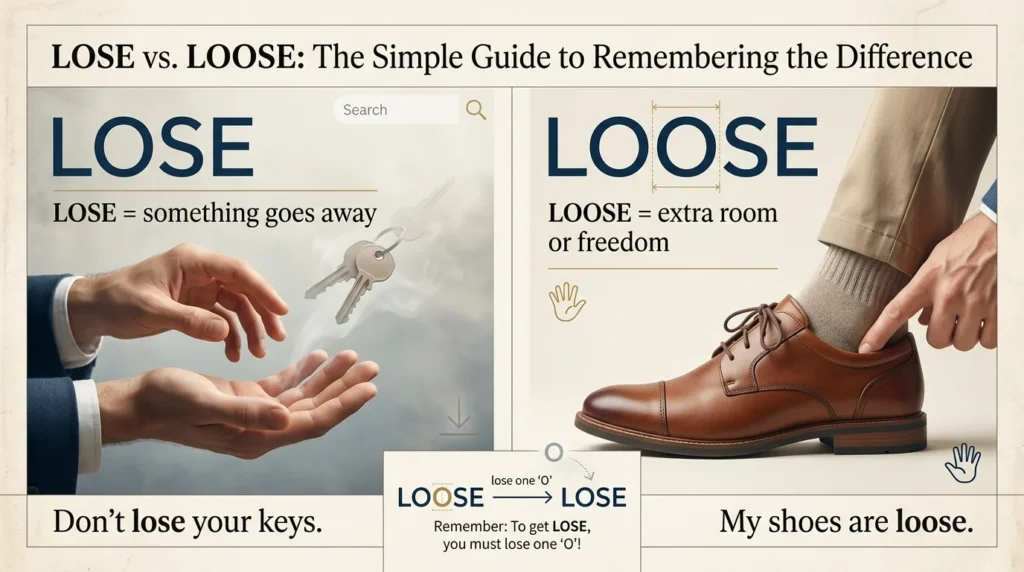
Memory Trick
The easiest memory trick is:
LOSE has one “O” because you can “lose” one O from LOOSE.
Think of it this way:
LOOSE → remove one O → LOSE
You have literally lost an O.
Another useful connection is:
LOSE → LOSS
Both are about something being gone or no longer retained.
For LOOSE, imagine extra space:
LOOSE = room to move
A loose shirt has extra room. A loose screw can move. A loose dog is free to move.
You can also use pronunciation:
- LOSE sounds like choose
- LOOSE sounds like goose
So:
Choose → Lose
Goose → Loose
The most reliable memory method, however, is still meaning:
Lose = something goes away.
Loose = something has room or freedom.
Real-Life Examples
At Work
Lose is common when discussing business, opportunities, customers, time, money, or data:
We could lose an important customer if we delay the delivery.
Make sure you don’t lose the latest version of the file.
Loose can describe physical equipment:
The office chair has a loose screw.
There is a loose cable under the desk.
In an Email
You might write:
Please back up the files so we don’t lose any important information.
Or:
The handle on the cabinet is loose and needs repair.
The two words can appear in professional communication, but their meanings remain completely different.
In Conversation
Everyday conversation frequently uses lose:
I always lose my keys.
Don’t lose your phone.
We don’t want to lose the match.
It also uses loose:
These jeans are too loose.
The dog got loose.
This tooth feels loose.
At School or University
Students may write:
Don’t lose your notes before the exam.
The binding on this book is loose.
In academic writing, lose can also be used figuratively:
The argument may lose its clarity if too many unrelated ideas are added.
Expert Tips
- Ask what the sentence means. If something is disappearing, being misplaced, or failing, choose lose.
- Look for “not tight.” If something has too much space or is not firmly attached, choose loose.
- Remember “lose weight.” Never write “loose weight” when you mean reducing body weight.
- Connect lose with lost. If the sentence could involve something being lost, you probably need lose.
- Connect loose with loosen. If the sentence describes something being less tight, think of the word family loose → loosen.
- Listen to the final sound. Lose ends with a /z/ sound; loose ends with an /s/ sound.
- Watch the -ing forms. The normal continuous form of lose is losing, not loosing.
- Do not assume “loose” is never a verb. It can mean release or unleash, although that use is less common in ordinary conversation.
- Check the noun form. “Loss” strongly points toward lose, while “looseness” points toward loose.
- Proofread common phrases. Search your writing for “loose” and “lose,” especially when writing quickly. Their visual similarity makes them easy to miss.
Quick Summary
Lose and loose are different words with different meanings. Lose is usually a verb meaning to misplace something, no longer have something, fail to keep something, or fail to win: “I don’t want to lose my keys” and “They may lose the game.” Loose is usually an adjective meaning not tight, not firmly fixed, or free: “My shirt is loose” and “The screw is loose.” Remember that lose has one o, while loose has two. If you mean “make something less tight,” use loosen. Also remember that losing is the normal -ing form of lose, while loosing is a separate word related to the less common verb loose.
If you are learning English,understanding commonly confused words can make your writing much clearer.
Frequently Asked Questions
Is “lose” or “loose” correct?
Both are correct words, but they are used for different meanings. Use lose for misplacing something, no longer having something, failing to win, or suffering a loss. Use loose when something is not tight, not firmly fixed, or free.
Is it “lose weight” or “loose weight”?
The correct phrase is lose weight.
I want to lose weight.
“Loose weight” is a common spelling error because loose looks similar, but it does not have the required meaning.
Is it “lose hope” or “loose hope”?
The correct expression is lose hope.
Don’t lose hope.
You lose something when you no longer have it, including abstract things such as hope, confidence, interest, or patience.
Is it “loose clothing” or “lose clothing”?
The correct phrase is loose clothing when you mean clothing that is not tight.
She prefers loose clothing in summer.
Is “loosing” a word?
Yes, loosing is a real word, but it is not normally the -ing form of lose. It comes from the less common verb loose, meaning to release or unleash.
For example:
The soldiers were loosing the animals.
For the verb lose, the correct form is:
She is losing weight.
Is “loose” a verb?
Yes. Loose can be a verb meaning to release or unleash something.
The hunter loosed the dogs.
However, if you mean “make something less tight,” loosen is generally the natural everyday verb:
Please loosen your tie.
Is “loosen” the same as “loose”?
No. Loose describes something that is not tight, while loosen means to make something less tight.
The knot is loose.
Please loosen the knot.
What is the difference between “lose” and “lost”?
Lose is the base form of the verb. Lost is its past tense and past participle.
Don’t lose your wallet.
I lost my wallet yesterday.
What is the difference between “loser” and “looser”?
A loser is a person or thing that loses.
The team was the loser in the final.
A looser is the comparative form of loose, meaning “more loose.”
This shirt is looser than the other one.
The extra o changes the word family and meaning.
Is “let loose” correct?
Yes. Let loose is a standard expression meaning to release someone or something, or to allow someone or something to act freely.
The children were finally let loose in the playground.
How do you remember lose vs loose?
Remember:
LOSE = something goes away.
LOOSE = something has extra room or freedom.
You can also remember that loose has an extra o, just as a loose object may have extra room around it.
Mini Quiz
| # | Question | Answer | Explanation |
|---|---|---|---|
| 1 | I don’t want to ___ my phone. | lose | The phone may no longer be in your possession. |
| 2 | These shoes are too ___ for me. | loose | The shoes do not fit tightly. |
| 3 | Our team might ___ the final. | lose | The team might fail to win. |
| 4 | I want to ___ weight. | lose | The correct expression is “lose weight.” |
| 5 | The screw is ___. | loose | The screw is not firmly fixed. |
| 6 | Which is correct: “I am loosing weight” or “I am losing weight”? | I am losing weight. | Losing is the -ing form of lose. |
| 7 | Please ___ the knot. | loosen | “Loosen” means make the knot less tight. |
| 8 | The dog got ___. | loose | The dog became free from restraint. |
| 9 | Don’t ___ hope after one failure. | lose | The expression is “lose hope.” |
| 10 | Which sentence is correct: “My shirt is lose” or “My shirt is loose”? | My shirt is loose. | “Loose” describes clothing that is not tight. |
Related Reading: Check out our detailed guide on Your vs You’re: Difference, Meaning, Rules & Examples for more insights.
Related Reading: Check out our detailed guide on Rug vs Rag: Meaning, Difference, and Examples for more insights.