
Seaver Meaning: Origin, Surname, History & Definition
The word Seaver is most commonly known as a surname rather than a standard English dictionary word. If you have searched for Seaver meaning, you may be trying to understand whether it has a definition, where it comes from, or why it appears in family names, historical records, and online searches.
Unlike common English vocabulary, Seaver does not have a widely accepted dictionary meaning. Instead, it is primarily used as a family name with historical roots. In some cases, people search for Seaver because of famous individuals who carry the surname. In this guide, Trendy Meaning explains what does Seaver mean, its origin, history, possible meanings, and usage.
Meaning & Definition
The Seaver meaning is generally associated with its use as a surname. It does not have a standard definition in modern English dictionaries.
As a family name, Seaver has historical origins and has been passed down through generations. Like many surnames, it may have developed from an occupation, a place, or an old personal name, depending on the family’s ancestry.
Today, Seaver is recognized mainly as a proper noun rather than an everyday English word.
Seaver Meaning in English
The Seaver meaning in English can be explained as:
- A surname (family name)
- A proper noun
- A name with historical and genealogical significance
Unlike words such as “happy” or “strong,” Seaver is not commonly used as an adjective, noun, or verb in everyday English.
What Does Seaver Mean?
When people ask what does Seaver mean, they are usually referring to the surname rather than a dictionary definition.
In simple words, Seaver is a family name that has been used for centuries and is associated with ancestry and genealogy.
For example:
“Seaver is the family’s surname.”
Here, Seaver simply identifies the family name.
Simple Explanation
Think of Seaver as:
A surname
A family name
A proper noun
A name with historical origins
Its meaning depends more on family history than on dictionary definitions.
Seaver Definition With Examples
The Seaver definition is best understood as a surname rather than a vocabulary word.
Examples of Seaver in Sentences
“Her last name is Seaver.”
“The Seaver family has lived here for generations.”
“He researched the history of the Seaver surname.”
“The document mentioned the Seaver family.”
These examples show how Seaver is typically used as a proper name.
Background
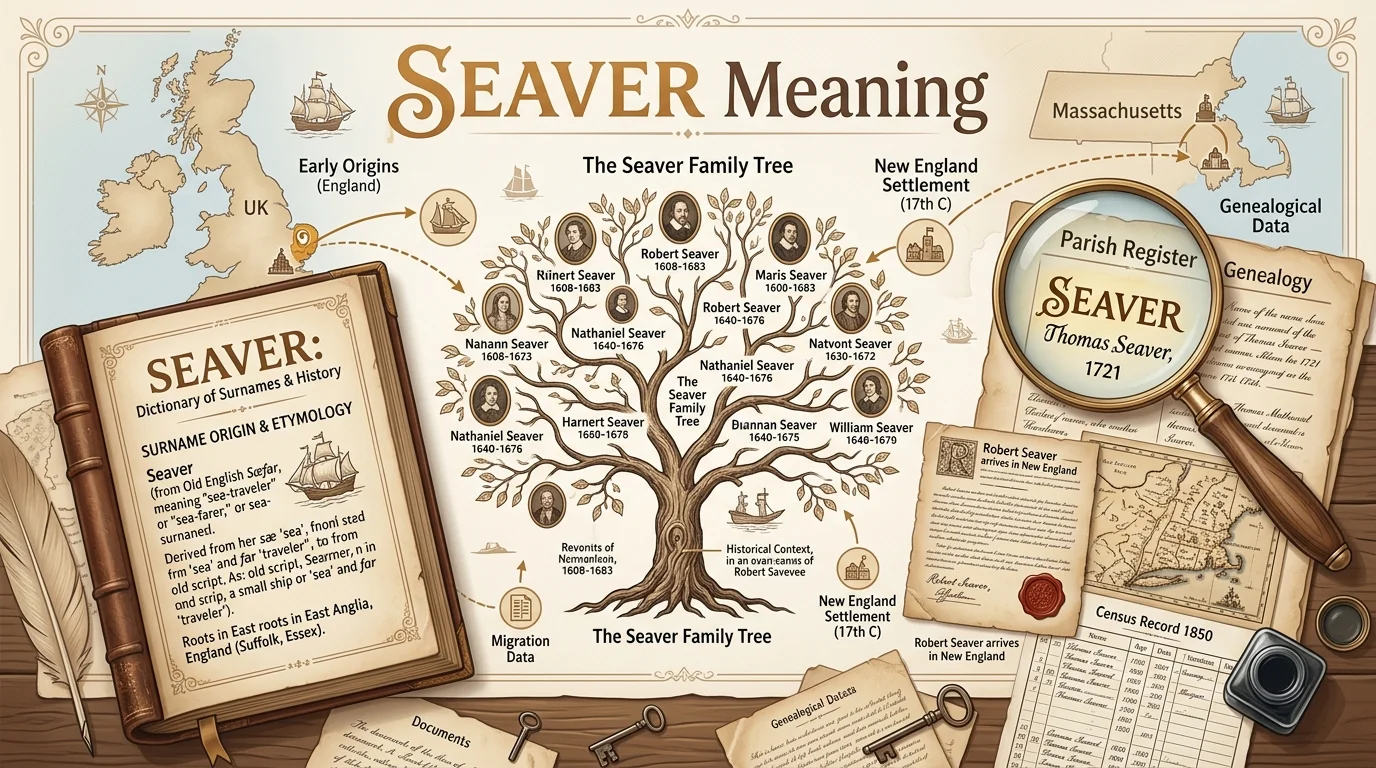
The surname Seaver has appeared in English-speaking countries for many generations. Like many family names, it has been preserved through genealogy records, census documents, and historical archives.
People often search for the meaning of Seaver when researching family history, ancestry, or famous individuals who share the surname.
Origin and History of Seaver
The exact origin of the surname Seaver is not universally agreed upon, but it is generally considered to have English roots. Over time, families carrying the Seaver surname settled in different regions, particularly in English-speaking countries.
Like many traditional surnames, its spelling and pronunciation have remained relatively consistent through history.
Usage in Different Contexts
The meaning of Seaver depends on the context in which it appears.
Seaver as a Surname

This is the most common use of the word today.
See Also: Solace Meaning: Definition, Examples & Emotional Healing
Example:
“John Seaver wrote the family history.”
Seaver in Genealogy
Researchers often encounter the surname while studying family trees and historical records.
Example:
“The Seaver lineage dates back several centuries.”
Seaver in Historical Records

The surname appears in census records, legal documents, birth certificates, and immigration records.
See Also: Myrrh Meaning: Biblical Definition, Uses & Origin
Seaver in Modern Usage
Today, Seaver continues to be used primarily as a family name rather than a common English word.
Seaver Meaning in Text
The Seaver meaning in text is generally the same as its standard usage. It is most often used as a surname or proper name rather than as a regular English word.
For example:
“I met someone whose last name is Seaver.”
In this sentence, Seaver simply identifies a person’s family name.
Unlike internet slang or abbreviations, Seaver does not have a commonly accepted texting meaning.
Seaver as a Surname
The surname Seaver has been passed down through generations and is found mainly in English-speaking countries. Like many family names, it helps identify a person’s ancestry and family heritage.
Examples:
“The Seaver family has a long history.”
“She proudly carries the Seaver surname.”
Today, Seaver continues to be recognized primarily as a last name.
Seaver in Genealogy
In genealogy, Seaver is important because it appears in family trees, historical records, census data, and ancestry research.
People researching the Seaver surname often look for:
Family history
Migration records
Birth and marriage certificates
Historical documents
Genealogists use these records to trace family origins across generations.
Seaver vs Common English Words
Unlike ordinary English vocabulary, Seaver functions as a proper noun.
Seaver
A surname or family name.
Example:
“Michael Seaver is the author’s name.”
Common English Words
Words with dictionary meanings used in everyday speech.
Example:
“Happy,” “strong,” or “travel.”
Simple difference:
Seaver = proper noun.
Common English words = regular vocabulary.
Famous People with the Seaver Surname
The Seaver surname has been carried by several well-known individuals in sports, entertainment, literature, and public life. Because of these notable figures, many people search for the meaning of Seaver online.
However, the surname itself does not have a universally accepted symbolic meaning beyond its historical family origins.
Related Names
Names that may appear in genealogy research alongside Seaver include:
Sever
Sevier
Seaver family
Surname variations
These names may have different origins and should not automatically be considered the same surname.
How to Use Seaver Correctly
Since Seaver is a proper noun, it should always begin with a capital letter.
Examples:
“The Seaver family moved to Boston.”
“Her surname is Seaver.”
“I found the Seaver name in historical records.”
Unlike common nouns, proper names like Seaver are not usually translated into other languages.
Frequently Asked Questions
What is Seaver meaning?
Seaver is primarily a surname or family name rather than a standard English dictionary word.
Is Seaver an English word?
No. Seaver is generally recognized as a proper noun used as a surname.
What does Seaver mean in text?
In text messages, Seaver usually refers to a person’s last name and does not have a special slang meaning.
Is Seaver a first name or last name?
It is most commonly used as a last name or surname.
Why do people search for Seaver meaning?
Many people search for Seaver while researching family history, genealogy, or notable people with the surname.
Conclusion
The Seaver meaning is best understood as a surname with historical and genealogical significance rather than a regular English vocabulary word. It is commonly found in family records, ancestry research, and historical documents. Understanding what does Seaver mean helps clarify that it is primarily a proper noun used to identify individuals and families, not a word with a standard dictionary definition.
At Trendy Meaning, we explain English words, names, abbreviations, and modern expressions with simple definitions, practical examples, and real-world usage to make learning easier.