
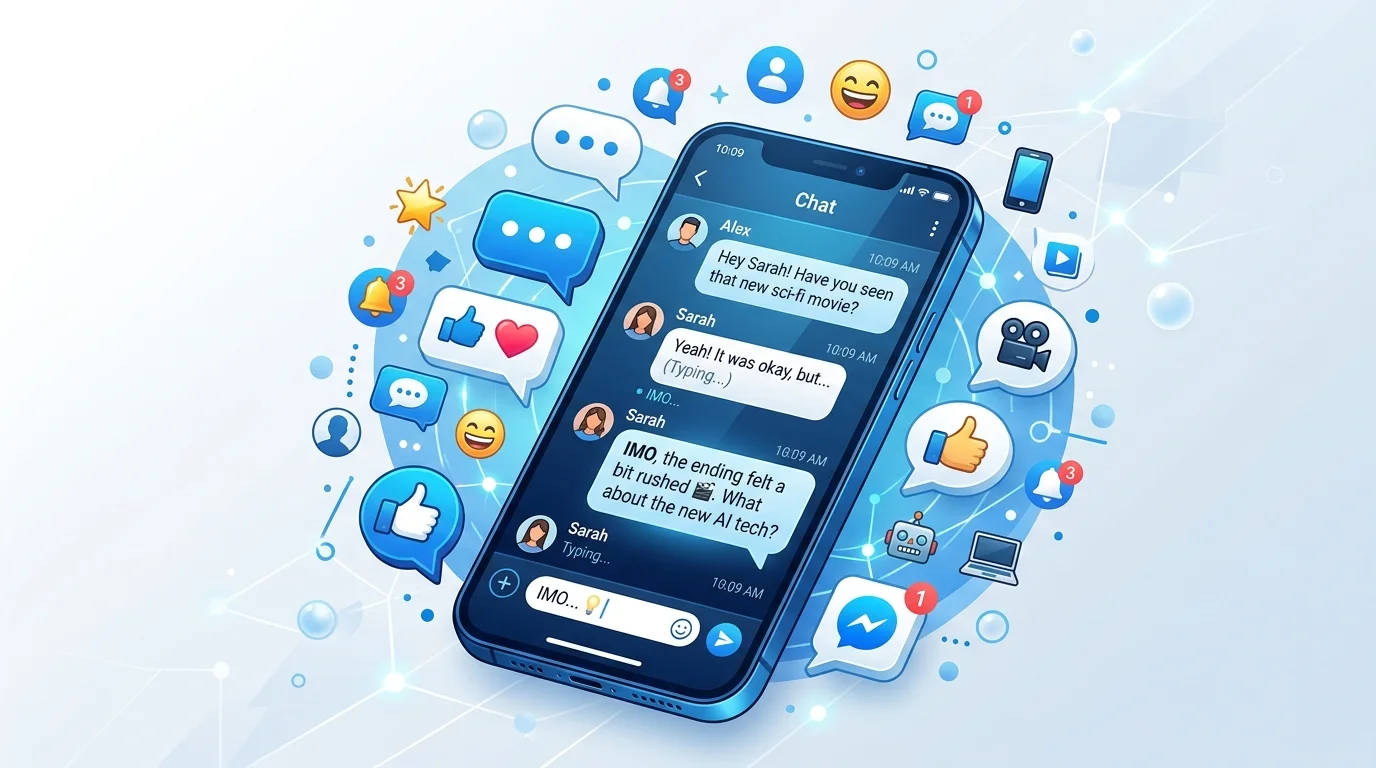
IMO Meaning: Definition, Texting Uses & Examples
If you’ve ever received a text message or scrolled through social media, you’ve probably come across the abbreviation IMO. It’s one of the most commonly used internet acronyms, yet many people still wonder what it actually means and when they should use it. Whether you’re chatting with friends, commenting on a social media post, participating in an online forum, or sending a professional message, understanding the IMO meaning can help you communicate more naturally and confidently. As online conversations become a bigger part of daily life, knowing common abbreviations like IMO is just as important as understanding regular English vocabulary.
In this complete guide, you’ll learn the IMO meaning definition, what it stands for, how it’s used in text messages and online conversations, and why people use it to express opinions politely. You’ll also discover the difference between IMO and similar abbreviations, practical examples from real conversations, and tips for using it correctly in different situations. If you’re interested in learning the meanings of internet slang, abbreviations, idioms, and English expressions, Punz Trend is a great place to explore detailed explanations written in simple and easy-to-understand language.
Meaning & Definition
The IMO meaning definition is “In My Opinion.” It is an internet abbreviation used before or after a statement to show that what follows is a personal opinion rather than a proven fact. Using IMO tells the reader that you’re expressing your own viewpoint and that others may have different opinions. This simple acronym helps make conversations friendlier because it softens statements and reduces the chance of sounding overly confident or argumentative.
Today, IMO is widely used in text messages, emails, social media platforms, online forums, gaming communities, blogs, and comment sections. Instead of writing the complete phrase “in my opinion,” people simply type IMO to save time while still making their message clear. Although it is considered informal, it has become one of the most recognized internet abbreviations in English and is understood by millions of users around the world.
Background
The abbreviation IMO became popular during the early years of internet communication when people wanted faster ways to type messages in chat rooms, discussion boards, and instant messaging platforms. Limited typing speed, character limits, and the growing popularity of online conversations encouraged users to shorten common phrases into simple acronyms. Along with abbreviations like LOL, BRB, FYI, and TBH, IMO quickly became part of everyday digital communication.
As smartphones, social media, and messaging apps became more common, the use of IMO spread far beyond internet forums. Today, it appears regularly on platforms like Facebook, X (formerly Twitter), Reddit, Discord, WhatsApp, Instagram, and many other online communities. Competitor articles often explain only the full form of IMO, but understanding its background shows why it became such an essential part of modern digital communication and why it remains relevant even as language continues to evolve.
Usage in Different Contexts
The IMO meaning changes very little across different situations because its purpose is always to introduce a personal opinion. However, the way it is used depends on the platform and audience. In casual text messages, friends often use IMO to share opinions about movies, music, games, food, or sports without sounding too forceful. For example, someone might write, “IMO, this is the best pizza in town.” The abbreviation signals that the statement is based on personal preference rather than an objective fact.
In online forums and social media discussions, IMO helps keep conversations respectful by acknowledging that other viewpoints are possible. It is also occasionally used in workplace chats or informal emails, although writing the complete phrase “in my opinion” is usually more appropriate in professional communication. Understanding these different contexts helps English learners recognize when IMO sounds natural and when using the full phrase is the better choice.
IMO Meaning Definition
The IMO meaning definition is simple but important for effective online communication. IMO stands for “In My Opinion.” It tells readers that the speaker is sharing a personal belief, preference, or viewpoint rather than presenting a fact. Because opinions are subjective, adding IMO shows humility and respect for other people’s perspectives. This makes conversations more balanced and reduces misunderstandings during discussions or debates.
For example, if someone says, “IMO, reading books is better than watching movies,” they are not claiming that everyone must agree. Instead, they are simply expressing a personal preference. This small abbreviation plays an important role in digital communication because it encourages polite discussion and reminds readers that different opinions can exist on the same topic.
What Does IMO Mean in Text and Chat?
If you’re wondering what does IMO mean in text and chat, the answer is straightforward. It stands for “In My Opinion” and is commonly used when someone wants to share their thoughts without sounding overly direct. Whether you’re texting a friend, chatting in a gaming community, or commenting on social media, IMO lets others know that your statement reflects your own perspective rather than an unquestionable fact.
For example, if your friend asks which smartphone they should buy, you might reply, “IMO, this model offers the best value for money.” Similarly, in a group chat discussing movies, someone could write, “IMO, the sequel was better than the original.” In both cases, the abbreviation politely introduces an opinion while inviting others to share their own views. This makes IMO one of the most useful and widely understood abbreviations in modern online communication.
IMO Meaning in Simple English
If you ask what is the IMO meaning in simple English, the easiest explanation is this: IMO means “this is what I personally think.” It tells people that you’re expressing your own opinion instead of stating a fact. The abbreviation helps make conversations friendlier because it shows respect for different viewpoints. Rather than insisting that everyone agree, it simply introduces your own perspective in a polite and informal way.
Imagine two friends discussing their favorite football team. One friend says, “IMO, this team has the strongest defense in the league.” They are not saying their opinion is the only correct one—they are simply sharing what they believe. In simple English, IMO is a quick and easy way to say, “This is my opinion.” Because it is short, clear, and widely recognized, it has become one of the most frequently used abbreviations in texting, social media, and online conversations.
See Also: Condescending Meaning: Definition, Examples & Usage
IMO vs IMHO Difference Explained
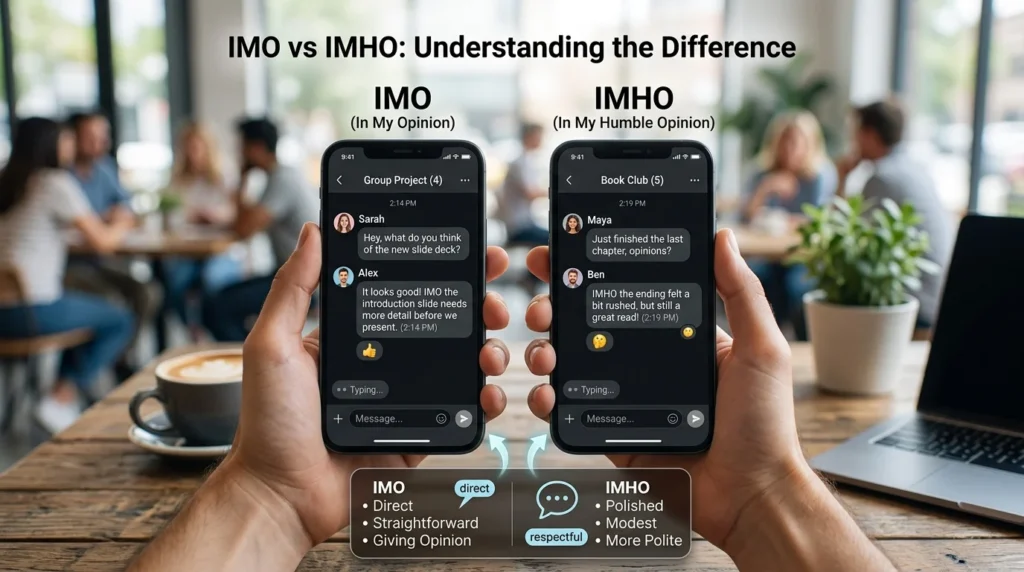
Many people use these abbreviations interchangeably, but understanding the IMO vs IMHO difference explained helps you communicate more naturally online. IMO stands for “In My Opinion,” while IMHO stands for “In My Humble Opinion.” Both introduce a personal opinion rather than a fact, but IMHO adds an extra layer of humility or politeness. By using IMHO, the writer suggests they are sharing their thoughts respectfully and are open to different viewpoints. In everyday online conversations, however, many people use both abbreviations with the same meaning.
There is another interesting point that many competitor articles overlook. Sometimes IMHO is used humorously or sarcastically rather than literally. For example, someone may write, “IMHO, that’s the worst movie ever made,” even though they feel very strongly about their opinion. Because of this, understanding the tone of the conversation is just as important as knowing the abbreviation itself. In most casual situations, IMO is the more common and straightforward choice, while IMHO is slightly more formal or intentionally modest.
How to Use IMO in a Sentence or Message
Learning how to use IMO in a sentence or message is simple because the abbreviation fits naturally into many kinds of conversations. It is usually placed at the beginning or end of a sentence to show that what you are saying reflects your personal opinion. Since it is informal internet language, it works best in text messages, online chats, discussion forums, gaming communities, and social media posts rather than formal business writing.
Here are some natural examples:
- IMO, this restaurant serves the best burgers in town.
- This phone offers the best value for money, IMO.
- IMO, studying a little every day is more effective than cramming before exams.
- That was the funniest episode of the series, IMO.
- IMO, teamwork always produces better results.
- The original version is still better, IMO.
- IMO, online learning has become much more effective in recent years.
- This is the easiest app to use, IMO.
When using IMO, remember that it introduces an opinion—not a proven fact. Using it correctly makes your messages sound more respectful and encourages healthy discussion instead of unnecessary arguments.
IMO Meaning on Social Media and Texting
The IMO meaning on social media and texting remains the same across different platforms, but the situations where people use it can vary. On apps like WhatsApp, Messenger, Instagram, Snapchat, Discord, Reddit, Facebook, TikTok, and X, people use IMO to express opinions about entertainment, sports, technology, fashion, food, travel, and current events. Because social media often involves discussions with people who have different viewpoints, adding IMO helps make opinions sound less confrontational and more conversational.
For example, someone commenting on a movie trailer might write, “IMO, this looks much better than the previous film.” A gamer might post, “IMO, this update improved the gameplay significantly.” On Reddit, users frequently begin detailed discussions with IMO to clarify that they are sharing personal experiences rather than objective facts. Competitor articles often define the abbreviation but fail to explain how it functions across different digital platforms. Understanding these real-life contexts makes it much easier to recognize and use IMO naturally in modern online communication.
Examples of IMO in Conversations
The easiest way to master the abbreviation is by seeing examples of IMO in conversations. These examples demonstrate how native English speakers naturally include IMO while texting, chatting, or participating in online discussions. Notice how the abbreviation keeps opinions friendly and avoids making statements sound overly absolute.
Conversation 1
Alex: Which laptop should I buy?
Sarah: IMO, this model offers the best performance for students.
Conversation 2
John: Did you like the new superhero movie?
Emma: IMO, the first movie was much better.
Conversation 3
David: Should I learn Python or JavaScript first?
Lisa: IMO, Python is easier for beginners.
Conversation 4
Chris: Which football team will win the league?
Ryan: IMO, they have the strongest squad this season.
Conversation 5
Mia: What’s the best way to improve English?
Sophia: IMO, reading every day and practicing conversations works best.
These conversations show that IMO can be used for almost any personal opinion, whether you’re discussing education, technology, sports, entertainment, travel, or daily life. Instead of sounding argumentative, the abbreviation signals that you’re simply sharing your perspective and respecting the possibility that others may think differently. This is one of the main reasons why IMO continues to be one of the most popular abbreviations in digital communication.
Origin and Full Form of IMO Abbreviation
The origin and full form of IMO abbreviation help explain why it has become one of the most widely recognized internet acronyms. IMO stands for “In My Opinion.” It first became popular during the early days of online communication in chat rooms, internet forums, and instant messaging services. As people looked for quicker ways to type common phrases, abbreviations like IMO, LOL, BRB, and FYI became part of everyday digital language. They saved time, reduced typing effort, and made conversations faster without changing the intended meaning.
Today, IMO is understood by millions of internet users worldwide and appears across almost every digital platform. Although it is mainly used in informal communication, it has become so familiar that many people recognize it instantly. Competitor articles often stop after explaining the full form, but it is equally important to understand why the abbreviation became popular. The rise of smartphones, social media, online gaming, and messaging apps has made short, clear expressions like IMO an essential part of modern English communication.
See Also: Nefarious Meaning: Definition, Examples & Easy Explanation
When Should You Use IMO in Online Communication
Knowing when should you use IMO in online communication helps you sound natural while avoiding misunderstandings. IMO is best used whenever you want to express a personal opinion without presenting it as an unquestionable fact. It works particularly well when discussing movies, books, sports, technology, travel, food, education, gaming, or any topic where different opinions are normal. Using IMO makes your message sound polite and shows respect for other people’s viewpoints.
However, IMO is not appropriate in every situation. In formal emails, academic writing, business reports, legal documents, or professional presentations, writing the complete phrase “in my opinion” is usually a better choice because it appears more professional. Similarly, when giving factual information or official instructions, using IMO may create unnecessary uncertainty. Understanding when to use the abbreviation—and when to avoid it—is something many competitor articles overlook, yet it is essential for effective communication in both personal and professional settings.
Common Texting Abbreviations Like IMO, IMHO, TBH, and FYI
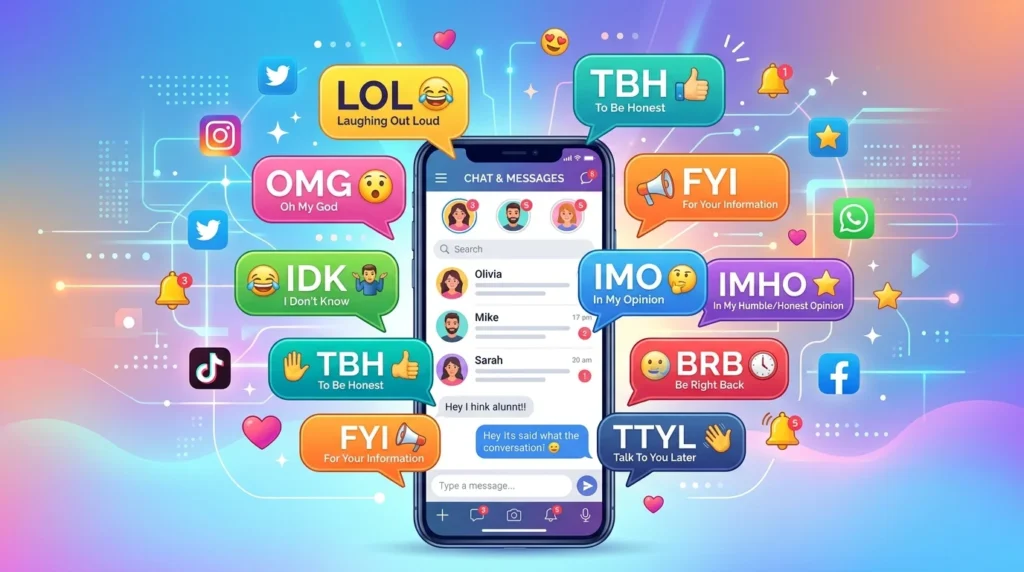
Learning common texting abbreviations like IMO, IMHO, TBH, and FYI helps you understand online conversations more easily. These abbreviations are widely used across messaging apps, social media platforms, gaming communities, and discussion forums. Knowing what they mean allows you to communicate more confidently and naturally in modern English.
Here are some of the most common abbreviations:
- IMO – In My Opinion
- IMHO – In My Humble Opinion
- TBH – To Be Honest
- FYI – For Your Information
- BRB – Be Right Back
- LOL – Laughing Out Loud
- IDK – I Don’t Know
- BTW – By The Way
- OMG – Oh My God or Oh My Gosh
- TTYL – Talk To You Later
These abbreviations make online communication faster and more convenient. While they are perfectly acceptable in casual conversations, text messages, and social media, they should generally be avoided in formal writing unless the audience expects informal language. Understanding these commonly used acronyms improves both reading comprehension and digital communication skills.
Frequently Asked Questions
What does IMO mean in texting?
In texting, IMO means “In My Opinion.” It is used to show that a statement reflects the sender’s personal view rather than an objective fact.
Is IMO rude to use?
No. IMO is generally considered polite because it makes it clear that you are expressing an opinion instead of insisting that everyone must agree with you.
What is the difference between IMO and IMHO?
IMO means “In My Opinion,” while IMHO means “In My Humble Opinion.” IMHO sounds slightly more modest, although many people use both abbreviations interchangeably.
Can I use IMO in professional emails?
It is usually better to write “in my opinion” instead of IMO in formal emails or business communication. The abbreviation is more suitable for casual conversations and online chats.
Where is IMO most commonly used?
IMO is commonly used in text messages, social media posts, online forums, gaming communities, messaging apps, and informal online discussions where people share personal opinions.
Conclusion
Understanding the IMO meaning is essential for anyone who communicates online. Whether you’re texting friends, posting on social media, participating in discussion forums, or chatting in gaming communities, IMO is a simple and effective way to express your personal opinion while respecting the views of others. By learning the IMO meaning definition, understanding what does IMO mean in text and chat, exploring IMO vs IMHO, seeing examples of IMO in conversations, and knowing when should you use IMO in online communication, you can communicate more confidently and naturally in modern English.
As internet language continues to evolve, understanding common abbreviations helps you stay connected and avoid confusion in digital conversations. If you want to learn more about English word meanings, internet slang, abbreviations, idioms, and commonly searched expressions, Punz Trend is a great place to explore. The site provides clear explanations, practical examples, and in-depth language guides that make learning English easier, faster, and more enjoyable for readers of all levels.
See Also: Tralalero Tralala Meaning Explained | TikTok Meme Guide