
Parens Meaning: What It Means and How to Use It
Parens meaning is a surprisingly common topic that many people search for when they come across the word “parens” in writing, editing, grammar discussions, academic papers, or online conversations. While the term may look unfamiliar at first, it is actually a shortened form of a punctuation mark that most people use regularly. Understanding what parens mean can help you improve your writing, communicate more clearly, and avoid common grammar mistakes that often confuse readers.
Whether you are a student, writer, blogger, editor, teacher, or simply someone curious about English grammar, learning about parens can make your writing more professional and easier to understand. Many people search for questions like what does parens mean in writing, parens meaning in English grammar, how to use parens in a sentence, and parens vs brackets meaning and usage. This guide covers every important aspect of the topic in a simple and practical way. If you ever want to explore more meanings, definitions, word explanations, and language-related content, you can always visit Punz Trend for detailed and easy-to-understand guides.
Meaning & Definition
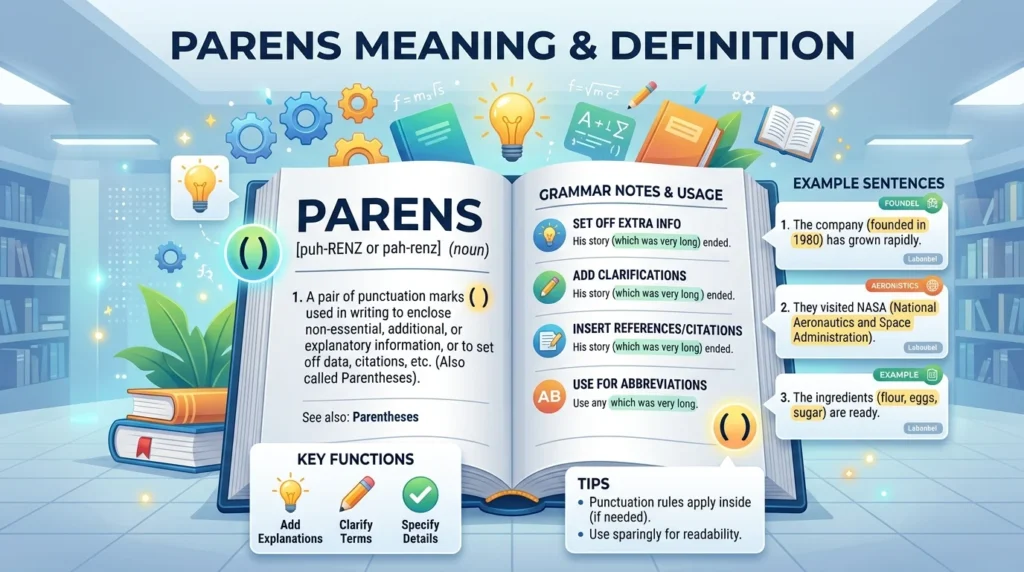
The term “parens” is an informal abbreviation of the word “parentheses.” Parentheses are the curved punctuation marks that appear as ( ) and are used to include additional information within a sentence. In everyday writing, grammar discussions, and editing communities, people often use the shorter word “parens” because it is quicker and more convenient to say or write.
In simple terms, parens refer to a pair of punctuation marks that surround extra details, explanations, examples, clarifications, or side notes that are related to a sentence but not essential to its main meaning. For example:
The meeting (which was originally scheduled for Monday) has been moved to Wednesday.
In this sentence, the information inside the parentheses provides extra context but is not required for the sentence to make sense. This is why parentheses are commonly used in books, blogs, academic writing, business documents, and online content.
Many users searching for parens meaning with examples are often surprised to learn that “parens” is not a separate grammar term. It is simply a shortened way of referring to parentheses.
Background
The history of parentheses goes back hundreds of years. The word “parenthesis” originates from Greek and refers to inserting additional words or thoughts into a sentence. Over time, writers and scholars adopted parentheses as a way to include supplementary information without interrupting the main flow of text.
As grammar evolved, editors and writers began using the shortened term “parens” in professional discussions. This abbreviation became particularly common among publishers, proofreaders, journalists, academics, and content creators. Today, the term appears frequently in style guides, writing forums, grammar resources, and editorial conversations.
Modern digital communication has also contributed to the popularity of the word. Since people often prefer shorter expressions when discussing grammar online, “parens” became a convenient alternative to repeatedly typing “parentheses.” Although informal, it is widely understood among writers and language professionals.
Usage in Different Contexts
The meaning and use of parens can vary slightly depending on the context. In general writing, parens are used to provide additional details without disrupting the main sentence. For example, authors may include explanations, dates, locations, or background information inside parentheses to improve clarity.
In academic writing, parens are frequently used for citations, references, abbreviations, and explanatory notes. Researchers often place publication years, source information, or brief clarifications inside parentheses. This helps maintain a professional structure while keeping the text readable.
In business communication, parens can clarify information such as deadlines, instructions, and specifications. In technical writing, they may contain measurements, formulas, abbreviations, or code-related notes. Even in casual online conversations, people use parens to add side comments, humor, or personal observations.
Because of their versatility, parens remain one of the most useful punctuation tools in English grammar and professional writing.
What Does Parens Mean in Writing?
When people ask what does parens mean in writing, they are usually referring to the use of parentheses to include extra information within a sentence. Writers use parens when they want to add details that enhance understanding without changing the primary message.
For example:
Sarah finally bought her dream car (a vintage convertible) after years of saving.
The phrase inside the parentheses gives readers additional information but does not affect the sentence’s core meaning. This ability to provide extra context is one of the main reasons parens are so valuable in writing.
Good writers use parens carefully because excessive use can make text appear cluttered or distracting. When used appropriately, they improve clarity and reader comprehension.
Parens Meaning in English Grammar
In English grammar, parens refer to parentheses that enclose parenthetical information. A parenthetical element is any word, phrase, clause, or sentence that adds supplementary information to the main statement.
Grammar experts consider parenthetical information nonessential because removing it does not change the sentence’s primary meaning. For example:
The new library (which opened last year) has become very popular.
Removing the parenthetical phrase still leaves a complete sentence:
The new library has become very popular.
This illustrates why parentheses are useful tools for organizing information while maintaining grammatical accuracy.
Why Are Parentheses Called Parens?
Many learners wonder why are parentheses called parens. The answer is simple: “parens” is merely a shortened nickname or abbreviation for “parentheses.”
Just as people shorten words like “application” to “app” or “photograph” to “photo,” grammar professionals often shorten “parentheses” to “parens.” The abbreviated form saves time during discussions about punctuation, editing, and writing.
Although “parens” is widely accepted in informal grammar conversations, most formal writing still uses the complete term “parentheses.”
See Also: 170+ Beer Puns That’ll Have You Saying Cheers
Difference Between Parens and Parentheses
One of the most common misconceptions involves the difference between parens and parentheses. In reality, there is no functional difference between them.
Parens = Informal abbreviation
Parentheses = Full grammatical term
Both words refer to the same punctuation marks ( ).
The difference exists only in terminology, not in meaning, grammar, or usage. Therefore, whenever someone uses the word “parens,” they are simply referring to parentheses in a shorter form.
How to Use Parens in a Sentence
Learning how to use parens in a sentence is important for clear communication. The most common uses include:
Adding explanations
Providing examples
Including dates
Clarifying abbreviations
Offering additional context
Examples:
The company launched its first product (a mobile application) in 2022.
Paris (the capital of France) attracts millions of tourists every year.
The event will begin at 9:00 AM (local time).
The key principle is that information inside the parentheses should support the sentence rather than replace essential information.
See Also: 111 Angel Number Meaning: Spiritual & Manifestation Guide
Parens Meaning With Examples
Examples are one of the easiest ways to understand parens meaning.
Example 1:
The concert (which sold out within hours) exceeded expectations.
Example 2:
The Amazon rainforest (located in South America) contains extraordinary biodiversity.
Example 3:
The software update (version 3.5) improves system performance.
Example 4:
John completed the project (despite several challenges) before the deadline.
Each example demonstrates how parentheses add useful details without disrupting sentence flow.
What Is the Purpose of Parens in Writing?
The primary purpose of parens in writing is to provide additional information while maintaining readability. Writers use them to:
Clarify ideas
Add context
Present examples
Include references
Explain abbreviations
Reduce sentence complexity
Without parentheses, writers would often need longer and more complicated sentence structures. Parens allow information to be included neatly and efficiently.
They also help readers distinguish between essential and supplementary information, improving overall comprehension.
Parens Abbreviation Meaning in Grammar
The parens abbreviation meaning in grammar is straightforward. It is simply an informal shortened version of the word parentheses.
Grammar professionals, editors, proofreaders, and writers commonly use this abbreviation during discussions about punctuation and sentence structure. Although informal, it is widely recognized and understood within writing communities.
You may see the term used in editing notes, grammar forums, educational resources, and style guide discussions.
When Should You Use Parens in Academic Writing?
Academic writing often requires precision, clarity, and proper citation practices. Parens are particularly useful when:
Including source citations
Providing publication years
Defining abbreviations
Adding brief explanations
Presenting statistical information
For example:
Recent research supports this conclusion (Smith, 2024).
Artificial Intelligence (AI) continues to transform multiple industries.
However, academic writers should avoid excessive parenthetical information because too many parentheses can distract readers and weaken readability.
Parens vs Brackets Meaning and Usage
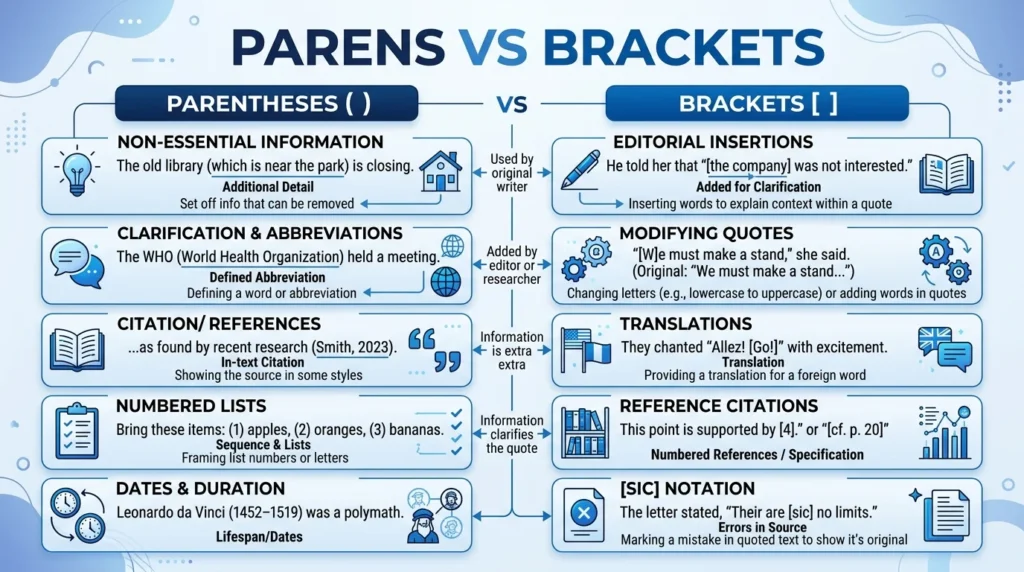
Many people confuse parens and brackets because both are punctuation marks that contain information.
Parentheses: ( )
Brackets: [ ]
Parentheses typically add supplementary information provided by the original writer.
Example:
The report (published last year) received positive reviews.
Brackets are usually used to insert editorial comments, clarifications, or modifications within quoted material.
Example:
“The company achieved [record-breaking] growth during the quarter.”
Understanding the distinction helps writers use punctuation more accurately and professionally.
Common Mistakes People Make When Using Parens
One common mistake is placing essential information inside parentheses. If readers need the information to understand the sentence, it should not be enclosed in parens.
Another mistake is overusing parentheses throughout a document. Too many parenthetical remarks can interrupt reading flow and reduce clarity.
Writers also frequently confuse parentheses with brackets or place punctuation incorrectly around them. Learning proper punctuation rules ensures cleaner and more professional writing.
SEO Summary
Parens meaning refers to the abbreviated form of parentheses, the punctuation marks used to include additional information in a sentence. Understanding parens meaning in English grammar, how to use parens in a sentence, parens meaning with examples, parens abbreviation meaning in grammar, and parens vs brackets meaning and usage can significantly improve writing clarity and professionalism. Whether used in academic papers, business communication, online content, or everyday writing, parens remain an essential part of effective English grammar.
Frequently Asked Questions
What does parens mean?
Parens is a shortened form of the word parentheses, which are the punctuation marks ( ) used to include additional information in a sentence.
Is parens a real word?
Yes. Parens is an accepted informal abbreviation commonly used by writers, editors, and grammar professionals.
What is the difference between BBL Meaning: Slang, TikTok & Surgery Explainedparens and parentheses?
There is no difference in meaning. Parens is simply the abbreviated version of parentheses.
How do you use parens correctly?
Use parens to add nonessential information, explanations, examples, or clarifications without interrupting the main sentence.
Are parens and brackets the same?
No. Parentheses use curved marks ( ) while brackets use square marks [ ]. They serve different grammatical purposes.
Why do writers use parens?
Writers use parens to provide extra information, context, examples, references, or explanations while keeping sentences easy to read.
Can parens be used in formal writing?
Yes. Parentheses are commonly used in academic, business, legal, and professional writing when applied correctly.
What is a parenthetical expression?
A parenthetical expression is additional information placed inside parentheses that supplements the main sentence.
When should parentheses be avoided?
Avoid parentheses when the enclosed information is essential to understanding the sentence or when excessive use harms readability.
Where can I learn more meanings and word definitions?
If you enjoy learning about word meanings, grammar terms, language concepts, and detailed explanations, visit Punz Trend, where you can explore a wide range of easy-to-understand meaning guides and educational content.
Conclusion
In conclusion, understanding parens meaning helps improve grammar, punctuation, and overall writing clarity. Whether used in academic, professional, or everyday writing, parens (parentheses) provide extra context without disrupting the main message. By learning how to use parens correctly, recognizing the difference between parens and brackets, and following proper grammar rules, you can make your writing more effective and reader-friendly. For more language guides, meanings, and grammar explanations, explore Punz Trend.