
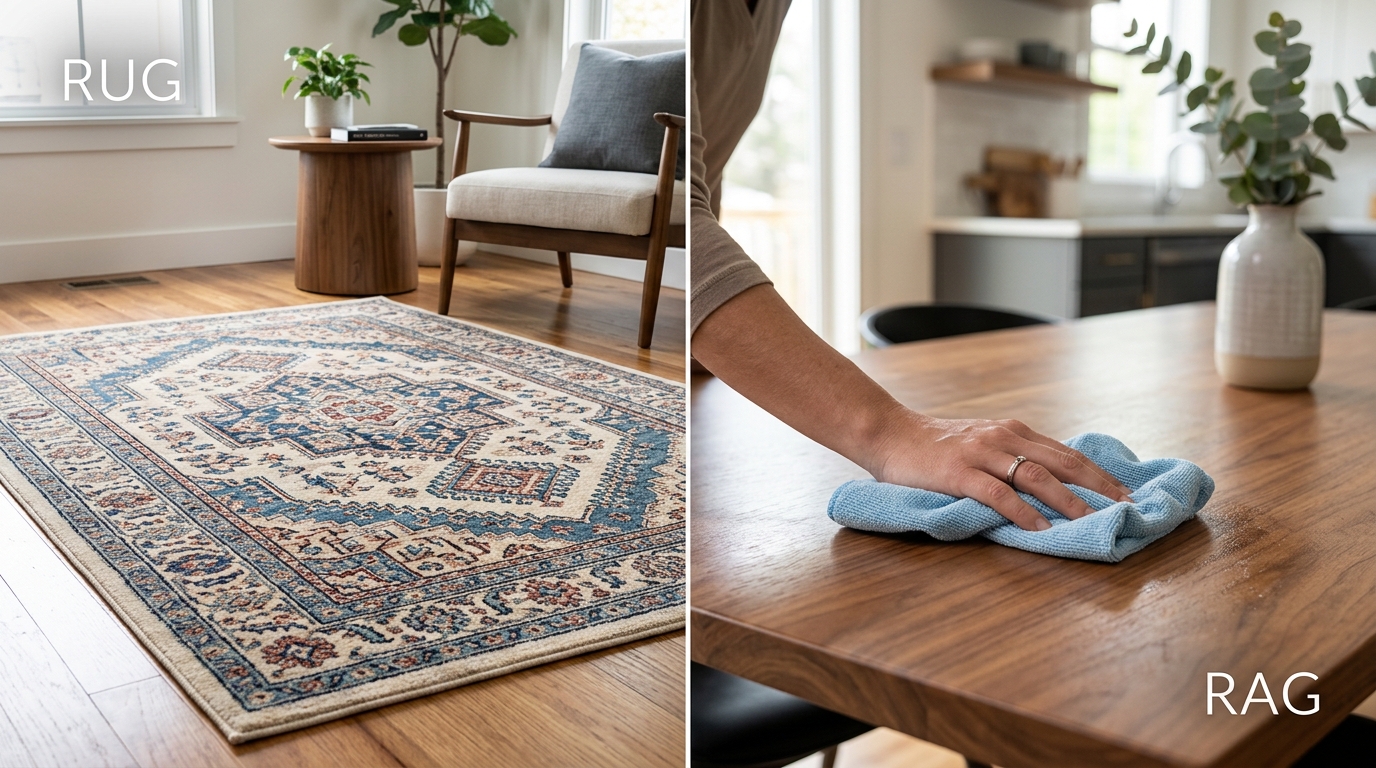
Rug vs Rag: Meaning, Difference, and Examples
If you are confused about rug vs rag, the good news is that the basic difference is simple: a rug is usually something that covers part of a floor, while a rag is usually a piece of cloth used for cleaning, wiping, polishing, or other practical work. The words look almost identical, but changing one vowel changes the meaning completely.
The confusion becomes more interesting because neither word is limited to its most common meaning. Rug can have additional meanings in British English and informal speech, while rag can refer to clothing, newspapers, teasing, practical jokes, and more. Understanding the main meanings first makes those extra uses much easier to recognize.
Quick Answer
Rug and rag are different words with different meanings. A rug is normally a floor covering, often used for decoration, comfort, warmth, or protection. A rag is generally a piece of old, worn, or waste cloth used for cleaning or other practical purposes. Remember it this way: a rug goes on the floor; a rag helps clean things.
What Is the Difference Between Rug and Rag?
The main difference between rug and rag is their usual function. A rug is an object intended to cover part of a floor. It may be decorative, practical, expensive, handmade, plain, thick, thin, modern, or traditional. A rug can make a room more comfortable, protect a floor, reduce noise, or simply improve the appearance of a space. Standard dictionary definitions describe a rug primarily as a floor covering made from thick or heavy material.
A rag, by contrast, is normally a piece of cloth that is old, worn, unwanted, or being used for a practical task. You might use a rag to wipe a kitchen counter, clean a window, remove oil from your hands, polish an object, or deal with a spill. The word does not require the cloth to be literally torn or filthy every time; its meaning depends on the way the piece of cloth is regarded or used.
So, if you are describing something that belongs on a floor as a covering, rug is normally the right word. If you are describing a piece of cloth used to wipe or clean something, rag is normally the right word.
| Word | Main meaning | Typical purpose | Example |
|---|---|---|---|
| Rug | A floor covering | Decoration, comfort, warmth, protection | The rug looks beautiful. |
| Rag | A piece of old or waste cloth | Cleaning, wiping, polishing | Use a rag to clean the table. |
This is primarily a vocabulary distinction, not a grammar rule. Both words are grammatically correct English nouns. The problem occurs when the wrong word is chosen for the intended meaning.
Why Does the Rug vs Rag Difference Matter?
Choosing rug instead of rag, or rag instead of rug, can change what the reader imagines. This matters because correct English is not only about building grammatical sentences. It is also about choosing words that communicate the intended meaning clearly.
Consider this sentence:
Please use a rug to wipe the counter.
The sentence is grammatically formed, but if you mean a small piece of cleaning cloth, rug is the wrong vocabulary choice. A reader will normally understand rug as a floor covering, so the instruction may sound strange.
Now consider:
We bought a beautiful rag for the living room.
Again, the sentence is grammatically possible, but the intended meaning is probably wrong. If you mean a decorative floor covering, rug is the natural choice.
This distinction is especially important in practical communication. Imagine writing a shopping list, giving cleaning instructions, describing furniture, completing an English assignment, or sending a workplace message. A spelling checker may not identify the problem because rug and rag are both correctly spelled English words. The software can see a valid word, but it cannot always know which meaning you intended.
That is why context is more useful than simply memorizing spelling.
The difference also matters for English learners because the words contain the same beginning and ending sounds. Their middle vowel is different: rug is /rʌɡ/, while rag is /ræɡ/.
A useful mental picture is:
- Rug → room → floor
- Rag → wipe → clean
If you can connect the word to its function, you are much less likely to confuse them.
The Core Rule
RUG = a floor covering.
RAG = a piece of cloth, especially one used for cleaning or practical work.
This simple rule handles the majority of everyday situations.
Use rug when the object is functioning as a floor covering:
- living-room rug
- bedroom rug
- area rug
- wool rug
- Persian rug
- bathroom rug
- prayer rug
Use rag when the object is a piece of cloth being used for wiping, cleaning, polishing, or similar work:
- cleaning rag
- old rag
- cotton rag
- polishing rag
- shop rag
- rag for wiping spills
There is one important phrase that may initially seem confusing: rag rug.
A rag rug is a real type of rug made from rags or strips of fabric. The word rag describes the material used to make it, while rug identifies the finished object. Dictionaries define rag rug as a rug made from pieces or strips of cloth that are woven, stitched, sewn, braided, or otherwise worked into a floor covering.
So the phrase does not contradict the basic rule.
Rag = the material.
Rug = the finished floor covering.
That distinction is a useful example of why meaning depends on the role a word plays in a phrase.
How to Use Rug and Rag Correctly
Use “rug” for a floor covering
Use rug when you are talking about a covering placed on a floor.
Examples include:
- We bought a new rug for the bedroom.
- The dog is sleeping on the rug.
- Please move the rug away from the door.
- The rug makes the room feel warmer.
- She vacuumed the rug before the guests arrived.
A rug does not have to be expensive or decorative. The defining idea is its role as a floor covering. A simple mat or handmade floor covering can still be described as a rug depending on its type and context.
Also Read: 280+ Taco Puns: Funny, Cheesy & Spicy One-Liners
Use “rag” for a piece of cloth used practically
Use rag when you mean a piece of cloth used for wiping, cleaning, polishing, or similar practical purposes.
Examples include:
- Grab a rag and wipe the spill.
- He cleaned the tools with an old rag.
- Keep a few rags in the garage.
- She used a soft rag to polish the table.
- The mechanic wiped his hands with a rag.
A rag is often made from old clothing, towels, or other fabric, but being old is not the only possible characteristic. The word can emphasize the cloth’s low-value, worn, scrap-like, or practical nature.
Do not treat “cloth” and “rag” as exact synonyms
Cloth is a broader and more neutral word.
For example:
Use a soft cloth to clean the camera lens.
This does not necessarily mean the cloth is old or disposable.
Compare:
Use a rag to clean the garage floor.
The word rag suggests a practical cleaning item rather than a carefully selected piece of fabric.
This distinction is especially useful when describing delicate objects. A cleaning cloth may sound more appropriate than rag when the material needs to be soft, clean, or specifically designed for the task.
Correct Examples of Rug and Rag
Here are original examples showing how the two words work in different settings.
- Conversation: “Did you move the rug from the hallway?”
- Home: “The new rug makes the living room look brighter.”
- Cleaning: “Could you hand me a rag for this spill?”
- Workplace: “Please keep a clean rag near the equipment.”
- Email: “The rug in Conference Room B needs to be cleaned.”
- School: “The artist placed a patterned rug in the center of the room.”
- Academic writing: “The study describes how textile scraps were reused to make rag rugs.”
- Social media: “Finally found the perfect rug for my reading corner!”
- Workshop: “Use a dry rag to remove the excess oil.”
- Shopping: “I’m looking for a washable rug for the bedroom.”
Notice that the grammatical structure can be almost identical:
She cleaned the rug.
She cleaned the rag.
Both sentences are grammatically correct. The nouns simply refer to different objects. In the first sentence, the likely meaning is that she cleaned a floor covering. In the second, the likely meaning is that she cleaned the cloth itself.
Incorrect vs. Correct: Rug and Rag
| ❌ Incorrect | ✅ Correct | Why |
|---|---|---|
| Use a rug to wipe the kitchen counter. | Use a rag to wipe the kitchen counter. | A piece of cleaning cloth is normally a rag. |
| We bought a beautiful rag for the living room floor. | We bought a beautiful rug for the living room floor. | A floor covering is normally a rug. |
| The mechanic cleaned the engine with a rug. | The mechanic cleaned the engine with a rag. | The context calls for a practical cleaning cloth. |
| Please put the rag beside the sofa as decoration. | Please put the rug beside the sofa as decoration. | A decorative floor covering is a rug. |
| I vacuumed the rag this morning. | I vacuumed the rug this morning. | Vacuuming commonly applies to a floor covering. |
| She used the rug to polish the silver. | She used the rag to polish the silver. | Polishing normally requires a cloth. |
| The new rag covers most of the bedroom floor. | The new rug covers most of the bedroom floor. | The object functioning as a floor covering is a rug. |
| Keep the rug in the cleaning bucket. | Keep the rag in the cleaning bucket. | A cleaning cloth belongs with cleaning supplies. |
| He wiped the window with a rug. | He wiped the window with a rag. | The intended object is a wiping cloth. |
| The designer chose a colorful rag for the floor. | The designer chose a colorful rug for the floor. | A chosen floor-covering design is a rug. |
The important point is that the “incorrect” sentences are not necessarily grammatically ungrammatical. Some are perfectly grammatical sentences that use the wrong word for the intended situation. That is a vocabulary and meaning problem.
Why Do People Confuse Rug and Rag?
Similar spelling
The words differ by only one vowel:
rug
rag
When people type quickly, especially on a phone, changing one vowel is an easy mistake.
Similar sound structure
Both words begin with /r/ and end with /g/. The important contrast is the vowel in the middle.
- rug → /rʌɡ/
- rag → /ræɡ/
Merriam-Webster gives these pronunciations as /ˈrəg/ and /ˈrag/, respectively.
Overgeneralization
A learner may notice that both objects can be made from fabric and conclude that the words are interchangeable. They are not.
English often has several words for materials that differ according to purpose. Cloth, fabric, rag, towel, blanket, carpet, and rug can overlap in material but not in normal meaning.
Autocomplete and spellcheck
Spellcheck usually focuses on whether a word exists and is spelled correctly. It may not understand that you meant rag instead of rug.
For example:
Please bring a rug so we can clean the windows.
There is nothing obviously wrong with the spelling. The problem is semantic: the word does not fit the intended task.
Translation interference
Learners may also translate directly from another language. A single word in one language may cover several English meanings, or a familiar word may be associated with the wrong household object.
The safest solution is to learn English words with context, not as isolated
ALSO READ:285+ Bad Puns: Hilariously Terrible One Liners
Rug vs Rag Pronunciation
Pronunciation is one of the most useful ways to keep these words separate.
Rug is pronounced /rʌɡ/. Its vowel is the same general vowel sound heard in words such as cup, luck, and sun.
Rag is pronounced /ræɡ/. Its vowel is the same general sound heard in words such as cat, map, and bag.
Try these pairs:
- rug — rag
- bug — bag
- mug — mag
- cup — cap
You do not need to exaggerate the sounds. Focus on the middle vowel.
A simple pronunciation memory aid is:
Rug rhymes with bug.
Rag rhymes with bag.
285+ Bad Puns: Hilariously Terrible One Liners
Rug vs Rag in Real English
Grammatically correct and natural
The rug is under the coffee table.
This is both grammatically correct and completely natural because rug normally refers to a floor covering.
I need a rag to wipe the counter.
This is also grammatically correct and natural because rag commonly refers to a cleaning cloth.
Grammatically possible but unusual
The rag is under the coffee table.
There is nothing grammatically wrong with this sentence. A rag could physically be under a table. However, without additional context, the sentence may make the reader wonder why a cleaning cloth is there.
The rug is beside the sink.
This is also grammatically correct. It could be perfectly natural if you are talking about a small floor rug beside the sink. It would be unusual only if the context suggests that you mean something used for wiping the sink.
Natural everyday English depends on meaning
The key lesson is that grammar alone cannot determine the correct word.
English speakers choose words according to meaning, context, purpose, and convention. A sentence can have perfect grammar while still using a noun that does not express the intended idea.
For learners, this is an important distinction: do not ask only, “Is this sentence grammatically correct?” Also ask, “Does this word describe the thing I actually mean?”
That question solves most rug-versus-rag mistakes.
Common Mistakes Checklist
- Mistake: Using rug for a cleaning cloth.
If you hold it in your hand to wipe something, rag is often the intended word. - Mistake: Using rag for a floor covering.
If it is placed on the floor as a covering, rug is normally correct. - Mistake: Assuming every piece of cloth is a rag.
Cloth is a broader, more neutral term. - Mistake: Thinking a dirty rug becomes a rag.
A rug remains a rug if it is still being used as a floor covering. - Mistake: Thinking every rag must be torn.
A rag can be worn, waste, or simply a piece of cloth used for practical work. - Mistake: Trusting spellcheck completely.
Both rug and rag are correctly spelled words, so software may not catch a meaning error. - Mistake: Ignoring pronunciation.
The middle vowel is different, so practicing /ʌ/ and /æ/ can help. - Mistake: Forgetting “rag rug.”
In this phrase, rag describes the material and rug describes the finished floor covering.
American vs. British English
There is no major AmE/BrE difference in the core distinction between these words. In both varieties, a rug commonly refers to a floor covering, while rag can refer to a piece of cloth or clothing material.
There are, however, additional regional meanings.
In British English, rug can also refer to a blanket or warm covering, especially a cover used for a person or animal. Merriam-Webster also records a British sense of rug meaning a blanket for an animal.
British English also has an additional rag meaning involving practical jokes or boisterous fun. Merriam-Webster labels this sense chiefly British.
These meanings do not change the main rule learners need for everyday vocabulary:
Rug = floor covering.
Rag = cloth used or regarded as a scrap, especially for practical work.
When writing for an international audience, the floor-covering and cleaning-cloth meanings are the safest meanings to focus on unless the context clearly signals a regional or figurative use.
Formal vs. Informal Usage
Both rug and rag are normal vocabulary words and can be used in formal writing when their literal meanings are appropriate.
For example:
The researchers examined traditional methods of producing rag rugs from recycled textiles.
This is suitable for academic or formal writing because the terminology is precise.
Similarly:
The office rug should be replaced because it has become damaged.
This is neutral and professional.
The word rag becomes more informal or context-dependent when it is used in other meanings. For example, rag can refer informally to a newspaper regarded negatively, and the verb to rag can mean to tease, scold, or criticize.
Therefore, in formal writing, do not assume that every meaning of rag has the same register.
The literal noun meanings are straightforward. The figurative or slang-related meanings require attention to audience and context.
Rug vs Rag Comparison Table
| Feature | Rug | Rag |
|---|---|---|
| Main meaning | Floor covering | Piece of cloth or fabric scrap |
| Typical purpose | Comfort, decoration, floor protection | Cleaning, wiping, polishing, practical work |
| Typical location | Floor | Kitchen, garage, workshop, cleaning area |
| Typical action | Walk on, vacuum, move, place | Wipe, clean, polish, scrub |
| Material | Wool, cotton, synthetic fibers, animal skin, other materials | Old, worn, leftover, or waste fabric |
| Condition | Can be new, old, clean, or worn | Often worn, old, unwanted, or practical |
| Part of speech | Noun | Noun; also has verb and other noun senses |
| Pronunciation | /rʌɡ/ | /ræɡ/ |
| Common phrase | area rug | cleaning rag |
| Special phrase | rag rug | rag rug describes a rug made from cloth pieces |
The table shows why these words should not normally replace each other. Their meanings are connected to different objects and functions.
Real-Life Situations
Interview
Interviewer: “What experience do you have with facility maintenance?”
Candidate: “I helped clean the floors, wash windows, and maintain the rugs.”
Here, rugs refers to floor coverings.
Workplace meeting
“We should replace the rug near the reception desk because it is worn.”
The word rug identifies the floor covering.
Cleaning instruction
“Use a clean rag to remove the remaining paint.”
The word rag identifies the cloth used for cleaning.
“Could you please arrange for the hallway rug to be cleaned before Friday?”
This is clear and professional.
Text message
“Can you grab a rag? I spilled coffee.”
The informal message uses rag naturally because the object is needed for wiping the spill.
School assignment
“The traditional rag rug was made from pieces of reused fabric.”
Here, rag rug is correct because the phrase describes a floor covering made from cloth pieces.
A Simple Way to Remember Rug vs Rag
Use this mental picture:
RUG → ROOM → FLOOR
RAG → REMOVE DIRT
Imagine walking into a room and seeing a patterned rug beneath your feet.
Then imagine holding a rag while cleaning a dirty table.
The two pictures are completely different, which makes the vocabulary easier to remember.
Another useful test is to ask:
“Is this object mainly being used as a floor covering?”
- Yes → rug
- No, it is a piece of cloth used for wiping or practical work → rag
This is better than memorizing the letters alone because it makes you think about meaning.
See Also: What Does WYF Mean in Text? Meaning, Examples & Replies
Is “Rag Rug” Correct?
Yes. Rag rug is a standard English expression.
At first, it may seem contradictory because rag usually means a piece of cloth, while rug means a floor covering. But the two words are performing different jobs in the compound noun.
In rag rug, rag describes the material from which the rug is made. Rug identifies the finished object.
For example:
We bought a handmade rag rug for the hallway.
The item is a rug, and its material or construction involves rags or fabric strips.
Dictionaries define rag rug as a rug made from pieces or strips of cloth, commonly woven, stitched, sewn, or otherwise assembled.
So remember:
A rag can be material used to make a rug.
That is why rag rug is perfectly correct.
Other Meanings of “Rug” and “Rag”
The basic household meanings are the ones most learners need, but both words have additional meanings.
Rug can be used informally to mean a wig or toupee. It also appears in expressions such as pull the rug from under someone, meaning to suddenly remove support or security.
Rag has several additional senses. It can refer to worn clothing, a newspaper considered low-quality or contemptible, or a piece or fragment of material. As a verb, to rag can mean to tease, criticize, scold, or torment. There are also British uses connected with practical jokes and a musical meaning related to ragtime.
These meanings are important when reading English because you may encounter rug or rag in a sentence where the literal household meaning does not make sense.
However, do not let these extra meanings make the basic distinction seem complicated. For ordinary household vocabulary, the rule remains simple: rug for a floor covering; rag for a piece of cloth used or regarded as a scrap or practical cleaning material.
Quick Practice Quiz
Choose rug or rag in each sentence.
- Please use a ___ to wipe the spilled juice.
- The blue ___ looks perfect in the bedroom.
- He keeps several old ___ in the garage.
- We vacuumed the living-room ___.
- The mechanic wiped his hands with a ___.
- They bought a handmade ___ for the hallway.
- Use a clean ___ to remove the grease.
- The cat is sleeping on the ___.
Answers
- rag — It is used for wiping.
- rug — It is a floor covering.
- rags — These are pieces of cloth used for practical work.
- rug — A rug is vacuumed as a floor covering.
- rag — It is used to wipe the hands.
- rug — The object is placed on the floor.
- rag — The cloth is being used for cleaning.
- rug — The cat is lying on a floor covering.
FAQ
Is a rug the same as a rag?
No. A rug is normally a floor covering, while a rag is generally a piece of cloth used or regarded as a scrap, often for cleaning or practical work.
Which is correct: “cleaning rug” or “cleaning rag”?
If you mean a piece of cloth used to wipe or clean something, cleaning rag is normally the appropriate expression. If you mean a floor covering that needs cleaning, you would normally say clean the rug.
Can a rug be old?
Yes. A rug does not have to be new or attractive to be called a rug. If it continues to function as a floor covering, it can still be a rug.
Does a rag have to be dirty?
No. A rag is often used for dirty work, but it does not have to be visibly dirty. The word can describe a piece of worn, waste, or practical cloth.
Can a rag become a rug?
A piece of rag material can be used to make a rag rug. The finished object is a rug because it functions as a floor covering.
How do you pronounce rug?
Rug is pronounced /rʌɡ/. The vowel is similar to the sound in cup, luck, and sun.
How do you pronounce rag?
Rag is pronounced /ræɡ/. Its vowel is similar to the sound in cat, map, and bag.
Is “rug” a British English word?
Yes. Rug is used in both American and British English for a floor covering. British English also has additional senses in which rug can refer to a blanket or warm covering.
Does “rag” have other meanings?
Yes. Besides the cloth meaning, rag can refer to worn clothing, a newspaper in certain informal contexts, and, as a verb, teasing or criticizing someone. Some additional senses are specifically or chiefly British.
What is a rag rug?
A rag rug is a rug made from rags or strips and pieces of fabric. The word rag describes the material, while rug identifies the finished floor covering.
Is “rug” a synonym for carpet?
Not exactly. A rug is generally a floor covering that covers only part of a floor, while carpet can refer to a floor covering that covers a larger area or an entire floor. The exact distinction can depend on context and regional usage.
What is the easiest way to remember rug and rag?
Think “rug = room/floor” and “rag = remove dirt.” If you walk on it, rug is probably the word you need. If you hold it to wipe something, rag is probably the word you need.
Quick Summary
Rug vs rag is mainly a difference in meaning, not grammar. A rug is normally a floor covering used for comfort, decoration, warmth, or protection, while a rag is generally a piece of cloth used or regarded as a scrap, especially for cleaning or practical work. Their pronunciations also differ: rug is /rʌɡ/, while rag is /ræɡ/. Both words are standard English, and neither is a misspelling of the other. Remember rug = floor and rag = cleaning cloth. Also remember the valid phrase rag rug, where rag describes the material and rug identifies the finished floor covering
1. Hero Image Prompt
Create a professional, modern educational hero image for an English vocabulary article titled “Rug vs Rag”. Use a clean split-screen composition. On the left, show a beautiful patterned floor rug placed naturally in a stylish living room, with a subtle label “RUG”. On the right, show a soft cleaning rag being used to wipe a wooden table, with a subtle label “RAG”. Make the visual difference immediately obvious: rug = floor covering, rag = cleaning cloth. Bright natural lighting, realistic photography style, clean home environment, premium editorial look, balanced composition, minimal background clutter, highly detailed fabric textures, professional educational website aesthetic. Leave some clean negative space around the center for the article title. 16:9 landscape, no watermark, no unnecessary text.
2. Comparison Graphic Prompt
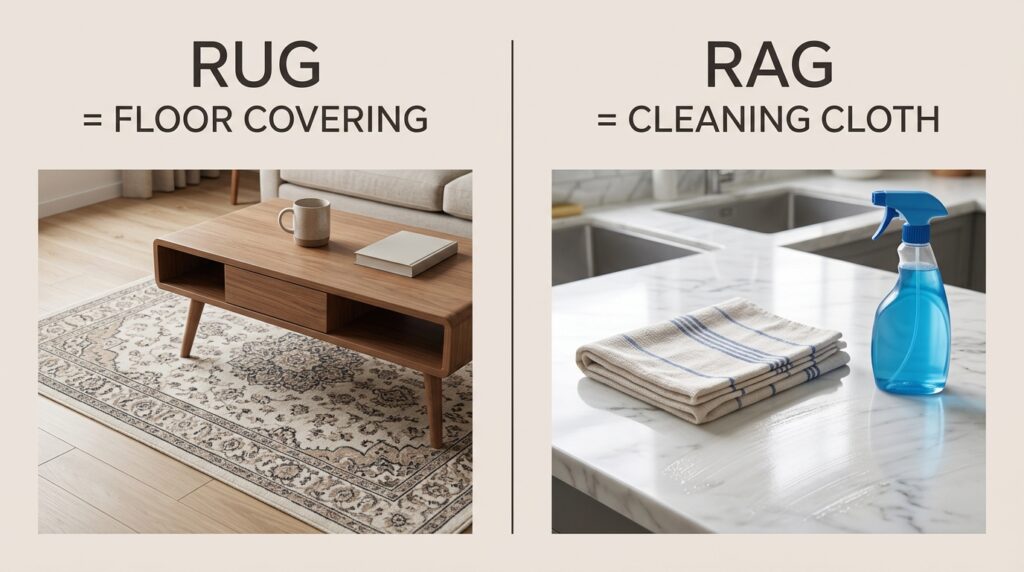
Create a clean educational comparison graphic explaining “Rug vs Rag”. Divide the image into two clearly separated sections. Left side: a decorative floor rug under a coffee table, visually representing RUG = FLOOR COVERING. Right side: a folded cotton cleaning rag beside a spray bottle and a freshly wiped countertop, visually representing RAG = CLEANING CLOTH. Use simple visual storytelling, modern editorial infographic style, soft neutral background, realistic but polished objects, strong visual hierarchy, minimal design, easy for English learners to understand instantly. 16:9 landscape, high resolution, no watermark, no excessive text..